
Unlock the Editor’s Digest for free
Roula Khalaf, Editor of the FT, selects her favourite stories in this weekly newsletter.
Home used to be an abstract concept for the architect and designer India Mahdavi. Born in Iran, she experienced a nomadic childhood, growing up in academic centres — Cambridge in Massachusetts; Heidelberg in Germany and the south of France — in the wake of her Iranian father, who was an economist and political scientist. Eventually, the now-63-year-old settled down in Paris, had her son Miles, and created a small village of creative studios and gallery spaces on Rue las Cases in the 7th arrondissement. But she still rents in the city and continues to travel. She has spent much of her time in Tehran visiting her parents and in Egypt where, for years, she has collaborated with a relation of hers, the environmentalist and businessman Mounir Neamatalla, at his hospitality outpost in Siwa. “I feel at home everywhere and nowhere at the same time,” she says.
 Cap Martin dining chairs and Diagonal dining table, both by India Mahdavi Editions, in the dining room of Mahdavi’s home in Arles. On the table are vases by Mahdavi for H&M Home and an India Mahdavi Editions ashtray. In the corner sits a lacquered chair by Kazuhide Takahama. The artwork on the ceiling is by Mathias Augustyniak and was executed by Atelier Boris Deltchev © Mark Anthony Fox
Since 2008, Mahdavi has been working in Arles in the south of France, where she has collaborated with the Swiss art patron and philanthropist Maja Hoffmann on projects related to Luma — the four-year-old museum campus with a glittering steel tower designed by Frank Gehry at its centre, which has transported the city into a dynamic cultural destination. In 2009, Mahdavi designed Villa Des Alyscamps, a private retreat used by Hoffmann’s inner circle of curators dubbed the “core group”. She also conceived the interiors at the whimsical boutique hotel Le Cloître, a few minutes’ walk from Arles’s Roman amphitheatre, and more recently she completed a cluster of artist residency spaces nearby.
 Formica cabinets and a vintage table in her kitchen, with Afro chairs and Babel Tower drawers by India Mahdavi Editions and a clock by Gaetano Pesce © Mark Anthony Fox
 India Mahdavi at the foot of the path leading to the pool © Mark Anthony Fox
 The four-poster rattan bed in Mahdavi’s master bedroom, which sits on a rug from an Italian vintage design gallery © Mark Anthony Fox
When Mahdavi mentioned to Hoffmann that she was thinking of buying a house in the area, her friend, a longtime Arles native, knew of just the right place: a two-storey property surrounded by a walled garden that had once belonged to the city notary. “It was a sleeping beauty,” Mahdavi recalls, standing in the garden of the house she first saw in 2019. “It had been empty for at least three years and had a sadness to it, but I knew I could bring it back to life.”
Mahdavi’s design superpower has always been her unorthodox and effusive use of colour. Her bubblegum-pink tufted banquettes at London’s Sketch restaurant were, when it opened in 2014, largely attributed to sparking the “millennial pink” trend, and the designer is also behind the interiors of some of the world’s most memorable hotels and residences, including the guest rooms at Rome’s 16th-century Villa Medici. Indeed, it was following a stay at the Condesa DF hotel in Mexico City, another hospitality project instilled with colour by Mahdavi, that Hoffmann decided to seek her out as a collaborator.
 The terrace looking on to the pool, with its dining table by Mahdavi and Maximilien Pellet, Afro dining chairs and Cap Martin rattan armchairs by India Mahdavi Editions, side table by Mahdavi for Monoprix and vase (on table) by Mahdavi for H&M Home © Mark Anthony Fox
 Artwork by Mathias Augustyniak on the dining room ceiling, with Criss Cross cabinets by India Mahdavi Editions, a vase by Eduardo Sarabia (on cabinets) and Papyrus floor lamp by Nucci Valsecchi © Mark Anthony Fox
 The bathroom, with All Seeing Bra & Briefs rugs by PAM for CC-Tapis, ceiling light by Pierre-Marie, bathtub by Mahdavi for Bisazza and rattan vanity and mirror by Mahdavi © Mark Anthony Fox
The original interiors of Mahdavi’s Arles house were not to her taste — “they were bourgeois with a maid’s quarters and lots of chintzy wallpaper”, she says — but she thought it important to keep as much of the decor as she could. “It’s about redefining the identity of the house without destroying it,” she says of her design approach. She focuses on restoring what can be saved — materials, surfaces and objects — out of respect for what came before her: “I want to add a chapter to a larger story rather than tear out all the pages.” Mahdavi spent the first summer in the house adding nothing to it, apart from a few pieces of furniture, which gave her time to understand the property: what she could keep, how she could use the rooms, and the movement of the sun through the space.

As she planned to spend as much time as possible in the garden, despite the clouds of mosquitoes that descend at dusk in Arles during the summer (the nearby Camargue is full of rice fields), her first intervention was to create a screened terrace extending out from the living room. Upstairs, the master bedroom has relocated to a room with a terrace offering views of the garden. “I am always on a quest for light,” says Mahdavi, who views it as a more vital working material than furniture. “I’m often trying to recreate that moment of beauty when the sun moves through the trees and there is a bit of a breeze creating dancing shadows.” To Mahdavi, light helps spark an emotion or feeling about a space.
 Looking from the entrance hall into the living room. On the left stands a floor lamp by Thomas Takada © Mark Anthony Fox
 The front door is glazed with blown glass from Saint-Just Glassworks © Mark Anthony Fox
 A guest bedroom with a vintage ceiling lamp by Seguso, Henri bench and cashmere blanket by India Mahdavi Editions, and rug by Renata Bonfanti © Mark Anthony Fox
Likewise colour is used as a decorative tool as well as to invoke an atmospheric mood. This comes into play the moment one enters Mahdavi’s home: light filters through a window of pink stained glass in the front door, flooding the hallway with a rose-hued luminescence. The sense of playfulness is palpable: guests are greeted by a birdcage on a tall pedestal filled with coloured blocks, which is highlighted by bright yellow wallpaper in a graphic pattern and accented by a 5ft-tall mirror in the shape of a peacock. “Playing with colour is extremely important,” says Mahdavi of her “intuitive” choices. “It’s not that there is one great colour,” she says. “It’s about the strength of a vibration created when one is next to another.”

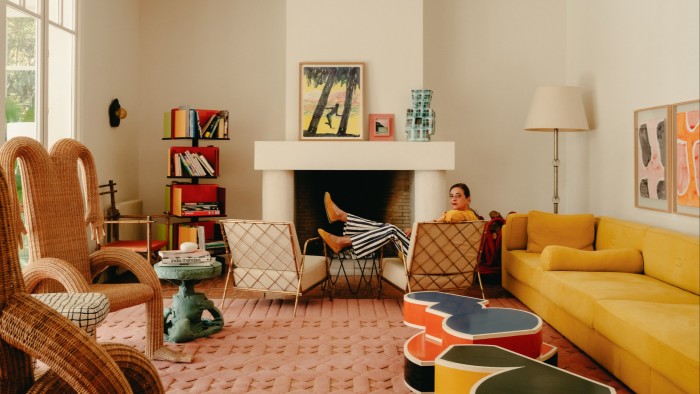
To the left of the entrance is a long living room. The arms of the two anthropomorphic wicker Nalgona chairs by designer Chris Wolston appear to wave people inside. Along one wall is an almost 20ft-long yellow upholstered sofa and daybed that Mahdavi designed as a place both to nap and where friends can congregate. She has flipped two sculptures painted in primary colours by the late French multidisciplinary artist Guy de Rougemont on their sides to create coffee tables. Above the fireplace hangs a saturated watercolour of a figure frolicking between trees by the Cuban artist Armando Mariño. “Part of what formed my design concept for this house were the different notions of family,” she says. “This was built as a family house, and it’s a place where I welcome my own family. But I also have friends I consider family and I’ve decorated it with artists and designers that I know, admire and want to support.”
 The library with Ruza chairs by Polina Miliou, a vintage coffee table by Gianfranco Frattini, a bamboo bench found at a Paris flea market, India Mahdavi Editions Oedipe sofa and cushion, artwork (on right) by Peyman Safizadeh and a rug by Mahdavi for H&M Home © Mark Anthony Fox
 Custom trompe l’oeil wallpapers in a bathroom, with a Trèfle mirror and Acapulco basket by India Mahdavi Editions, and Glow-Ball sconces by Flos © Mark Anthony Fox
 Mahdavi by the pool, with a pair of pomegranates from the garden © Mark Anthony Fox
Upstairs, on the first floor, the library and TV room exude cosiness: the walls and shelves are painted bright red; two papier-mâché throne-like chairs in the same colour by the Greek designer Polina Miliou are contrasted with a purple couch. Mahdavi’s bedroom is also vibrant. She sleeps in a lacquered violet four-poster rattan bed in a space anchored by a monumental rug she picked up years ago at a vintage design gallery in Italy.
The remaining three bedrooms (one belonging to her son and the other two for guests) on the top floor are relatively minimalistic and serene — not everyone can dream in a colour. But the bathroom walls are decorated with graphic, almost surrealist-style wallpaper that was designed by Mahdavi in a pattern inspired by one of the original wallpapers in the house.
 The entrance hall, with Oiseaux Malins 5 sculpture by Franck Scurti and Pavone mirrored coat rack by Sirio Alessandri © Mark Anthony Fox
Mahdavi takes me into her kitchen — a vibrant space filled with multicoloured Formica cabinets. But there is always an unexpected counterpoint in Mahdavi’s designs. She points to an uneven line that zigzags across the floor. “That’s where there was a wall that I ended up taking down. I decided to keep the scar,” she says.
Recommended

We head out to Mahdavi’s beloved garden, the lush landscaping a nod to her many trips to Iran. Tall cypress trees line a long narrow path from the street to the house, pistachio and pomegranate trees shade the pool, and hyacinth vines (which are native to Persia and symbolise rebirth) grow over a pergola in front of the pool house. It’s a dreamlike oasis that feels like it has no time or location. “We are in central Arles but we could be anywhere,” Mahdavi smiles. The house evokes memories of all the places that are meaningful to her. Finally, she finds herself very much at home.