
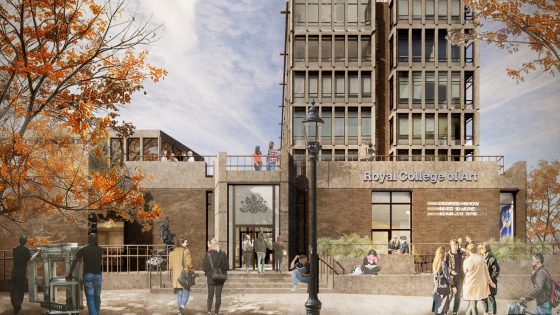
Working with Clementine Blakemore Architects, the practice – whose Appleby Blue Almshouse is shortlisted for this year’s RIBA Stirling Prize – plans to carry out a ‘careful balance of conservation and transformation’ on the famous building designed by HT Cadbury-Brown and Hugh Casson.
According to the RCA, the scheme for the block in London’s Albertopolis district has undergone ‘extensive consultation’ with the college community and local partners, including Westminster City Council and Historic England.
The proposals aim to meet the needs of a modern teaching environment’ and ensure the ‘buildings can serve future generations of students’ while protecting the RCA’s heritage.
Works are set to be phased, starting later this year and completing in 2032, allowing the RCA to continue its teaching and research throughout the seven-year overhaul.
The project will create new teaching and learning spaces, modernise studios and workshops, and open up the campus with step-free access and more areas open to the public.
As part of the plans, the historic 1851 Place entrance facing the Royal Albert Hall will be reinstated, providing ‘a striking new gateway’ and reconnecting the RCA to Exhibition Road’s world-famous museums and institutions.
A new café, gallery and event spaces are proposed so as to ‘invite greater public engagement’.
RCA president and vice-chancellor Christoph Lindner said the project represented a ‘major investment in the future’ of the RCA, adding: ‘With the renovation of our historic Kensington site, the RCA will once again operate from two central London campuses – Kensington and Battersea – bringing our community together with a new creative energy, driving cross-disciplinary exploration, with dynamic spaces to innovate, question and discover.’
According to the college, the project, though costing £90 million, will generate ‘longer-term savings through increased energy efficiency and consolidated campuses’.
Witherford Watson Mann Architects won the RIBA Stirling Prize in 2013 for Astley Castle, a project for the Landmark Trust which interwove a minimal new structure with the historic ruins of the castle.