
Demand for Astaxanthin in the EU: Outlook and Forecast (2025-2035)
The European astaxanthin industry is projected to grow from USD 50.8 million in 2025 to USD 123.6 million by 2035, advancing at a CAGR of 9.3%. The Haematococcus pluvialis segment is expected to lead sales with a 70% share in 2025, while aquaculture applications are anticipated to account for 45% of the application segment.
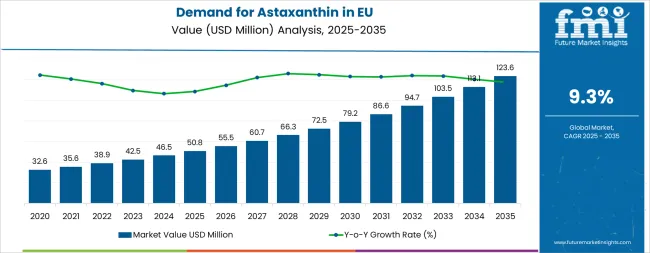
The European astaxanthin industry is projected to grow from USD 50.8 million in 2025 to approximately USD 123.6 million by 2035, recording an absolute increase of USD 72.7 million over the forecast period. This translates into total growth of 143.1%, with demand forecast to expand at a compound annual growth rate (CAGR) of 9.3% between 2025 and 2035. The overall industry size is expected to grow by nearly 2.4X during the same period, supported by the increasing demand for natural antioxidants, growing aquaculture industry requirements for feed pigmentation, and developing applications across dietary supplements, functional foods, and cosmetics segments throughout European operations.
Quick Stats for Astaxanthin in the EU
Astaxanthin in the EU Value (2025): USD 50.8 million
Astaxanthin in the EU Forecast Value (2035): USD 123.6 million
Astaxanthin in the EU Forecast CAGR: 9.3%
Leading Product Type in Astaxanthin in the EU: Haematococcus pluvialis (70.0%)
Key Growth Countries in Astaxanthin in the EU: All major operations growing uniformly at 9.3% CAGR
Top Application Segment in Astaxanthin in the EU: Aquaculture (45.0%)
Demand for Astaxanthin in the EU: Key Takeaways
Metric
Value
Market Value (2025)
USD 50.8 million
Market Forecast Value (2035)
USD 123.6 million
Forecast CAGR (2025-2035)
9.3%
Between 2025 and 2030, EU astaxanthin demand is projected to expand from USD 50.8 million to USD 79.1 million, resulting in a value increase of USD 28.3 million, which represents 38.9% of the total forecast growth for the decade. This phase of development will be shaped by rising consumer demand for natural antioxidants and anti-aging ingredients, increasing aquaculture production requiring feed pigmentation solutions, and growing awareness of astaxanthin’s health benefits, including cardiovascular support, eye health, and skin protection. Manufacturers are expanding production capacity to address evolving preferences for naturally extracted astaxanthin over synthetic alternatives, with investments in microalgae cultivation technologies and fermentation processes.
From 2030 to 2035, sales are forecast to grow from USD 79.1 million to USD 123.6 million, adding another USD 44.4 million, which constitutes 61.1% of the overall ten-year expansion. This period is expected to be characterized by further expansion of natural extraction methods, integration of advanced biotechnology for cost-effective algal production, and development of novel applications in functional foods, beauty-from-within cosmetics, and sports nutrition formulations. The growing emphasis on clean-label ingredients and increasing consumer preference for naturally sourced bioactive compounds will drive demand for algae-derived astaxanthin over synthetic production methods.
Between 2020 and 2025, EU astaxanthin sales experienced robust expansion at a CAGR of 8.8%, growing from USD 33.3 million to USD 50.8 million. This period was driven by increasing consumer awareness of antioxidant benefits, rising demand for salmon and trout aquaculture feed additives, and growing recognition of astaxanthin’s superior antioxidant potency compared to other carotenoids. The industry developed as specialized biotechnology companies and ingredient manufacturers recognized the commercial potential of natural astaxanthin extraction. Production technology improvements, cost reduction initiatives, and the expansion of applications beyond aquaculture began to establish consumer confidence and mainstream acceptance of astaxanthin as a premium ingredient.
Why is the Demand for Astaxanthin Growing in the EU?
Industry expansion is being supported by the rapid increase in health-conscious consumers across European countries and the corresponding demand for natural antioxidants with scientifically validated health benefits, including anti-inflammatory properties, cardiovascular support, and skin protection against UV damage. Modern consumers rely on astaxanthin-containing dietary supplements as comprehensive wellness solutions supporting multiple health dimensions simultaneously, driving demand for products that deliver bioavailable natural astaxanthin with proven efficacy and clean-label credentials. Even moderate health optimization goals, such as maintaining skin health, supporting eye function, or enhancing athletic recovery, can drive comprehensive adoption of astaxanthin supplements to maintain optimal wellness and prevent age-related decline.
The growing awareness of synthetic versus natural ingredient distinctions and increasing recognition of naturally extracted astaxanthin’s superior bioavailability are driving demand for algae-derived products from certified producers with appropriate quality standards and sustainable production practices. Regulatory authorities are increasingly establishing clear guidelines for astaxanthin product labeling, natural versus synthetic designation requirements, and quality specifications to maintain consumer protection and ensure product authenticity. Scientific research studies and clinical trials are providing evidence supporting natural astaxanthin’s health benefits and superior antioxidant activity, requiring specialized cultivation methods and standardized extraction protocols for Haematococcus pluvialis microalgae processing, purification, and formulation into stable, bioavailable ingredient forms.
Segmental Analysis
Sales are segmented by product type (species), application, distribution channel, nature (production method), and country. By product type, demand is divided into Haematococcus pluvialis and other species (Chlorococcum, Chlorella). Based on application, sales are categorized into aquaculture, dietary supplements, food & beverages, personal care & cosmetics, and PET food. In terms of distribution channel, demand is segmented into distributors/B2B, direct (manufacturers), online/marketplaces, and others. By nature, sales are classified into chemical synthesis (synthetic) and natural extraction (algal/yeast). Regionally, demand covers Germany, France, Italy, Spain, the Netherlands, and the Rest of Europe.
By Product Type, Haematococcus pluvialis Segment Accounts for 70% Share

The Haematococcus pluvialis segment is projected to account for 70% of EU astaxanthin sales in 2025, establishing itself as the dominant source organism across European operations. This commanding position is fundamentally supported by Haematococcus pluvialis microalgae’s ability to produce the highest natural astaxanthin concentrations among biological sources, superior bioavailability compared to synthetic alternatives, and widespread recognition as the premium natural astaxanthin source for high-value applications. The Haematococcus format delivers exceptional quality and efficacy, providing manufacturers and consumers with naturally produced astaxanthin in the preferred 3S,3’S stereoisomer configuration that demonstrates superior antioxidant activity and bioavailability compared to synthetic racemic mixtures.
This segment benefits from established cultivation technologies, improving production economics through photobioreactor and open pond systems, and extensive scientific validation demonstrating health benefits and safety profiles supporting regulatory approvals and consumer acceptance. Additionally, Haematococcus-derived astaxanthin offers versatility across various applications, including premium dietary supplements, functional foods, cosmeceuticals, and aquaculture feeds, where natural pigmentation and health benefits justify premium pricing.
The Haematococcus pluvialis segment is expected to increase its share from 70.0% in 2025 to 76.0% by 2035, demonstrating strengthening positioning as consumer preference shifts increasingly toward naturally extracted astaxanthin and production costs decline through technological advancement and scale economies throughout the forecast period.
Superior astaxanthin concentration and natural 3S,3’S stereoisomer providing enhanced bioavailability and efficacy
Scientific validation through clinical studies supporting health claims and regulatory approvals
Premium positioning enabling higher pricing in dietary supplements and cosmetics applications
By Application, Aquaculture Segment Accounts for 45% Share
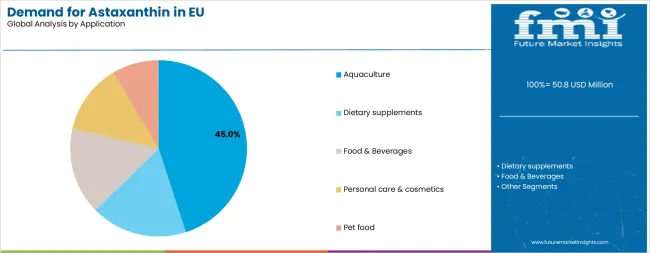
Aquaculture applications are positioned to represent 45% of total astaxanthin demand across European operations in 2025, declining to 40% by 2035, reflecting the segment’s substantial but gradually diminishing dominance as human nutrition applications grow proportionally faster. This considerable share directly demonstrates that salmon and trout feed pigmentation represents the largest single application for astaxanthin, where the carotenoid provides essential coloring for farmed fish flesh while delivering health benefits supporting fish growth, disease resistance, and stress tolerance.
Modern aquaculture operations increasingly demand natural astaxanthin for premium salmon and trout products, driving requirements for feed additives that deliver authentic wild-fish coloration, enhance fillet quality, and support fish health throughout production cycles. The segment benefits from established feeding protocols, proven efficacy in pigmentation and fish performance, and regulatory approvals supporting astaxanthin use in aquaculture feeds across European operations, where salmon farming represents a substantial industry, particularly in Norway and Scotland.
The segment’s share decline from 45.0% to 40.0% reflects faster growth in dietary supplements and other human nutrition applications rather than absolute aquaculture volume decline, as growing health supplement demand and expanding functional food applications drive proportionally higher growth in non-aquaculture segments during the forecast period.
Essential pigmentation function providing characteristic salmon color meeting consumer expectations for quality
Fish health benefits including immune support, stress resistance, and reproductive performance
Established regulatory approvals and feeding protocols supporting consistent aquaculture usage
By Distribution Channel, Distributors/B2B Segment Accounts for 60% Share
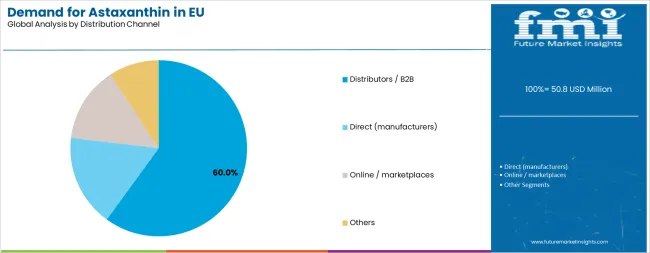
Distributors and B2B channels are strategically estimated to control 60% of total European astaxanthin sales in 2025, declining to 55% by 2035, reflecting the critical importance of specialized ingredient distributors for reaching diverse end-use applications, including aquaculture feed manufacturers, dietary supplement formulators, and cosmetics companies. European astaxanthin purchasers consistently demonstrate strong preferences for sourcing through established ingredient distributors that provide technical support, quality assurance, regulatory documentation, and inventory management, facilitating consistent supply chains.
The segment provides essential reach for astaxanthin producers, with distributors maintaining relationships across multiple industries, offering formulation support, and providing regulatory expertise supporting product development and compliance requirements. Major European ingredient distributors systematically expand astaxanthin offerings, representing various production sources and quality grades, addressing diverse application requirements from aquaculture commodity grades to pharmaceutical-grade supplements.
However, the segment experiences slight share erosion as alternative channels, including direct manufacturer sales and online platforms, capture incremental share, reflecting large customers’ preferences for direct sourcing relationships and emerging digital platforms connecting ingredient suppliers with formulators. By 2035, distributors are projected to hold a 55% share, down from 60% in 2025, as direct sales expand from 25% to 28% and online channels grow from 10% to 15%.
Industry reach across aquaculture, supplements, and cosmetics through established distributor networks
Technical support and regulatory documentation facilitating customer compliance and formulation optimization
Quality assurance and supply chain management ensuring consistent ingredient availability
By Nature, the Natural Extraction Segment Accounts for 51% Share
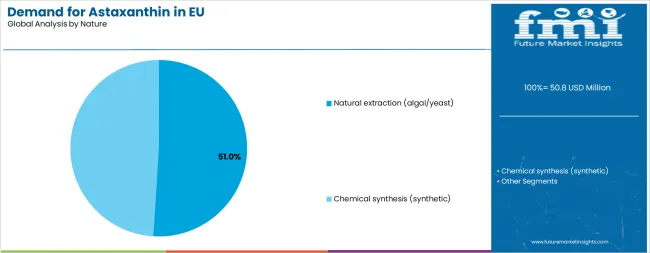
Natural extraction methods (algal/yeast) are strategically positioned to contribute 51% of total European astaxanthin sales in 2025, increasing substantially to 62% by 2035, representing astaxanthin produced through biological cultivation of microalgae (primarily Haematococcus pluvialis) or fermentation of yeast (Phaffia rhodozyma). These natural production methods successfully deliver superior bioavailability, clean-label positioning, and consumer preference advantages while commanding premium pricing in dietary supplement and cosmetics applications where natural sourcing represents essential marketing and regulatory positioning.
Natural extraction serves premium supplement brands, functional food manufacturers, and cosmeceutical companies that prioritize clean-label credentials, superior bioavailability over synthetic alternatives, and marketing differentiation through natural sourcing claims. The segment derives significant competitive advantages from demonstrated superior antioxidant activity compared to synthetic astaxanthin, regulatory approvals for novel food and dietary supplement applications, and consumer willingness to pay substantial premiums for naturally sourced bioactive ingredients.
The segment’s increasing share through 2035 reflects accelerating consumer preference for natural ingredients, improving production economics making natural astaxanthin increasingly cost-competitive, and regulatory trends favoring naturally extracted compounds over synthetic alternatives. By 2035, natural extraction is projected to hold a 62% share, up from 51% in 2025, with synthetic production declining from 49% to 38% as natural sources capture aquaculture applications previously dominated by lower-cost synthetic alternatives.
Superior bioavailability and antioxidant activity demonstrated in clinical studies
Clean-label positioning enabling premium pricing in supplements and cosmetics
Regulatory advantages with natural designation supporting marketing claims and consumer appeal
What are the Drivers, Restraints, and Key Trends of Astaxanthin in the EU?
EU astaxanthin sales are advancing rapidly due to accelerating consumer demand for natural antioxidants, growing scientific evidence supporting diverse health benefits, and increasing aquaculture industry requirements for natural pigmentation solutions. However, the industry faces challenges, including high production costs for naturally extracted astaxanthin limiting mass accessibility, supply constraints from microalgae cultivation capacity limitations, and competition from lower-cost synthetic alternatives in price-sensitive aquaculture applications. Continued production cost reduction and clinical validation of health benefits remain central to industry development.
Expansion of Advanced Microalgae Cultivation Technologies
The rapidly accelerating development of advanced photobioreactor systems and optimized cultivation protocols is fundamentally transforming natural astaxanthin production from a small-scale specialty ingredient to an increasingly cost-competitive alternative challenging synthetic production economics. Advanced cultivation technologies featuring closed photobioreactor systems, optimized nutrient formulations, controlled stress induction protocols, and efficient harvesting methods enable producers to maximize astaxanthin accumulation in Haematococcus cells while reducing contamination risks, improving consistency, and lowering production costs per kilogram. These technological innovations prove particularly transformative for dietary supplement and cosmetics applications, where production cost reductions enable broader accessibility while maintaining natural extraction’s premium positioning and bioavailability advantages.
Major natural astaxanthin producers invest heavily in cultivation technology optimization, photobioreactor design improvements, and process automation targeting cost reduction, recognizing that production economics directly determine competitiveness against synthetic alternatives and accessibility for price-sensitive applications. Producers collaborate with biotechnology research institutions, engineering companies, and agricultural technology providers to develop next-generation cultivation systems incorporating LED lighting optimization, automated harvesting, and integrated processing that reduce capital and operating costs while increasing production yields and product quality consistency.
Integration of Beauty-from-Within and Functional Food Applications
Modern ingredient manufacturers systematically incorporate astaxanthin into emerging beauty-from-within cosmetics and functional food formulations that deliver skin health benefits through internal consumption rather than topical application. Strategic integration of astaxanthin into ingestible beauty supplements, functional beverages, and fortified foods enables manufacturers to position comprehensive skin protection solutions where antioxidant activity, UV damage prevention, and collagen support create differentiated value propositions addressing consumer demands for natural anti-aging solutions. These application innovations prove essential for expansion beyond traditional dietary supplements, as beauty-from-within represents a rapidly growing category with premium positioning and consumer willingness to pay for scientifically validated ingredients.
Companies develop clinical evidence demonstrating astaxanthin’s skin benefits, including reduced wrinkle depth, improved elasticity, and UV protection, supporting marketing claims and product differentiation in competitive beauty supplement categories. Manufacturers leverage beauty-from-within positioning in product development, marketing campaigns, and retail partnerships with beauty specialty stores and cosmetics retailers, expanding astaxanthin accessibility beyond health food channels into premium beauty retail environments where ingredient sophistication and scientific validation support premium pricing and brand positioning.
Growing Emphasis on Sustainability and Traceability in Aquaculture
European aquaculture operations increasingly prioritize sustainability credentials and supply chain traceability for feed ingredients, with natural astaxanthin derived from microalgae offering environmental advantages over synthetic alternatives and wild-caught krill-based sources. This sustainability trend enables natural astaxanthin producers to position environmentally responsible pigmentation solutions where microalgae cultivation avoids marine resource extraction, reduces environmental impact compared to petrochemical synthesis, and provides traceability supporting sustainable seafood certifications, including ASC (Aquaculture Stewardship Council) and organic aquaculture standards. Sustainability positioning proves particularly important in premium salmon operations where retailers and consumers demand environmental responsibility and transparent supply chains.
The development of carbon footprint documentation, lifecycle assessment data, and sustainability certifications expands natural astaxanthin’s competitive positioning in aquaculture applications where environmental credentials increasingly influence purchasing decisions alongside traditional considerations of cost and efficacy. Producers collaborate with salmon farmers, sustainability certification bodies, and environmental organizations to develop comprehensive sustainability narratives supporting natural astaxanthin adoption in premium aquaculture operations serving environmentally conscious European consumers.
Demand Analysis of Astaxanthin in the EU by Key Countries
Country
CAGR (2025-2035)
Netherlands
9.8%
Spain
8.5%
Italy
7%
Germany
6.2%
France
6%
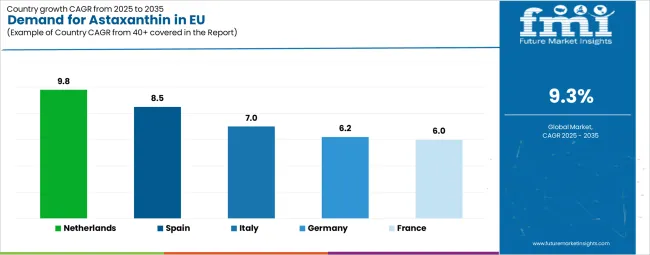
EU astaxanthin sales demonstrate varied growth rates across major European economies, with Germany recording a 6.2% CAGR, France at 6.0%, Italy at 7.0%, Spain at 8.5%, and the Netherlands leading with 9.8% CAGR through 2035, driven by synchronized consumer trends toward natural antioxidants, growing aquaculture industry demand, and expanding dietary supplement consumption supporting healthy aging and disease prevention. Germany maintains leadership through its established supplement manufacturing and biotechnology infrastructure. France benefits from functional food innovation and the premium cosmetics industry. Italy leverages growing health supplement adoption and Mediterranean aquaculture. Spain shows steady growth supported by aquaculture operations and supplement expansion. The Netherlands emphasizes biotechnology leadership and aquaculture feed innovation, achieving the highest regional growth rate. Overall, sales show differentiated regional development reflecting varying levels of maturity and consumer adoption across EU member states.
The report covers an in-depth analysis of top-performing countries are highlighted below.
Germany Leads European Sales with Established Supplement Industry
Revenue from astaxanthin in Germany is projected to exhibit robust growth with a CAGR of 6.2% through 2035, driven by an exceptionally well-developed dietary supplement industry, strong consumer interest in evidence-based natural health products, and comprehensive biotechnology infrastructure supporting ingredient research and development. Germany’s sophisticated understanding of nutraceuticals and internationally recognized leadership in quality standards are creating substantial demand for premium natural astaxanthin across dietary supplements, functional foods, and cosmeceutical applications.
Major supplement manufacturers, retailers including DM, Rossmann, and specialized health stores, and online platforms systematically expand astaxanthin product offerings, often positioning natural astaxanthin as a premium ingredient within antioxidant and anti-aging supplement categories. German demand benefits from high consumer health awareness, substantial disposable income supporting premium supplement purchases, and cultural appreciation for scientifically validated natural ingredients that naturally support astaxanthin adoption across health-conscious mainstream consumers.
Well-established dietary supplement industry with sophisticated consumers seeking evidence-based ingredients
Strong biotechnology infrastructure supporting astaxanthin research and ingredient development
Premium positioning acceptance with consumers willing to pay for naturally sourced bioactive compounds
France Demonstrates Strong Growth with Functional Food Innovation
Revenue from astaxanthin in France is expanding at a CAGR of 6%, substantially supported by evolving consumer attitudes toward functional foods, growing beauty-from-within supplement adoption, and the established cosmetics industry increasingly incorporating ingestible beauty ingredients. France’s sophisticated beauty culture and increasing interest in natural anti-aging solutions are systematically driving demand for astaxanthin-containing supplements and functional products addressing skin health, cardiovascular wellness, and healthy aging.
Major retailers, pharmacies, and specialized beauty retailers progressively establish astaxanthin supplement ranges and functional food offerings serving growing consumer demand for natural antioxidants with clinically validated benefits. French sales particularly benefit from beauty industry sophistication driving ingestible beauty supplement adoption, with astaxanthin’s skin protection and anti-aging benefits resonating strongly with French consumers’ emphasis on beauty and wellness integration.
Beauty-from-within trend driving astaxanthin adoption in skin health and anti-aging supplements
Pharmacy channel strength supporting natural supplement distribution and consumer education
Premium cosmetics culture accepting high-value natural ingredients in ingestible beauty products
Italy Maintains Strong Growth with Supplement Adoption and Aquaculture
Revenue from astaxanthin in Italy is growing at a robust CAGR of 7%, fundamentally driven by increasing dietary supplement consumption, growing health consciousness particularly among aging populations, and established Mediterranean aquaculture operations, including trout and sea bass farming, requiring natural pigmentation solutions. Italy’s traditionally health-focused Mediterranean culture is evolving to incorporate preventive health supplements, with natural antioxidants like astaxanthin appealing to consumers seeking evidence-based wellness solutions.
Major pharmacy chains, health retailers, and aquaculture feed manufacturers strategically incorporate astaxanthin into product portfolios, addressing diverse applications from human nutrition to fish farming. Italian sales particularly benefit from pharmacy-based supplement distribution providing credibility and professional recommendations, combined with aquaculture industry requirements for natural feed ingredients supporting product quality and sustainability positioning.
Growing supplement adoption driven by aging population and preventive health awareness
Pharmacy distribution channel providing credibility and professional guidance
Mediterranean aquaculture operations requiring natural pigmentation and fish health ingredients
Spain Focuses on Aquaculture Applications and Emerging Supplement Demand
Demand for astaxanthin in Spain is projected to grow at a CAGR of 8.5%, substantially supported by the established aquaculture industry, including marine fish farming, the growing dietary supplement sector among health-conscious urban consumers, and increasing awareness of natural antioxidants’ health benefits. Spanish aquaculture operations and emerging supplement consumption create dual demand drivers supporting development across both industrial feed applications and consumer health products.
Major aquaculture feed manufacturers and health retailers systematically expand astaxanthin usage and product availability, with coastal regions’ aquaculture operations providing substantial demand for feed-grade astaxanthin while urban centers drive dietary supplement consumption. Spain’s growing health and wellness culture, combined with the traditional aquaculture industry presence, creates balanced development across commercial and consumer applications.
Established aquaculture industry providing consistent demand for feed-grade astaxanthin
Growing urban health consciousness driving dietary supplement adoption
Coastal regions’ fish farming operations requiring natural pigmentation solutions
Netherlands Emphasizes Biotechnology Leadership and Aquaculture Feed Innovation
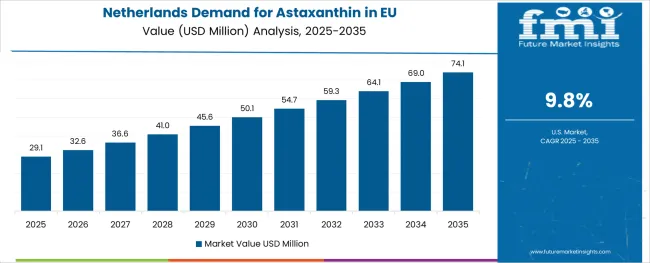
Demand for astaxanthin in the Netherlands is expanding at a CAGR of 9.8%, fundamentally driven by advanced biotechnology capabilities, an established aquaculture feed industry serving European operations, and sophisticated consumer interest in evidence-based natural supplements. Dutch expertise in microalgae cultivation and feed technology positions the Netherlands as an innovation hub for astaxanthin production and application development.
Netherlands sales significantly benefit from biotechnology research infrastructure, innovative food technology companies developing astaxanthin applications, and established aquaculture feed manufacturers serving European salmon and trout farming operations. Dutch consumers demonstrate strong receptivity to scientifically validated natural ingredients, supporting premium supplement adoption while the biotechnology sector advances production technologies, reducing natural astaxanthin costs and improving accessibility.
Biotechnology leadership supporting astaxanthin production technology development
Aquaculture feed industry presence serving European fish farming operations
Consumer sophistication accepting premium pricing for scientifically validated natural ingredients
Europe Split by Country
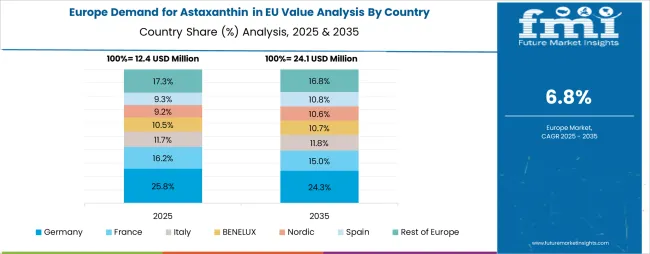
EU astaxanthin sales are projected to grow from USD 50.8 million in 2025 to USD 123.6 million by 2035, registering varying CAGRs across major European operations over the forecast period. Germany is expected to maintain leadership with a 25% share in 2025, projected to grow at a 6.2% CAGR, supported by a well-developed dietary supplement industry, strong aquaculture feed manufacturing presence, and advanced biotechnology infrastructure. France follows with 18.0% share and a 6% CAGR, attributed to growing functional food adoption and an established cosmetics industry demanding natural ingredients.
Italy contributes 15% of sales with a 7% CAGR, driven by dietary supplement consumption growth and Mediterranean aquaculture operations. Spain accounts for a 12% share with an 8.5% CAGR, while the Netherlands represents 10% with the highest growth rate of 9.8%, supported by advanced biotechnology capabilities and aquaculture feed industry presence. The Rest of Europe region holds 20% share, encompassing Nordic salmon farming operations, Eastern European emerging operations, and other EU member states with developing astaxanthin applications.
Competitive Landscape
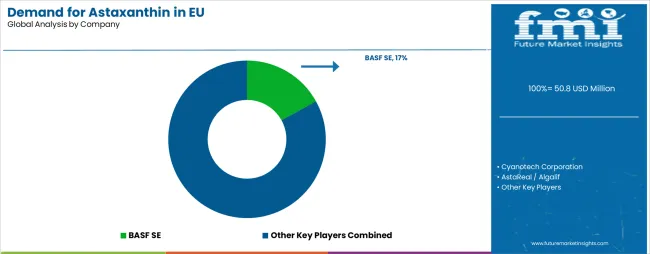
EU astaxanthin sales are defined by competition among specialty chemical companies, biotechnology firms specializing in microalgae cultivation, and ingredient manufacturers serving diverse end-use applications. Companies are investing in advanced cultivation technologies, cost reduction initiatives, clinical research validating health benefits, and application development to deliver high-quality, cost-effective, and scientifically validated astaxanthin ingredients. Strategic partnerships with aquaculture feed manufacturers, dietary supplement brands, and cosmetics companies are central to strengthening position.
Major participants include BASF SE with an estimated 10.0% share, leveraging its specialty chemicals expertise, established ingredient business serving nutrition and personal care operations, and European manufacturing scale supporting consistent supply and competitive pricing. BASF benefits from a diversified customer base across aquaculture, supplements, and cosmetics, comprehensive technical support capabilities, and the ability to serve both synthetic and natural astaxanthin demand through multiple production platforms.
Cyanotech Corporation holds approximately 8.0% share, emphasizing natural astaxanthin production from Haematococcus pluvialis microalgae cultivation in Hawaii, with European distribution supporting dietary supplement and cosmetics applications. Cyanotech’s BioAstin brand success in natural astaxanthin positioning creates premium presence, particularly in dietary supplement channels where natural sourcing and clinical validation support brand differentiation and consumer loyalty.
AstaReal/Algalif accounts for roughly 6.0% share through specialized focus on natural astaxanthin production, significant European presence including Icelandic production facilities, and strong positioning in dietary supplement and functional food applications. The company benefits from vertical integration in microalgae cultivation, extensive clinical research supporting health claims, and established relationships with premium supplement brands seeking scientifically validated natural ingredients.
DSM N.V. represents approximately 5.0% share, supporting growth through a comprehensive nutrition ingredients portfolio, established relationships with aquaculture feed manufacturers, and technical expertise in carotenoid applications. DSM leverages multinational scale, research and development capabilities, and a broad customer base across animal nutrition and human health applications, providing diversified exposure and technical leadership.
Other companies and regional players collectively hold 71.0% share, reflecting the fragmented nature of European astaxanthin sales, where numerous specialized producers, regional distributors, synthetic manufacturers, and emerging biotechnology companies serve specific applications, geographic operations, and quality segments. This fragmentation provides opportunities for differentiation through production methods (photobioreactor versus open pond), quality grades (feed versus pharmaceutical), source organisms (Haematococcus versus yeast), and application specialization addressing aquaculture, supplements, or cosmetics requirements.
Key Players
BASF SE
Cyanotech Corporation
AstaReal/Algalif
DSM N.V.
Regional producers and biotechnology companies
Scope of the Report
Item
Value
Quantitative Units
USD 123.6 million
Product Type (Species)
Haematococcus pluvialis, Other Species (Chlorococcum, Chlorella)
Application
Aquaculture, Dietary Supplements, Food & Beverages, Personal Care & Cosmetics, Pet Food
Distribution Channel
Distributors/B2B, Direct (Manufacturers), Online/Marketplaces, Others
Nature (Production)
Chemical Synthesis (Synthetic), Natural Extraction (Algal/Yeast)
Forecast Period
2025-2035
Base Year
2025
Historical Data
2020-2024
Countries Covered
Germany, France, Italy, Spain, the Netherlands, and the Rest of Europe
Key Companies Profiled
BASF SE, Cyanotech Corporation, AstaReal/Algalif, DSM N.V., Regional producers
Report Pages
180+ Pages
Data Tables
50+ Tables and Figures
Additional Attributes
Dollar sales by product type (species), application, distribution channel, and production nature; regional demand trends across major European operations; competitive landscape analysis with established chemical companies and specialized biotechnology producers; natural versus synthetic production method comparison; integration with aquaculture feed formulation and dietary supplement development; innovations in microalgae cultivation technologies and extraction processes; adoption across human nutrition and animal feed applications; regulatory framework analysis for natural astaxanthin approvals and health claims; clinical research supporting health benefits; and penetration analysis for premium supplement brands and aquaculture operations across European activities.