
The boss of Klarna has claimed that artificial intelligence has allowed the fintech company to shed more than half its workforce, insisting that he was trying to be more “honest” on the issue than other business leaders.
Sebastian Siemiatkowski, who co-founded the “buy now, pay later” company in 2005, has shrunk its workforce from 7,400 people to about 3,000, while increasing revenues and customers.
“So, we’re simply not recruiting, which means that we can avoid doing layoffs,” he told Bloomberg Television.
Last year Klarna announced that it was using an AI-powered chatbot to handle two thirds of its customer service inquiries, doing the equivalent work of 700 full-time agents, estimating that it would drive a $40 million improvement in annual profit that year.
The company, which launched its shares in New York last month in one of the biggest IPOs this year, had taken savings from its payroll costs and reinvested them into paying its remaining employees more, Siemiatkowski said. The expectation was that wage costs would remain steady as its workforce declined, he has previously said.
Siemiatkowski, 44, said that society needed to “figure out” how to respond to the disruption caused to the jobs market by the technology, which would create some new roles but hit others like translators. “I feel there is a massive shift coming to knowledge work; and it’s not just in banking, it’s in society at large,” the Swede said.
He foresaw “concerns for society” about the adoption of the technology, particularly in the hands of non-democratic countries, but that it would be good for society overall.
“It means less excess profits in what has been not as well-functioning markets as they could have been,” he said.

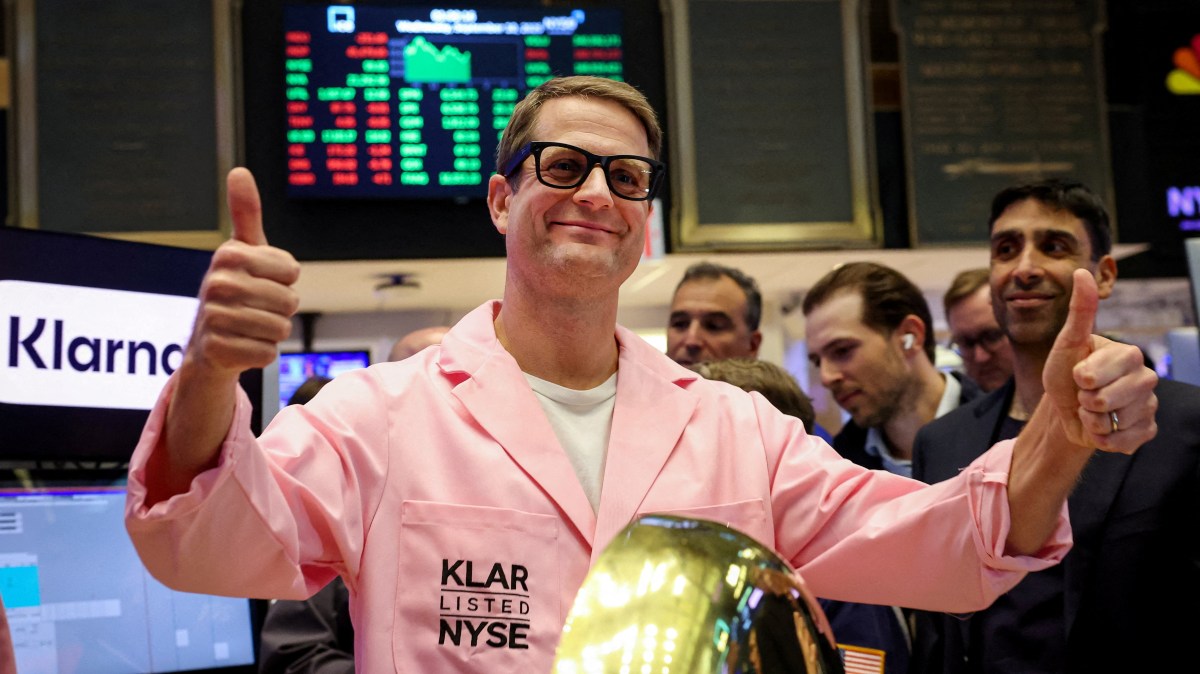
Klarna’s New York IPO last month was one of the biggest this year
AP
Siemiatkowski is the latest chief executive to acknowledge that jobs will be cut as a result of AI, after Andy Jassy, the chief executive of Amazon, cautioned staff in June that the rollout of generative AI systems such as chatbots and AI agents — tools that carry out tasks autonomously — would reduce Amazon’s total corporate workforce in the next few years.
“As we roll out more generative AI and agents, it should change the way our work is done. We will need fewer people doing some of the jobs that are being done today and more people doing other types of jobs,” Jassy told employees, in a rare explicit warning from a major chief executive of the potential impact of the technology on the workforce.
The Bank of England has warned that the sharp rise in the valuations of American technology companies could spark a sell-off in global markets that would hit the UK, as investors have clamoured to capitalise on AI.
Stock market valuations, particularly in the United States, “appeared stretched” and on some measures in the US were “comparable to the peak of the dotcom bubble”, officials on the Bank’s financial policy committee said.
Klarna revolutionised the ecommerce payment landscape with its buy-now, pay-later services, allowing consumers to make purchases and pay for them later or in instalments.
The business has claimed that it is used by 111 million customers globally, with its flexible payment options offered by retailers at checkouts including John Lewis, Asos, Argos, Ticketmaster and Booking.com.