
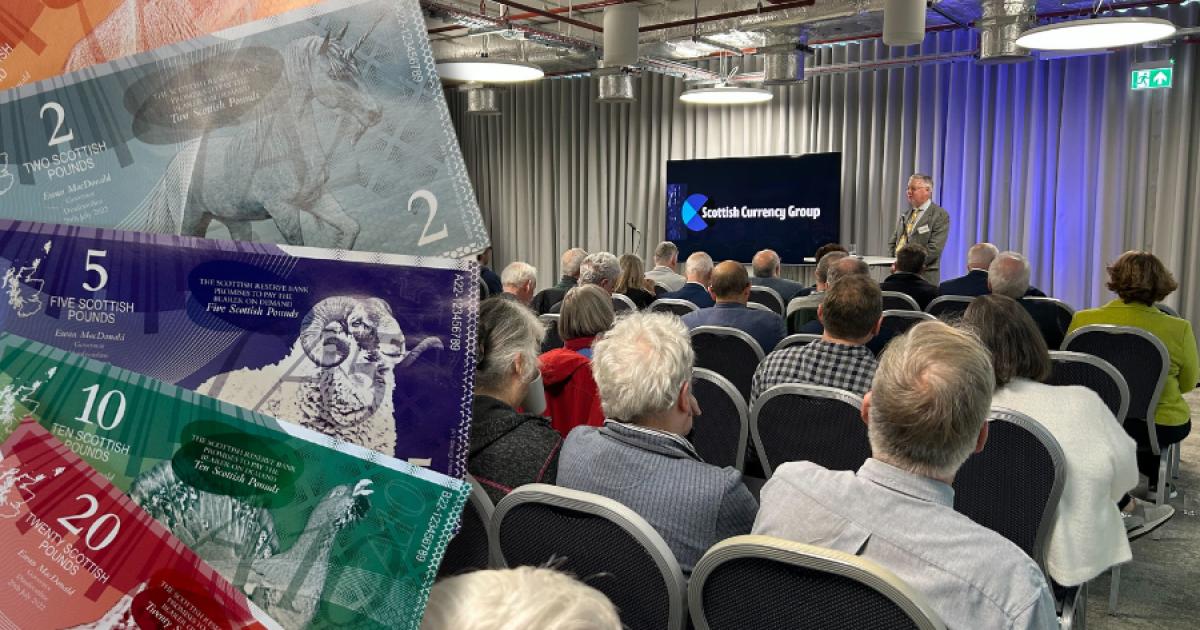
The Scottish Currency Group (SCG) held its third annual conference, which aims to explore currency and the economy in an independent Scotland, in Dunfermline on Saturday.
Contributors ranged from former MPs, academics, and experts in finance who all echoed the same point – if Scotland wants to achieve independence those in charge at the Scottish Government need to be bolder with their ambitions and have more faith in establishing the country’s own currency.
National columnists and accounting expert Professor Richard Murphy summed up the event by saying that a Scottish currency is about showing faith in the country and its ability to govern itself. Something he challenged the current SNP leadership to show more of.
“Money is about faith in the potential of Scotland. It’s about hope in the fact that potential might be released, but most of all, Scottish currency is love for Scotland,” he said.
READ MORE: ‘No zonal pricing? No pylons’: Kenny MacAskill calls for block on new developments
“It’s without saying, we believe in Scotland above all else, and that’s why we want our own currency, because that’s the only way we will deliver for the people of Scotland.
“They need it to deliver for themselves to make it their own for their own benefit, and for the benefit of those who can come after them.”
Speakers at the two-day conference included former SNP MP Philippa Whitford and Scotonomics’s William Thomson, and Common Weal Robin McAlpine and Craig Dalzell along with Alba’s Kenny MacAskill, and were asked to explain their “vision for independence” with a focus on economics.
Professor Thibault Laurentjoye, who was commissioned by the Labour Welsh government to look at currency options if Wales were to become independent, has also been commissioned by the SCG to look at currency frameworks for an independent Scotland.
Laurentjoye, a French academic who is an assistant professor in economics at Aalborg University Business School in Denmark, delivered his interim report at the conference and is expected to publish the final report next year.
Dr Tim Rideout, convener of the SCG, said that the conference aimed to consider the “why” of independence is as important as the “how”, as speakers used their expertise to argue ideas and policy frameworks.
Scottish Currency Group (Image: NQ)
Whitford (above) spoke about how the Scottish Government has been “swimming against the tide” with the last 10 years of austerity drastically cutting public services, but she said the SNP have still managed to deliver critical policy changes, like the baby box and abolishing the two child payment cap. However, the former Central Ayrshire MP argued there needs to be more radical change proposed by the Scottish Government and that she would like to see the likes of an integrated care system, as she hammered home the point that poverty is one of the largest contributors to ill health.
She addressed the fact that the Scottish Government is unable to make the “radical” changes needed to truly address an aging population and child poverty due to the constraints of having no control over its own budget and lack of borrowing powers.
READ MORE: Opponents of assisted dying prepare to make case against legislation
Whitford also argued that recent initiatives from the UK Government, like its newly formed investment vehicle GB Energy, are not just a “farce” but a “threat” to Scotland’s resources. McAlpine also addressed the conference about Scotland’s resources, saying, “we need to get out as fast as we can” from the Union, as he said the country is being “regionalised”.
He argued that Scotland doesn’t have any of its own “big players,” citing the likes of ScottishPower, being a subsidiary of the Spanish energy firm Iberdrola, and how around 70% of Scottish whisky distilleries are owned by companies in other countries like America and Japan.
McAlpine suggested nationalising energy to help retain the wealth in Scotland, along with other bold plans like implementing a limit of how many distilleries foreign companies can own, while establishing our own whisky distribution network.
The establishment of a national statistics agency was also floated by McAlpine, along with other speakers, in which he said would help the independence movement move forward collectively as a country and stop acting like a “region”.
Independence was very much at the heart of the conference, and it aimed to show ordinary Scots how Scotland can survive on its own, by demonstrating just how easy it is to set up the country’s currency and central bank.
Examples of potential notes in an independent Scotland (Image: NQ)
Ian Stewart, a banker for 40 years and a member of the SCG, reiterated the point that Scotland’s right to self-determination needs to be broken down for ordinary people and explained in terms that matter to them the most.
An example he gave to “convince the ordinary person” is having a central bank of Scotland offering fixed-rate mortgages for 30 years, which he said councils used to offer similar deals prior to the Thatcher era.
Murphy’s comments summed up the summit and the overall mood on the first day best when he said: “In 2026 we have a Scottish Government in Holyrood, we have a Welsh Government in Cardiff, and a Sinn Féin in Northern Ireland and we have three countries, excluding England, in the Union, with governments who believe independence, then we had to take independence seriously.
“Scotland is going to be independent.” He added: “I think that the tipping point is coming very close.
“The idea that England has something to offer to the people of Scotland, to the people of Wales, to the people of Northern Ireland, is becoming a joke.
“England hasn’t offered anything to the people of England, more people are telling me in England. So why the heck should anybody in Scotland believe it has?
“And yet that’s the point. Scotland has something to believe in. England hasn’t.
“Scotland could believe in its own currency, but the currency is that symbol of faith in the country, it is the symbol of faith in the value of the country, the symbol of the faith in the power to govern itself. And it’s the symbol of the faith of the Scottish people to manage the affairs of Scotland for themselves.”