

When we once imagined the future we pictured flying cars, air taxis and trips to Mars. But a robot buying a sausage roll in Greggs before getting in a black cab? Not exactly what Back to the Future Part II promised.
Yet that is exactly what Londoners saw earlier this week when Koid, a humanoid robot, was spotted on the capital’s streets interacting with construction workers and riding around in a taxi — sending passers-by reaching for their phones in disbelief.
Koid also became the first humanoid robot to open the London Stock Exchange.
The stunt marked the debut of KraneShares Global Humanoid & Embodied Intelligence Index ETF — or Koid for short — a stock market fund investing in the rapidly growing world of humanoid robotics and “embodied AI”.
It could also be a sign of things to come, as robotics become more ingrained in everyday life.
“Humanoid robotics and embodied intelligence are reshaping industries and the way we live and work,” Xiaolin Chen, the head of international at KraneShares, said.
The star of the show is a Unitree Ultimate Humanoid Robot G1. Humanoid robots are machines designed to mimic the body and perform human tasks, combining sensors, artificial intelligence and dexterity to operate in real-world environments such as manufacturing, logistics, healthcare and consumer services.

Koid’s antics were part of a publicity stunt for KraneShares Global Humanoid & Embodied Intelligence Index ETF
JONATHON CHARLES DEMSKE
The robot is controlled by an operator via a phone, headset or other type of controller. It follows what the operators do and its movements include waving, shaking hands and blowing a kiss.
It can be programmed to do boxing, kung fu, backflips and warehouse-based tasks. Set to “AI mode”, it can even hold a conversation with people.
• London stockpicker has whale of a time riding on Nvidia wave
Humanoid robots are transitioning from research labs to real-world applications, appearing in factories, logistics centres, healthcare facilities and even homes. Researchers at Morgan Stanley project that by 2050 there could be 1 billion humanoid robots generating $5 trillion in annual revenue, driven by adoption across multiple sectors.
Experts predict that quoted companies such as Tesla, Nvidia, UBtech, Rainbow Robotics, as well private firms such as Unitree and Figure AI, will continue to prosper as we enter an era of embodied AI — robots employing artificial intelligence to interact, move around and complete real-world physical tasks.
• Google and Microsoft cloud revenue soar, defying ‘AI bubble’ concerns
London in particular is fast becoming the UK’s testing ground for automation. Waymo, the American autonomous vehicle company, will launch driverless taxis on the capital’s streets from next year, making it the first European city to have an autonomous taxi service of the kind now familiar in San Francisco — where the company is under fire after one of its cabs was implicated in a hit-and-run on a “bodega cat” named KitKat, also known as the “Mayor of 16th Street”.
Waymos in London will, at least at the start, have a safety driver in them too.
• Waymo’s driverless taxis will be on London’s roads by next year
Other innovations on the way include a medical drone delivery service for Guy’s and St Thomas’ NHS Foundation Trust, first trialled last year. The trust expects its on-demand blood-test deliveries will speed up turnaround times.
In June, Apian, a healthcare logistics firm, worked with Great Ormond Street Hospital to explore the integration of autonomous ground-delivery robots, with the aim of reducing delays and freeing up staff. The robots would enable hands-free transport of samples and supplies directly between delivery drones and clinical teams.
Other autonomous delivery robots are operating in Manchester, Leeds and Cambridge. The boss of one operator, Estonia’s Starship Technologies, told The Guardian in October it had “solved everything there is to solve”.
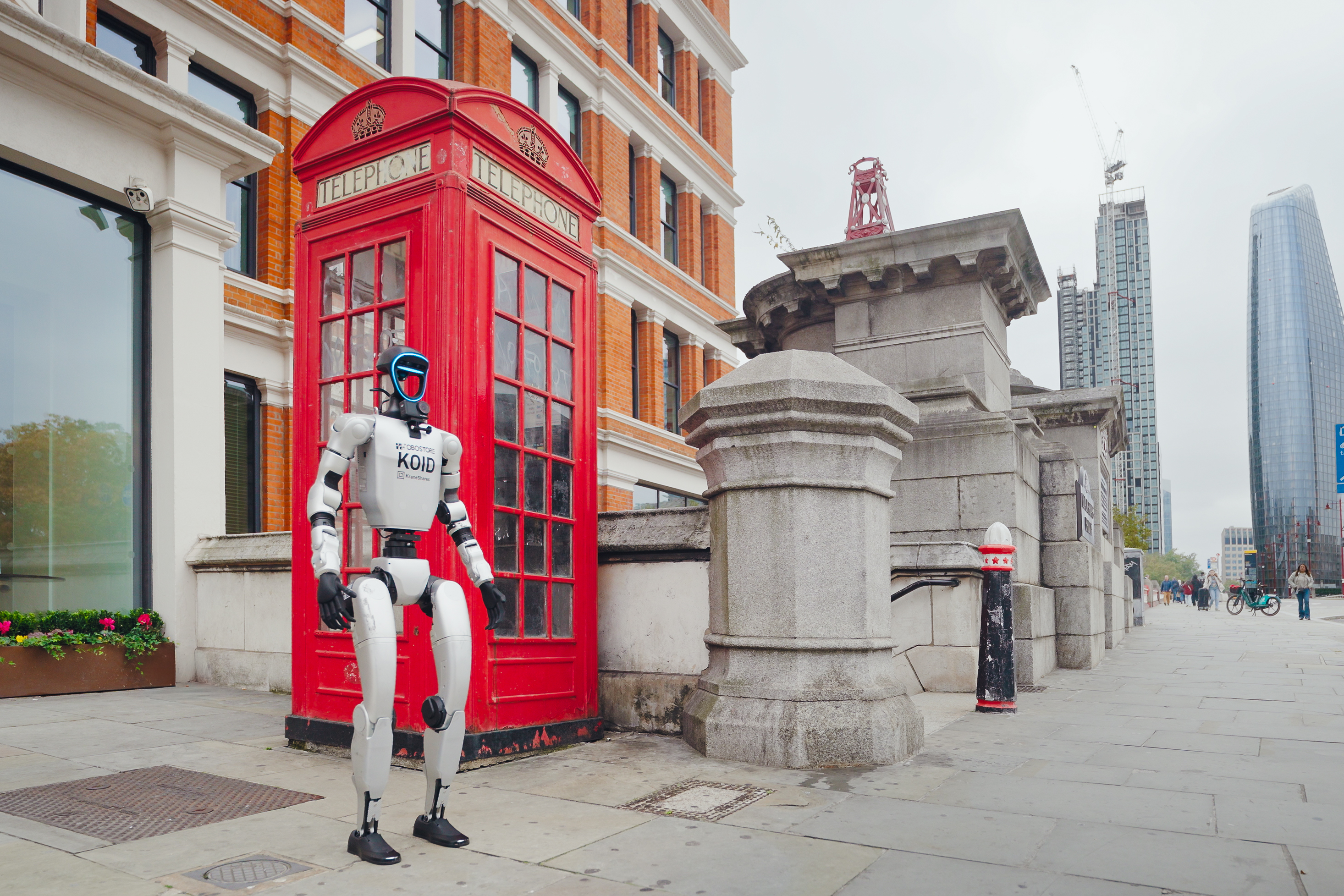
Old meets new: Koid takes in the sights in London
JONATHON CHARLES DEMSKE
However, regulators still stand in the way of widespread adoption. The UK-based Vertical Aerospace envisions a future where autonomous, zero-carbon flying taxis will take off vertically from the centre of London and reach Heathrow in a fraction of the time it takes on the Tube.
• The AI robots aren’t taking our jobs — for the time being, at least
Will Nathan, the firm’s head of public affairs, said: “If the UK wants to turn these world-class technologies into world-leading industries, regulators, innovators and government need to move in step. In aviation, we’re fortunate to have a forward-thinking regulator in the CAA that understands it needs to enable safe innovation. Flexibility, speed, clarity and proportionality underpin good regulation.
“But this can only go so far. It needs to be coupled with clear government support that can turn early technology breakthroughs into jobs, exports and growth. The UK has the talent and technology; now it needs the confidence to back them.”