
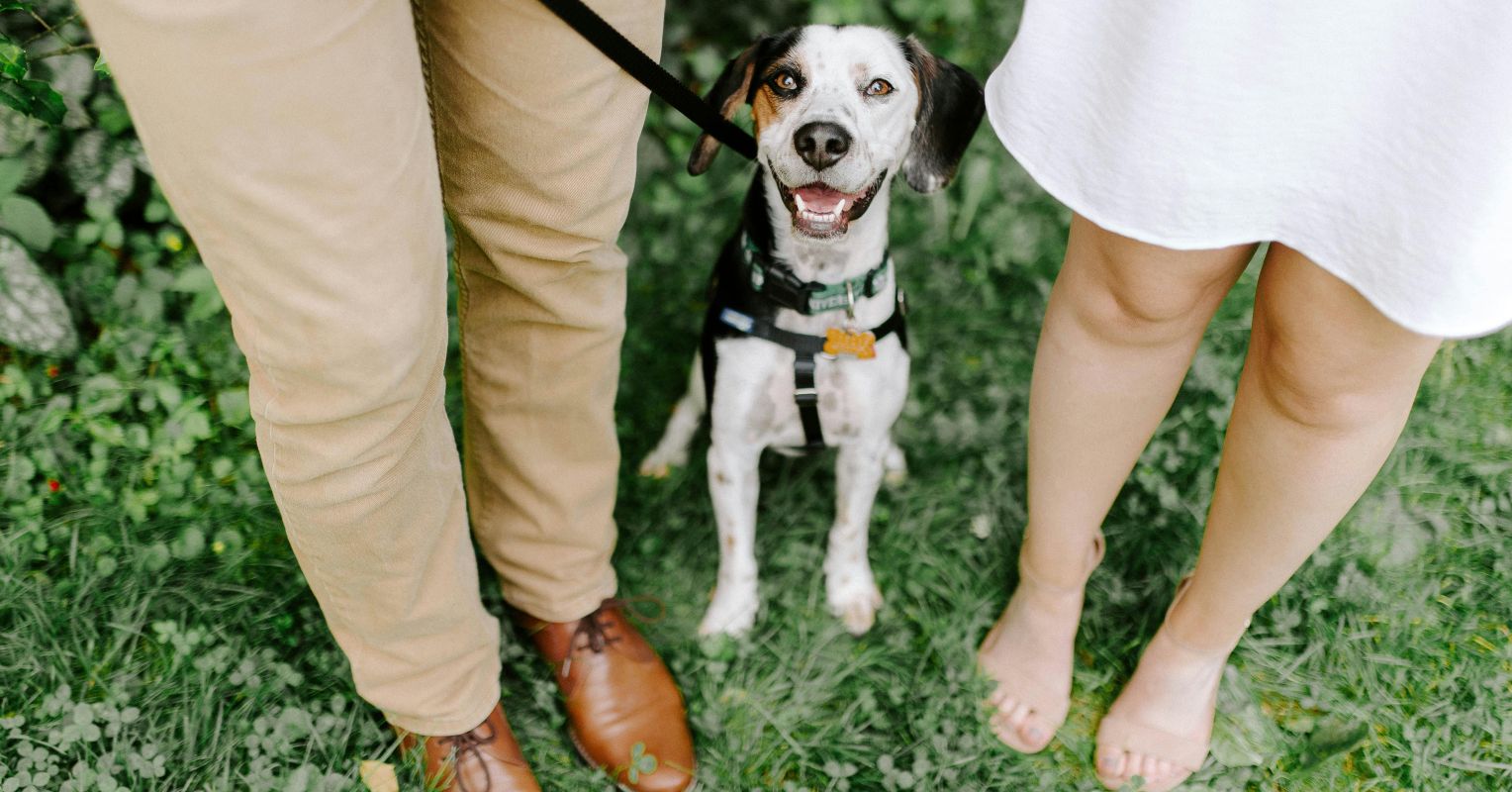
Need one more reason to love your dog? New research suggests they might be called “man’s best friend” for reasons beyond reliable companionship.
A recent study experimentally manipulated the presence or absence of pets (mostly dogs), and the findings point to the possibility that pets may provide an indirect boost to romantic relationship quality (Barklam & Felisberti, 2025).
Pets and Our Romantic Relationships
Does your pet help your love life? Dog owners are convinced that they do. One study found that 86 percent of dog owners believe their dogs positively affect their romantic relationship (Cloutier & Peetz, 2016). But does this hold up under empirical scrutiny? Initial evidence is scarce but generally positive.
For instance, single women (more so than men) use a potential partner’s pet ownership as a sign of underlying mate quality (Gray et al., 2015). Specifically, owning a dog, as compared to owning a cat, implied socially relevant information to single women, who might see these dog-owning men as better potential caregivers, i.e., better potential partners. Within ongoing relationships, dog ownership might be viewed as a factor that enhances relationships, but owning a dog may also add stress and possibly jealousy to a relationship (Tallichet et al., 2023).
Pets May Subtly Shape Relationship Dynamics
If pets make you happy, that could be one pathway by which they improve your relationship. In a novel study, researchers asked whether positive emotional displays triggered by the presence of a pet might have a lingering effect on subsequent interactions with a romantic partner (Barklam & Felisberti, 2025).
In other words, if your pet makes you happy, does this happiness have a downstream effect on the quality of your romantic relationship?
To answer this question, Barklam and Felisberti (2025) invited 36 romantic couples and 45 friend pairs from the general community and Kingston University in London to each engage in three five-minute videoed sessions. The first session involved no manipulation; partners or friends just talked freely with each other. For the second session, one third of dyads interacted in the presence of one of their pets (typically a dog but sometimes a cat), while another third interacted in the presence of a stuffed animal toy. The final session, like the first, involved the opportunity for free conversation. Researchers also used a control sample of non-pet-owning dyads (the final third of the sample) and moved them through a similar sequence, with their second session including the stuffed toy animal.
Dog-Related Joy May Improve Relationship Well-being
Barklam and Felisberti (2025) discovered that when pet-owning couples were able to spend time with their pets (session two), they experienced an increased number of positive facial expressions. More importantly, facial coding showed that these positive expressions lingered into the subsequent “free talk” session, in which romantic partners engaged with no pet or toys present. This lingering did not happen among friends.
Interestingly, when pet-owning couples were randomly assigned to the stuffed toy condition, they still demonstrated increases in positive facial emotion, which did linger into the next free talk session. Such was not the case with non-pet-owning people. It is possible that being around a stuffed animal could have triggered thoughts about a beloved pet, which may have generated a deeper level of positive affect for the pet-owning couples compared to the non-pet-owning couples, for whom the stuffed animal did not generate lingering positive facial expressions.
Pets and Long-Term Love
Relationships do not operate within a vacuum; any experiences that change our behaviors (i.e., facial expressions) have the potential to impact our partner and our relationship dynamic. Based on this research (Barklam & Felisberti, 2025), when pets bring joy to their owners, that joy does not stay only with the owner but may extend into the owner’s interactions with others. Such an effect offers a new pathway of influence: Pets may indirectly support relationship well-being by encouraging lingering expressions of happiness.