
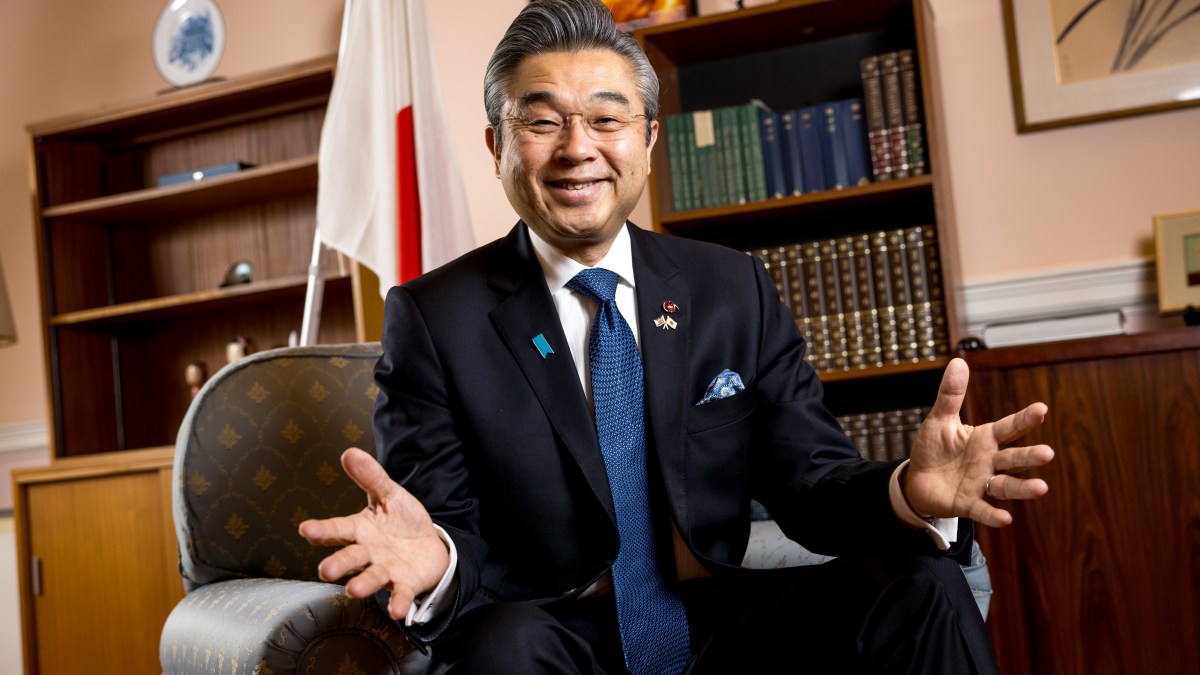
At the peak of her powers, Margaret Thatcher’s presence in a room was once compared to the Higgs Boson particle: people clustered around her wherever she went.
I observed a similar phenomenon when Hiroshi Suzuki, the Japanese ambassador to Britain, walked into the Labour Party conference last month. Eyes turned. Newspaper editors jumped up to shake his hand. Whispers went round: “That’s the Japanese ambassador.” Suzuki swept by, nodding regally to the gallery. He’d just been chatting to the prime minister.
There are no other diplomats, not even our moneybags American overlords, who provoke this kind of enraptured response from our political class. So why him?
Since his arrival as Japanese ambassador in November last year, Suzuki has become a phenomenon. His enthusiastic peregrinations around Britain have become a rare glimpse of sunlight amid the gloom of social media. Suzuki has downed pints of Boddington’s Bitter with Andy Burnham in Manchester (“By ’eck, it’s gorgeous” he enthused), tried Ma Boyle’s “Scouse” stew in Liverpool (“that’s boss scran”), drank Vimto, devoured buttery crumpets and, most famously, taught himself the Welsh national anthem. One newspaper called him the “Paddington Bear of diplomats”, so now he usually takes a stuffed Paddington Bear toy with him on his adventures.
Watch some of Suzuki’s best moments:
Suzuki’s lovebombing of Britain has been a triumph of twee. He has turned the wide-eyed, camera-wielding enthusiasm of the stereotypical Japanese tourist into a powerful diplomatic tool, playing the attention economy with a joyful sincerity that has delighted the internet. (“If only our own politicians liked Britain this much” is a common refrain.)
What Suzuki hasn’t done, until now, is given any newspaper interviews. So I feel strangely honoured when I am ushered into a sitting room at the Japanese embassy in central London. With clunking predictability, I manage to breach etiquette by sitting in the wrong seat (“That is the ambassador’s chair,” a mortified press officer informs me) and then here he is, a distinguished 64-year-old Kyotoite, the Japanese ambassador. He appears to have left Paddington in the bedroom.
So how did Suzuki come up with this plan to reinvent the fusty art of diplomacy? He only set up his X feed a few years ago, when he was made ambassador to India in 2022. Upon his arrival in Britain, there was some “trial and error” to establish what posts worked (food, football, beer, teddy bears), but his secret weapon, he says, has been love.
“My starting point is to show my affection to the British people as the representative of Japanese people,” he says. “Because Japanese people, they really love the UK. They respect its long history and rich culture, such as football or afternoon tea or Shakespeare or the Beatles. If you go to hotels in Tokyo, it’s fully booked for afternoon tea. I wanted to get that across.”
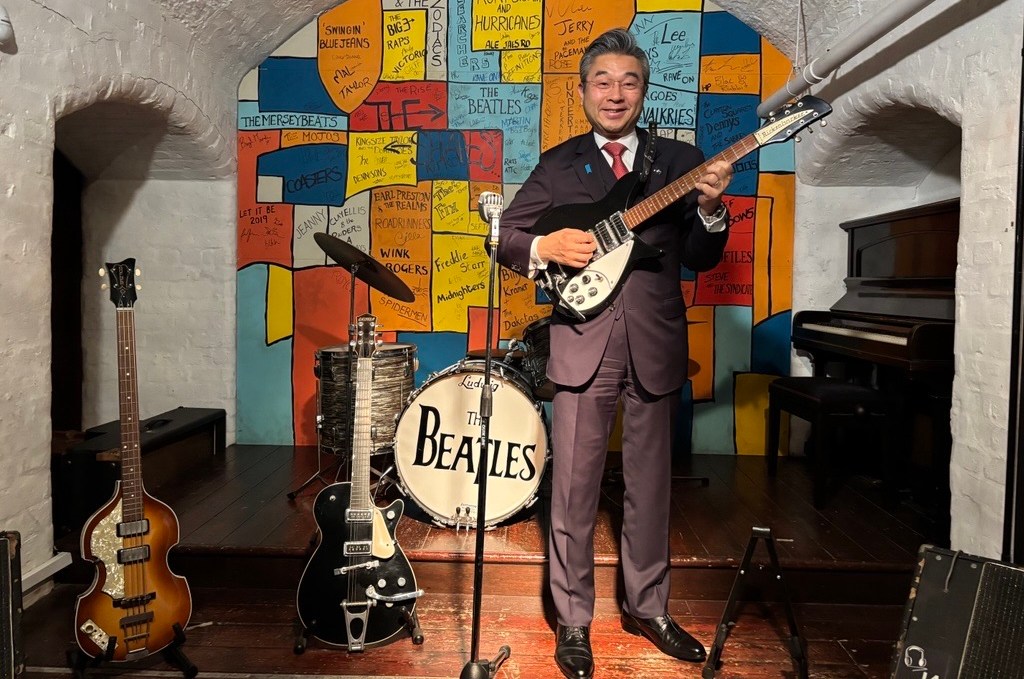
At the Beatles Story Museum in Liverpool
Good diplomacy always works on two levels: knotty transactionalism and fridge magnet symbolism. The latter is softer but also critical, which is why the Windsors remain such a potent British asset and why Suzuki’s pint-downing is so effective. His already famous stint as ambassador to London is the culmination of a long career that has included postings in Rome, Tehran and Seoul. Suzuki also had a short sojourn in Britain in 2012, during the London Olympics, and seems to have bottled some of that era’s buoyant energy.
He’s amazed at how “trendy” Japanese culture has become in the years since. “When you go on a stroll over the weekend, matcha is everywhere,” he says.
“There are so many more Japanese restaurants, you can eat sushi, wagyu beef; the British people love Japanese cuisine and culture. We saw that, obviously, with the sumo event at the Royal Albert Hall. I wasn’t so sure of the reception for sumo. But it was a full house for five days. On the last day, there was a standing ovation. It was just amazing.”
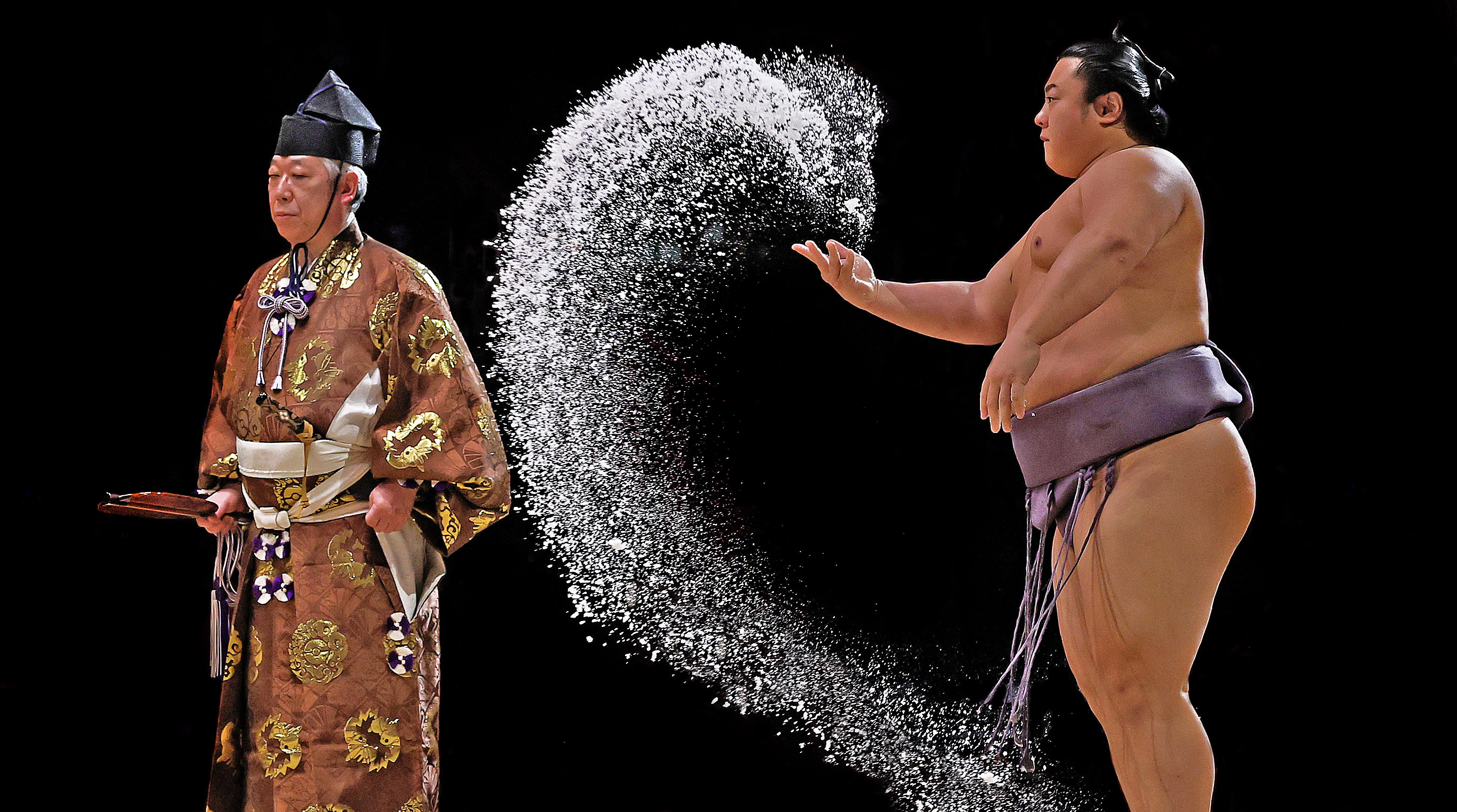
Tobizaru Masaya throws salt into the dohyo at the Royal Albert Hall
SUNDAY TIMES PHOTOGRAPHER MARC ASPLAND
His own passion for British culture takes the typical form of a sixtysomething middle-class bloke. He loves football and “used to be a Chelsea supporter” until he became ambassador; now he supports all teams with a Japanese player. He’s a Queen fan. Favourite album? “I like all their albums.”
Naturally he’s a Top Gear fan too. “Sometimes I can catch replays of the traditional Top Gear,” he says. “With Jeremy Clarkson. My wife and I are huge fans of Jeremy. The last time we were here in the UK, our car navigation voice was Jeremy’s voice. It was so funny. It was not just the voice, but also the character. So when I ignored an instruction more than once, then the voice navigation goes dead for the next five minutes because Jeremy was so cross.”
He’s partial to a bit of Shakespeare and has taken his wife Eiko to see Much Ado About Nothing in Stratford-upon-Avon. And his soul was fired by a recent trip to the Lake District. “I visited the Wordsworth House where he wrote many poems,” he says. “You know, 10,000 daffodils dancing. It’s just amazing. So it was my moment to read Wordsworth poems.”
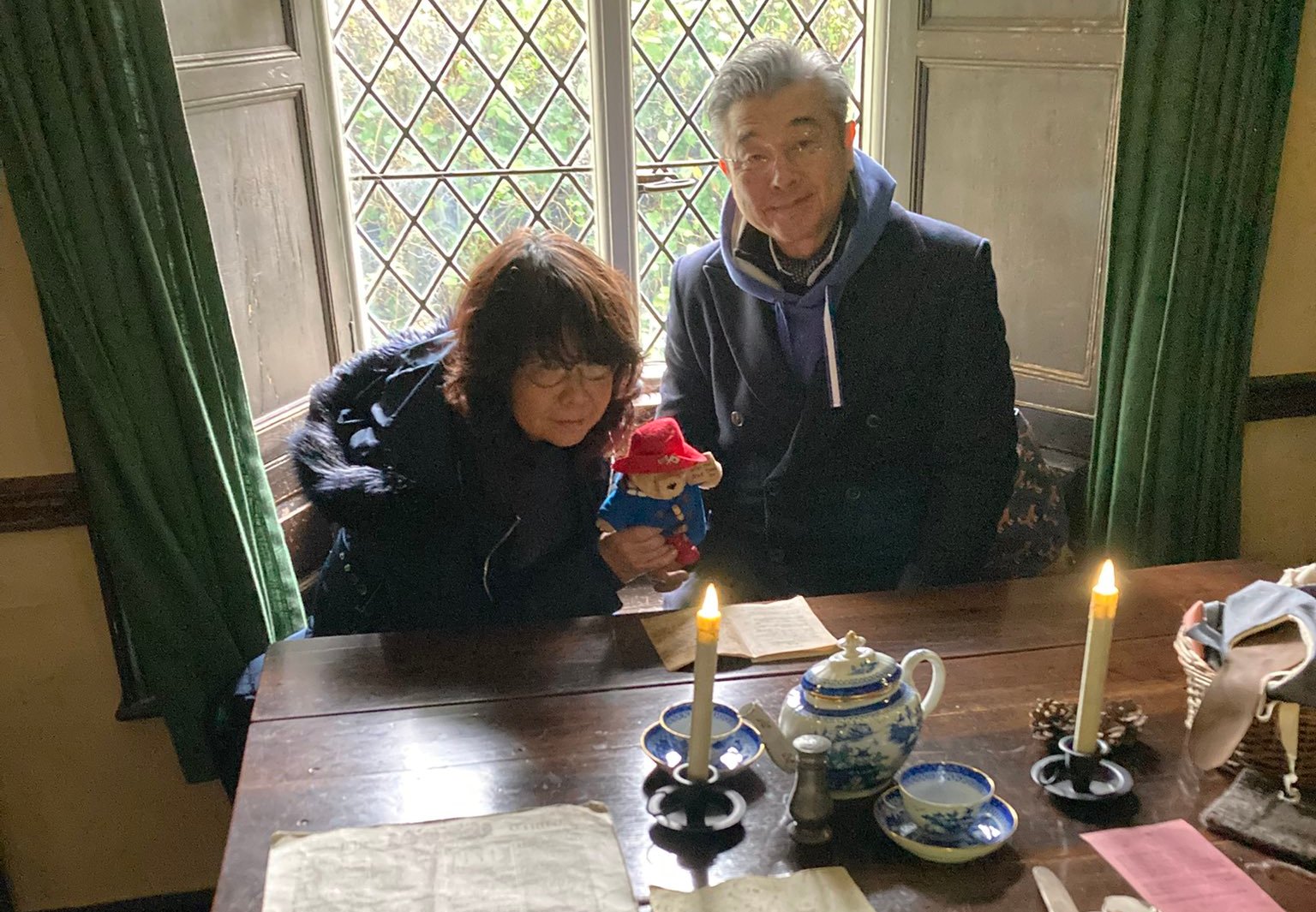
At William Wordsworth’s home in the Lake District with his wife
NOT KNOWN, CLEAR WITH PICTURE DESK
I know I’m being played a bit here: he’s deploying our great poets — Shakespeare, Wordsworth, Clarkson — to charm me, but the tune is irresistible. And behind the schmaltzy bonhomie also lies a sharp political mind. A Foreign Office veteran tells me Suzuki is an impressive operator who was sought out by David Lammy, when he was foreign secretary, for advice on how to approach Donald Trump. (The president was a close friend of Suzuki’s mentor, Shinzo Abe, who was Japan’s longest-serving prime minister.)
Suzuki spent almost a decade as political secretary to Abe, who was assassinated in 2022. “We were very close,” he says. “He was a visionary leader. So we tossed many ideas around. He fought for the ideals that he wanted to realise, but at the same time, he was very warm, very engaging. I really enjoyed serving for prime minister Abe.”
Another Abe protégée is Sanae Takaichi, who has just become Japan’s prime minister. “In world outlook they are very close,” says Suzuki. “Takaichi-san really admired prime minister Abe. And she followed in his steps.” She’s also the first woman to rule Japan. “It’s a huge deal. Japan finally broke the glass ceiling!”
Takaichi is also an avowed fan of the Iron Lady. “Margaret Thatcher is an iconic political leader that she really wants to learn so much from,” Suzuki says. “She wants to make the Japanese economy strong again. That means proactive government spending but in a responsible way, bearing in mind this fiscal discipline.”
Takaichi has had a “rocket start” over the past week, meeting President Trump on his Asian tour. Trump complimented her “very strong” handshake and called her a “delight”, promising a “golden age” in US-Japanese relations.
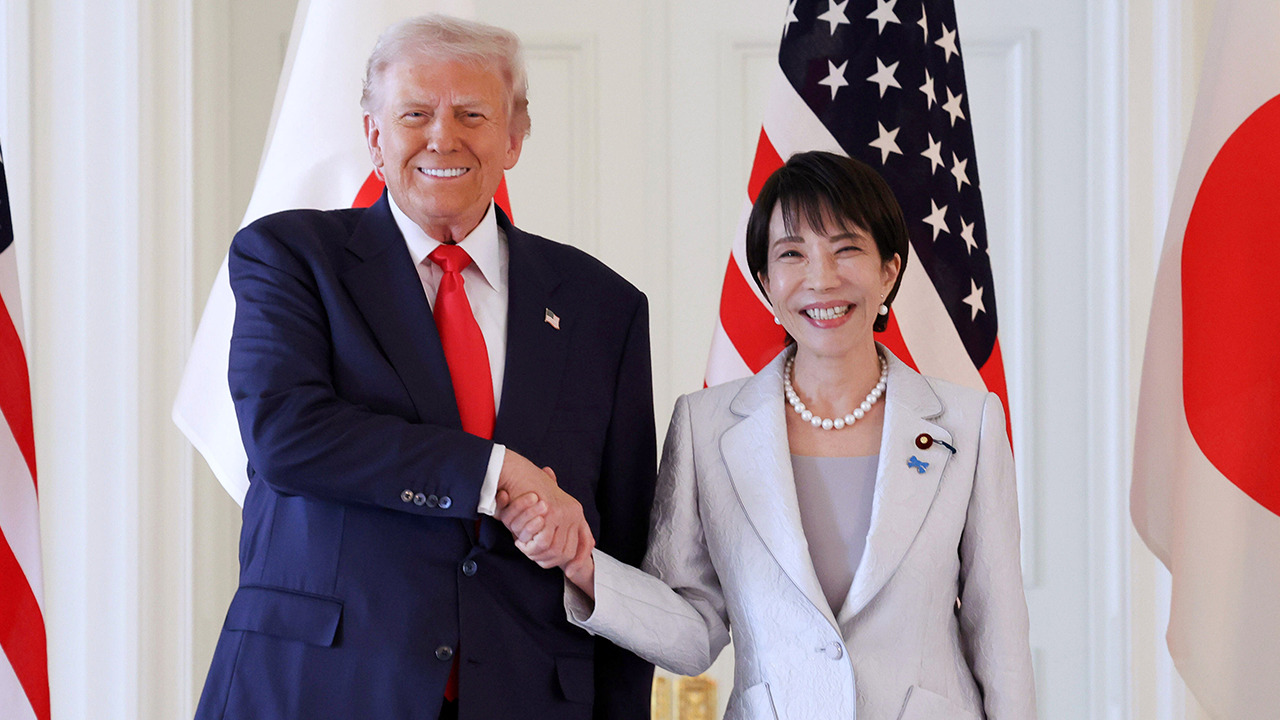
Sanae Takaichi met President Trump in Tokyo last week
However things work out with the US, Anglo-Japanese relations are certainly in their own golden age, comparable to the high point of the Thatcher era. For all their many differences, our venerable old nations find themselves in very similar positions: two middling island powers, wealthy but stagnant, navigating a dangerous world of US-Chinese competition and Russian aggression.
“The partnership between the UK and Japan is critical in preserving and nurturing the rule of law,” Suzuki says. “Russia has invaded Ukraine in a flagrant violation of international law. So Britain is really playing a key role, spearheading assistance to Ukraine. At the same time, Japan is providing £10 billion of assistance to Ukraine.”
Suzuki also thinks we can learn from Japan on the tricky issue of how to deal with China, its hulking neighbour. “Japan learnt the hard way the importance of economic security,” he says. “What’s important is that we have a trusted supply chain. And to have a trusted supply chain, we need trusted partners like Britain. It’s impossible to sever economic relations 100 per cent with China, so what we need is de-risking.” He points to rare earth deals that Japan has struck with Australia and Malaysia, reducing its dependence on Beijing, as an example.
All of which leads me to my final, most important question: how on earth did he learn the Welsh national anthem? “Oh, it was very tough. Very tough. I had to practise many, many times. Many times.”
Having mastered Hen Wlad Fy Nhadau through a series of YouTube tutorials, Suzuki posted a video of himself singing it and holding an obligatory red dragon. “I was in a cold sweat,” he recalls. “When I agreed to it I didn’t know what I was getting myself into. The accent is so difficult.”
Still, he pulled it off. The video is comic but also a masterful and generous act of diplomacy. “Any great partnership, like the strategic partnership between UK and Japan, must have an emotional underpinning,” Suzuki explains. “For those British people who come to love Japan, Japan will be their partner for life.” With his canny marriage of style and substance and unceasing barrage of good vibes, we could all learn a thing or two from the Japanese ambassador.