
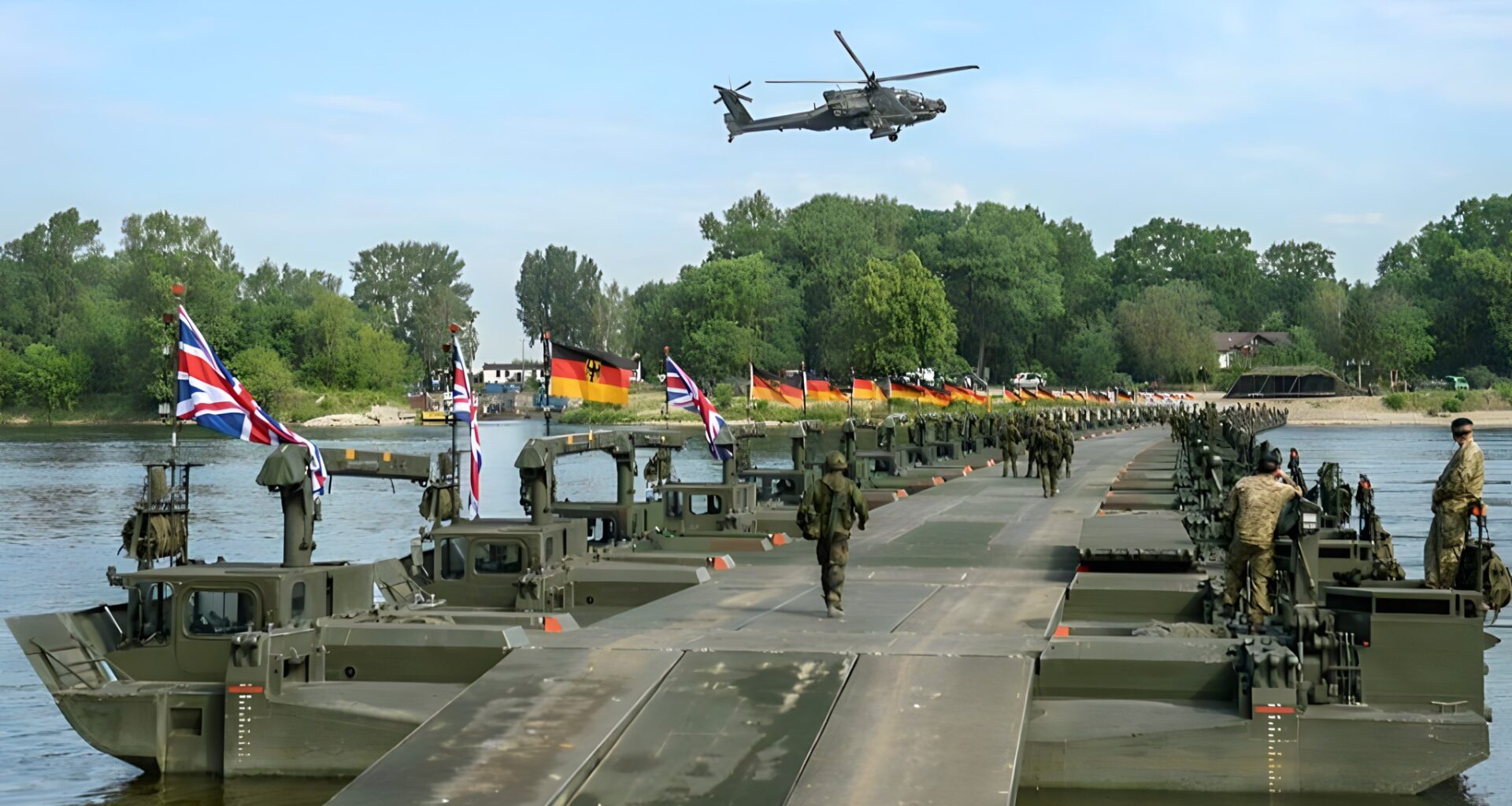
The United Kingdom and Germany have signed a major contract for next-generation military bridging equipment in a deal worth £200 million, reflecting what the Ministry of Defence describes as a deepening defence partnership between the two countries.
The agreement will deliver 36 M3 EVO amphibious bridging vehicles to the British Army, produced by General Dynamics European Land Systems (GDELS) in Germany, with Germany also purchasing several units under the joint contract, according to the Ministry of Defence. The vehicles will allow troops and heavy armour, including tanks and artillery, to cross rivers or other water obstacles by forming floating bridges or ferries.
The deal builds on the 2024 Trinity House Agreement and follows recent steps to expand UK-German cooperation, including the Kensington Agreement signed in July 2025. The equipment will replace the M3 Amphibious Rig, which has been in service for about three decades, with the new systems expected to enter service in the early 2030s.
Minister for Defence Readiness and Industry Luke Pollard MP said in the press release that “this world-leading new system will better equip the British Army, helping our troops to be more effective on the battlefield.” He added that the project “delivers on the Strategic Defence Review’s ambition to transform our Armed Forces as we face this new era of threat.”
Pollard said the initiative “fulfils both countries’ commitments as allies to work together to provide robust bridging capability for NATO forces, in line with the Strategic Defence Review’s NATO-first approach.”
The M3 EVO will be capable of carrying all current and future British Army land systems and will operate as part of the joint UK-German Amphibious Engineer Battalion based in Minden. The Ministry of Defence said the system represents a major modernisation step for the Royal Engineers, improving mobility and interoperability with NATO partners.
The contract also opens export opportunities for UK industry. Germany plans to purchase the British-made General Support Bridge (GSB), produced by KNDS UK in Stockport, which supports around 300 jobs. The GSB can form a 46-metre bridge in under 90 minutes, able to carry NATO’s heaviest tanks, including the Challenger 3, according to the Ministry of Defence.
Colonel Adam Foley, the British Army’s lead for Military Engineering Capability, said in the press release that “this is an excellent example of close collaboration between the UK and Germany. This contract award further strengthens the Trinity House Agreement and the United Kingdom’s NATO commitments delivered through the multinational 130 Pioneer Battalion in cooperation with Germany.”
He added that “military bridging is the bedrock of successful operations” and the new systems “will enable the UK to maintain operational advantage by allowing commanders the freedom of manoeuvre they require on the battlefield.”
The Organisation for Joint Armament Cooperation signed the agreement on behalf of both governments. UK National Armaments Director Rupert Pearce said the contract “superbly demonstrates what modern warfighting readiness looks like, with British and German forces using top-quality NATO-standard equipment, UK industry exporting innovation, and our two nations standing together against the threats we face.”