
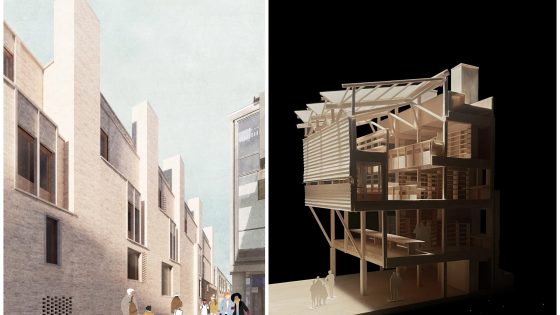
The 2021 Stirling Prize-winning practice proposed an extension to Christ’s College involving the demolition of the current 1970s library building and its replacement with a new library, social and study space, as well as alterations to the college’s kitchen, Upper Hall and toilet provision.
Christ’s College was founded in 1505. The oldest parts of its library were completed by 1515 and further extensions were added in the 1730s, 1950s and 1970s — the latter by architect and Cambridge lecturer Christophe Grillet.
The four-storey scheme features a timber structure and stretches along Christ’s Lane, where its façade would have ‘a rich mix of stone and brick and the rhythmic play of chimney stacks’, according to the Dublin-based practice, founded by Yvonne Farrell and Shelley McNamara.
The scheme divided residents’ views, eliciting both an opposition campaign called Christ’s Lane Action Group, which sparked 65 objections, and a petition in support with 57 comments backing the development, which were lodged with the council over the summer.
Concerns centred on the size and style of the new building, which some feared would turn the street into a ‘canyon’ with overly large chimneys and a ‘fortress-like’ appearance.
Following a comments from Historic England, the height of the chimneys was reduced, alongside other changes accommodating suggested amendments.
Despite this, the campaign group reiterated its opposition to the application, arguing that the ‘minor reduction in chimney heights’ did not address the fundamental concern over the overall mass of the building and its effect on its historic surroundings.
The planning officer ultimately concluded that the provision of the new, accessible library facilities, as well as improvements to the performance of the site, outweighed the ‘less than substantial harm’ to nearby heritage assets, such as the Grade I-listed Bodley Library. Councillors on the planning committee voted on Wednesday (29 October) to approve the application. However, the decision was split, with four in favour and two councillors voting in opposition.
The new library will be entered from the ground floor through an entrance hall with the main stairs, library reception desk and lift access. The ground floor also has a student study hub and a multi-faith prayer room.
General study spaces are distributed throughout the three upper library floors, with voids allowing light down to the second and third floors. The upper floor has been designed as a a ‘sky gallery’, with a pleated glazed roof featuring an expressed timber structure.
The scheme will enlarge Bath Court, a small courtyard outside the current 1970s library, with the entrance tucked under overhanging space created by the building’s increased mass at upper levels.
Grafton’s proposed interventions also include enhancements to the Upper Hall dining area, including the removal of the current suspended ceiling to expose the historic timber roof structure. The Upper Hall will connect to the new library at the first floor, with a glazed opening between the two.
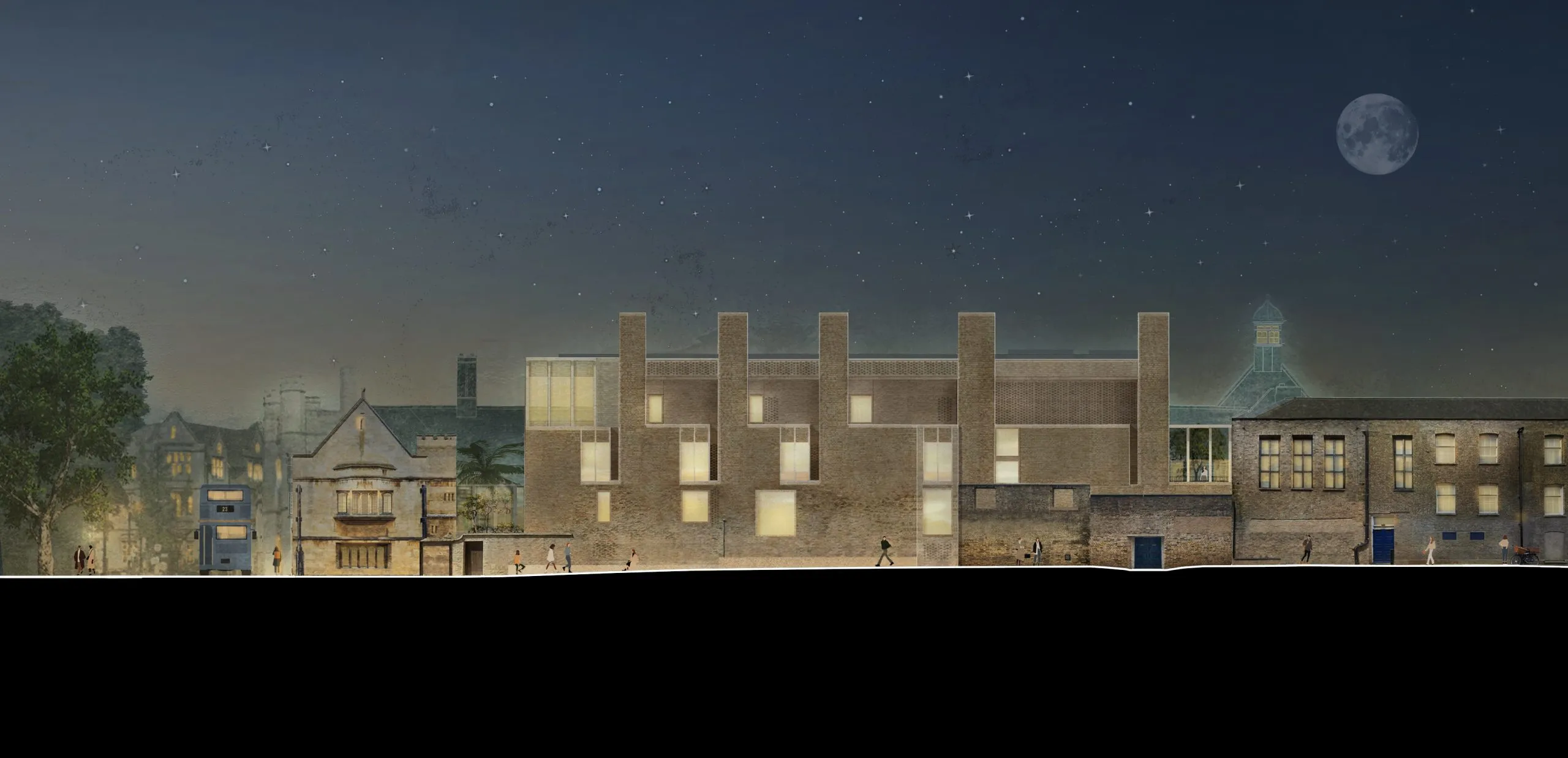
Proposed Christ’s Lane elevation (June 2025)
Upgrades also include new openable double-glazed window casements to be inserted into the Upper Hall’s retained timber frames and mullions, as well as a thermal upgrade and acoustic panelling added to the roof.
Grafton said its design for chimney stacks as part of the façade was ‘very much in proportion with a broad range of historic precedent that we examined locally’ but added that the stacks were ‘directly connected with the approach to sustainability’.
The chimneys will be used to draw fresh air in and replace internal air to control temperature in the new library reading room, the height and width of the stacks increasing the draw of air.
Grafton’s planning application replaces a previous scheme for the site drawn up by Rick Mather Architects. This was granted planning permission in 2011 and again 2016 but was never taken forward.
Work on the latest scheme is expected to start on site in 2026.