

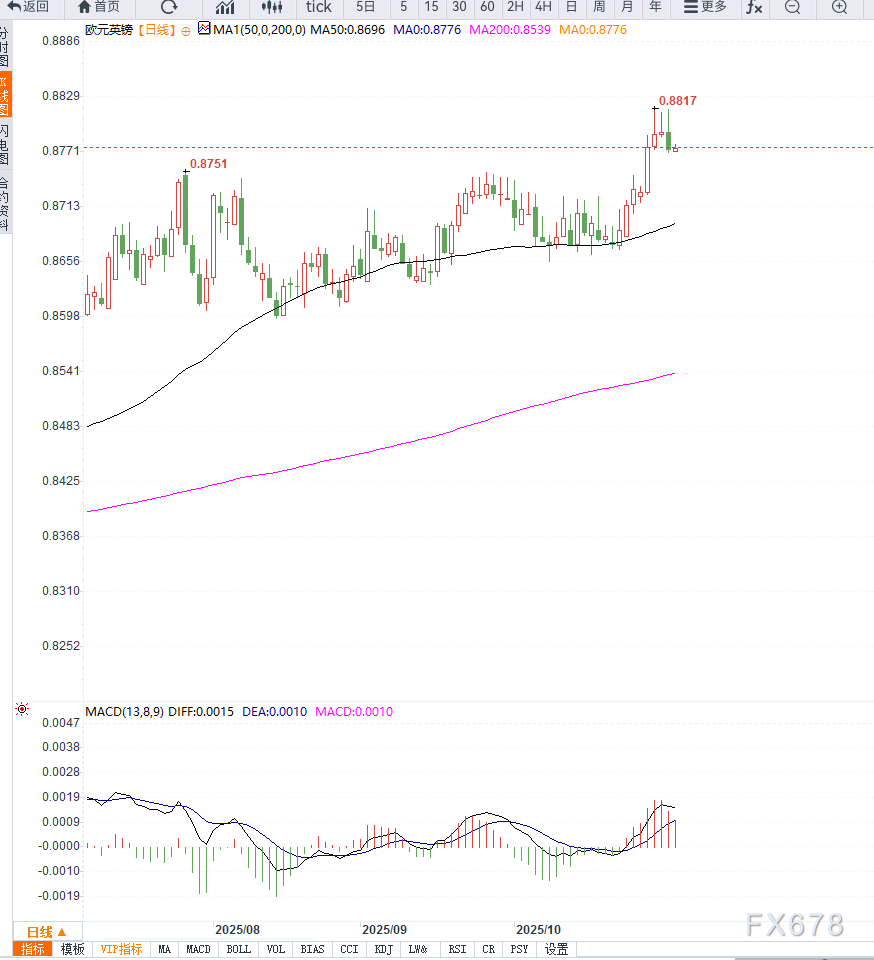
The euro extended its upward trend against the pound on Monday during the early European session, with trading prices hovering around 0.8775. The market sentiment was weighed down by political and fiscal uncertainties in the UK, pressuring the pound to decline.
UK Chancellor of the Exchequer Rachel Reeves is facing dual political pressures from Parliament and within her party. Investors are concerned that the upcoming autumn budget report may include tax hikes and fiscal tightening measures, potentially dampening economic growth expectations.

Some market analysts believe that if fiscal tightening is too aggressive, the Bank of England (BoE) may initiate an interest rate cut cycle earlier than expected, lowering rates from the current 4.0% to 3.75%.
 UK economic analyst Jonathan Clark stated, “Uncertainty surrounding fiscal policy has undermined investor confidence, and the details of the autumn budget will determine the market’s judgment on the medium-term trajectory of the pound.”
It is widely anticipated in the market that the Bank of England will maintain the current interest rate unchanged at its Thursday rate meeting, primarily due to persistently high inflation levels. Policymakers prefer to assess their next monetary policy move after the release of fiscal policy measures.
Meanwhile, the European Central Bank (ECB) maintained its deposit rate at 2.0% for the third consecutive time at last week’s meeting. ECB President Christine Lagarde emphasized, “The central bank is currently in a favorable position and will take all necessary measures to sustain this state.”
In addition, Joachim Nagel, a member of the ECB Governing Council, stated on Monday that the latest economic data in the Eurozone is broadly consistent with the central bank’s forecasts, but policymakers remain flexible to address potential risks.
In France, Finance Minister Sébastien Lecornu will hold closed-door discussions with lawmakers this week in an attempt to reach a consensus on budget issues. According to market surveys, if budget negotiations fail and trigger a vote of no confidence, the French government could face dissolution risks, potentially leading to snap elections.
A European political researcher noted, “If the fiscal deadlock in France persists, it will exert phased pressure on the euro.”
Editor’s View:
In the short term, the upward movement of the euro against the pound is primarily driven by uncertainties in UK fiscal policy rather than improvements in the Eurozone’s internal fundamentals. If the UK’s autumn budget turns out to be as tight as the market fears, the pound may continue to face downward pressure. However, political risks in France could exert counter-pressure on the euro in the medium term, keeping the EUR/GBP exchange rate in a volatile pattern.