
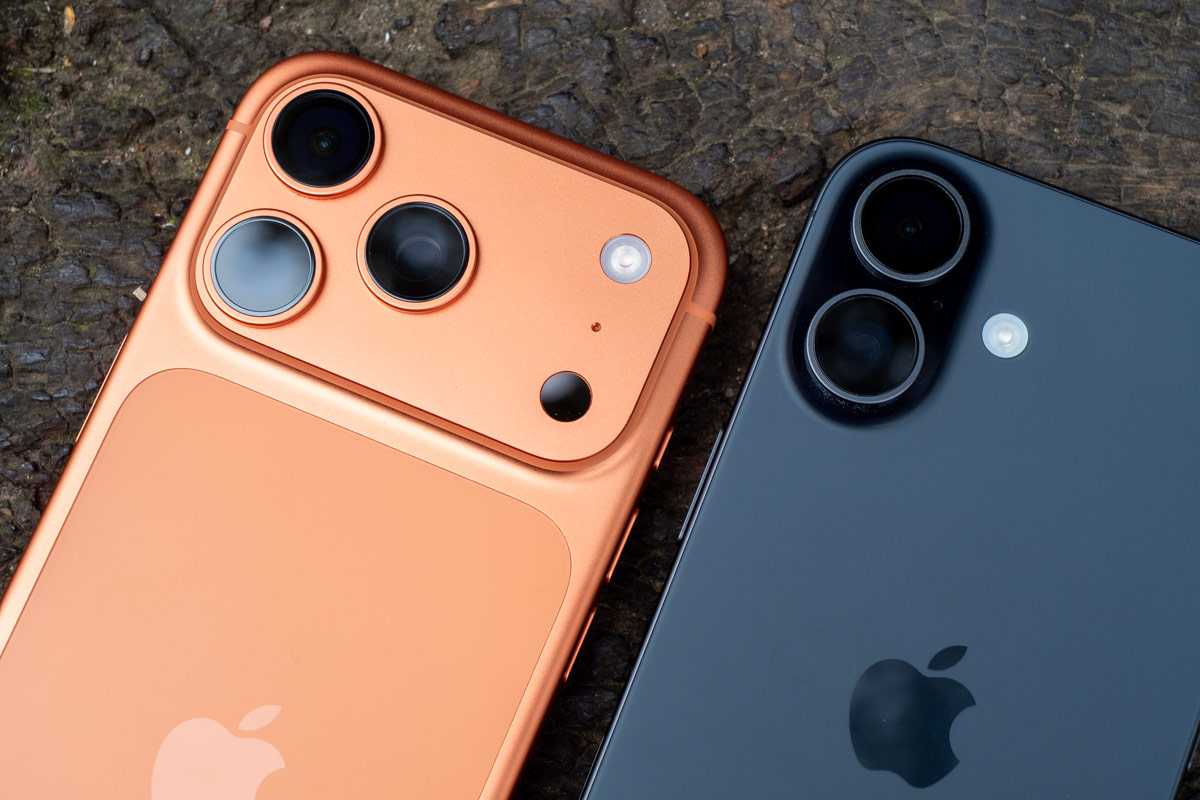
It’s fair to say that both the iPhone 17 Pro and the iPhone 17 are very much at home on our list of the best smartphones for photographers.
Apple has been making phones which are excellent for photography for some time now – but considering there are several models in the line-up, it begs the question, do you really need the most expensive, high-end iPhone, or will the “base” model do the job?
Price wise, the iPhone 17 is much more affordable than its “Pro” sibling, while giving you many of the same or similar specifications. Some of the things you’ll be losing out on if you pay the extra for the iPhone 17 Pro you might find you don’t really need – but here we’ll take a closer look at how the two match up to give you a better idea of how they compare.
I’ve been using both models at the same time to see how they stack up in different scenarios – and to try and determine whether you actually need to spend that additional cash or not.
iPhone 17 Pro vs iPhone 17: Specs
Have a look at the table below. Here I’ve outlined some of the major specifications, particularly those that are likely to be of interest from a photography standpoint.
You’ll see that actually, the two models have a reasonably similar spec sheet. The main difference highlighted here is the lack of a telephoto lens – with the iPhone 17 Pro you’ll enjoy a 4x optical zoom lens which also gives you 8x “optical quality” zoom too.
Not everybody will be bothered about having a zoom though – if you own an older model which has a zoom lens, ask yourself how often you use it. My own personal experience tells me that I’m pretty sure I could live without it, especially if my budget was tight.
iPhone 17 ProiPhone 1748MP f/1.78 main camera, OIS, 24MP output, 24mm48MP f/1.6 main camera, OIS, 24MP output,26mm48MP f/2.2 ultrawide camera, 24MP output, 13mm48MP f/2.2 ultrawide camera, 24MP output, 13mm48MP f/2.8 4x telephoto camera, 100mm, 8x “optical quality” cropN/A18MP f/1.9 selfie camera with square sensor18MP f/1.9 selfie camera with square sensorHEIF, JPEG, raw (DNG) stills HEIF, JPEG stills 4K 120fps video4K 60fps video6.3-inch XDR OLED Super Retina 2622 x 1206 pixels, 3000 nits max brightness, 120Hz Ceramic Shield 2 front and back6.3-inch XDR OLED Super Retina 2622 x 1206 pixels, 3000 nits max brightness, 120Hz Ceramic Shield 2 front onlyIP68 splash, water and dust resistantIP68 splash, water and dust resistantApple Intelligence, A19 Pro ProcessorApple Intelligence, A19 processor31 hour battery life, wireless and fast charging (40W) available30 hour battery life, wireless and fast charging (40W) available256GB/512GB/1TB storage256GB/512GBstorage150 x 71.9 x 8.75mm, 204g149.6 x 71.5 x 7.95mm, 177g
Another difference is the ability to shoot in the more flexible “raw” format. This gives you scope to adjust your images after you’ve shot them in a bit more fine grain detail than you can with an ordinary HEIF or JPEG file. But again, I pretty much never shoot in raw on my phone – so could I live without it? Absolutely.
There’s a slight difference in the main lens – the iPhone 17 Pro has a 24mm equivalent focal length, while the iPhone 17 has a 26mm. In most scenarios this is going to be largely unnoticeable.
Both models offer 4K video recording, but the 17 Pro has far more advanced features. It can shoot at 120fps (compared to 60fps for the iPhone 17), and also offers ProRes video recording, Genlock support and Apple Log 2. Most average users will never need to use these tools, but if you’re a content creator you may find them to be very useful.
Elsewhere there are some other differences, such as a slightly better battery life for the iPhone 17 Pro, a better processor (which affects the speed of the phone’s operation – something which is really only likely to be in any way noticeable if you’re doing high-intensity tasks such as gaming or editing 4K video), and the ability to buy the iPhone 17 Pro in a 1TB option.
There are some design differences too. The iPhone 17 Pro has the new camera “plateau” while the iPhone 17 sticks to a more straightforward / classic design. There are different colours available for the two models – personally I actually prefer those you get with the iPhone 17, but the iPhone 17 Pro’s vivid orange colour certainly is striking.
Both phones have the same 6.3-inch screen, and they both have the same specification too – the same brightness, refresh rate and “always on” capability. Both have a Ceramic Shield front, but only the 17 Pro has it on the back too. They’re very similar in size to each other, but the 17 is a little lighter.
It’s worth noting that you can get the iPhone 17 Pro in the “Max” version too – giving you a 6.9” screen. There’s no “Plus” option for the iPhone 17 as there has been in previous years, so if you want a big phone, then you’re out of luck if you also want it to be cheap.
The iPhone 17 Pro has the faster A19 Pro processor, while the iPhone 17 has the still new, but not quite as fast, A19 processor. This will likely make little difference to most ordinary users – but anyone who is doing a lot of power intensive tasks, such as gaming or shooting/editing 4K video may find some benefit to having the faster option.
Battery life between the two isn’t dramatically different, with Apple quoting only one hour less of video playback for the iPhone 17.
iPhone 17 Pro vs iPhone 17: Image Quality
I used both phones to take photos in a number of different situations to give me the opportunity to directly compare both models. In the examples below, the image taken with the iPhone 17 Pro is always on the left, the iPhone 17 is always on the right.
GENERAL-1X LENS

 1x main lens, iPhone 17 Pro (left), iPhone 17 (right). Image credit: Amy Davies
Here we can see that the both models produce fairly similar results, with excellent colour rendition and detail from each. The 1x lens for the iPhone 17 has a slightly narrower field of view (26mm) compared to the iPhone 17 Pro (24mm). Personally, I prefer 24mm, but it’s unlikely to make a huge amount of difference in most situations.
ULTRAWIDE

 Ultrawide lens, iPhone 17 Pro (left), iPhone 17 (right). Image credit: Amy Davies
Again, the two pictures here are almost identical, which is exactly what I’d expect. Detail and colour rendition are great from both.
2x

 2x lens, iPhone 17 Pro (left), iPhone 17 (right). Image credit: Amy Davies
The 2x option from both models uses the central portion of the 1x sensor
4x

 4x zoom, iPhone 17 Pro (left), iPhone 17 (right). Image credit: Amy Davies
Here is where we see the iPhone 17 Pro pulling ahead of the iPhone 17 a lot more clearly. The result from the 17 Pro is crisp and full of detail, which is what we’d expect from an actual zoom lens, rather than a digital zoom. The 17’s 4x option is just about usable if you’re only looking at it at small sizes, but if you’re at all interested in zoom, this may not be the phone for you.
8x / 10x

 8x zoom iPhone 17 Pro (left), and 10x zoom iPhone 17 (right). Image credit: Amy Davies
Again, there’s a much clearer divide here. The iPhone 17 Pro’s 8x “optical quality” image is very good, showing a decent amount of detail and it’s certainly very usable. Meanwhile, the 17 image is a bit of a blurry mess at this point.
MACRO

 Macro, iPhone 17 Pro (left), iPhone 17 (right). Image credit: Amy Davies
The close-up images from both devices look remarkably similar. Both use the ultrawide lens which is the same on both models so that’s hardly a surprise. I can see no difference here, so if macro is your thing then these two phones are evenly matched.
LOW LIGHT PERFORMANCE

 1x main lens in night mode, iPhone 17 Pro (left), iPhone 17 (right). Image credit: Amy Davies
The low light performance from both phones is pretty strong. If we look at images taken by the 1x lens, it’s hard to spot much of a difference. There’s a touch more detail seen in the ultrawide of the 17 Pro, but it’s only if you’re really examining it closely that it’s obvious. There’s also more detail from the “2x” option of the 17 Pro, too.
PORTRAIT

 Portrait mode, iPhone 17 Pro (left), iPhone 17 (right). Image credit: Amy Davies
Although the sitter has moved in between shots (toddlers are like that), I can see that the portraits produced are pretty similar – with similar types of outlines. The blurring of the background is pretty good for both and they’ve both coped reasonably well with somewhat fussy outlines.
SELFIE

 Selfie camera, iPhone 17 Pro (left), iPhone 17 (right). Image credit: Amy Davies
As I’d expect, the selfies are pretty much identical – that makes sense considering the selfie cameras on both models are the same.
iPhone 17 Pro vs iPhone 17: Value for Money
Coming in at under $800/£800 for the 256GB option (and I would argue most people don’t need more than that), the iPhone 17 is a great value option (for an iPhone at least).
It’s perhaps expensive compared to some similar Androids, but if you’re locked into the Apple ecosystem, or just prefer the operating system then it’s a very good way to get one of the latest phones without having to fork out a huge sum of money.
For many people, the iPhone 17 is likely the better choice – you get a lot of similarities without the added flashiness (and cost) of the 17 Pro.
But what do you get for the extra £300? Well, you get an extra lens, a faster processor, a better battery life, and – arguably – a more interesting design (although personally I much prefer the colours available for the 17). There’s also some other stuff like advanced video options and the ability to shoot in raw format.
I reckon I could live without the zoom lens – it’s fairly rare that I use it – and the other stuff while nice to have wouldn’t be a deal breaker for me. I could definitely live without the video and photo stuff that I never use, but, everyone’s different – and you may have your own different feelings about that.
Overall, I’d say that the iPhone 17 represents better value for money for most ordinary users – but if you’re in need of the added benefits that the 17 Pro provides, £300 extra isn’t a ridiculous amount to ask.
Verdict
If you’re asking yourself should I buy an iPhone 17 Pro or an iPhone 17, what you need to do is consider what use you’d get out of the extra features that the extra $300/£300 the Pro model will get you.
The Pro is undoubtedly a better phone, with some worthy additional features that may – or may not – be of use to you depending on the type of phone user that you are.
Most of the time, the 17 and the 17 Pro take very similar pictures. The 1x and the ultrawide lenses on both are pretty evenly matched. As I’d expect, the zoom is much better on the iPhone 17 Pro model, but, if you’re anything like me, it’s something that is used fairly infrequently anyway (you might be nothing like me and use it all the time – no judgement).
On the whole, I’d say most people should probably opt for the iPhone 17 if you just want a well rounded phone that takes nice pictures. Of course, if you need its advanced features and the telephoto lens, then paying an extra $300/£300 to get it is probably worth it.
Which one would you opt for?
Related reading: