
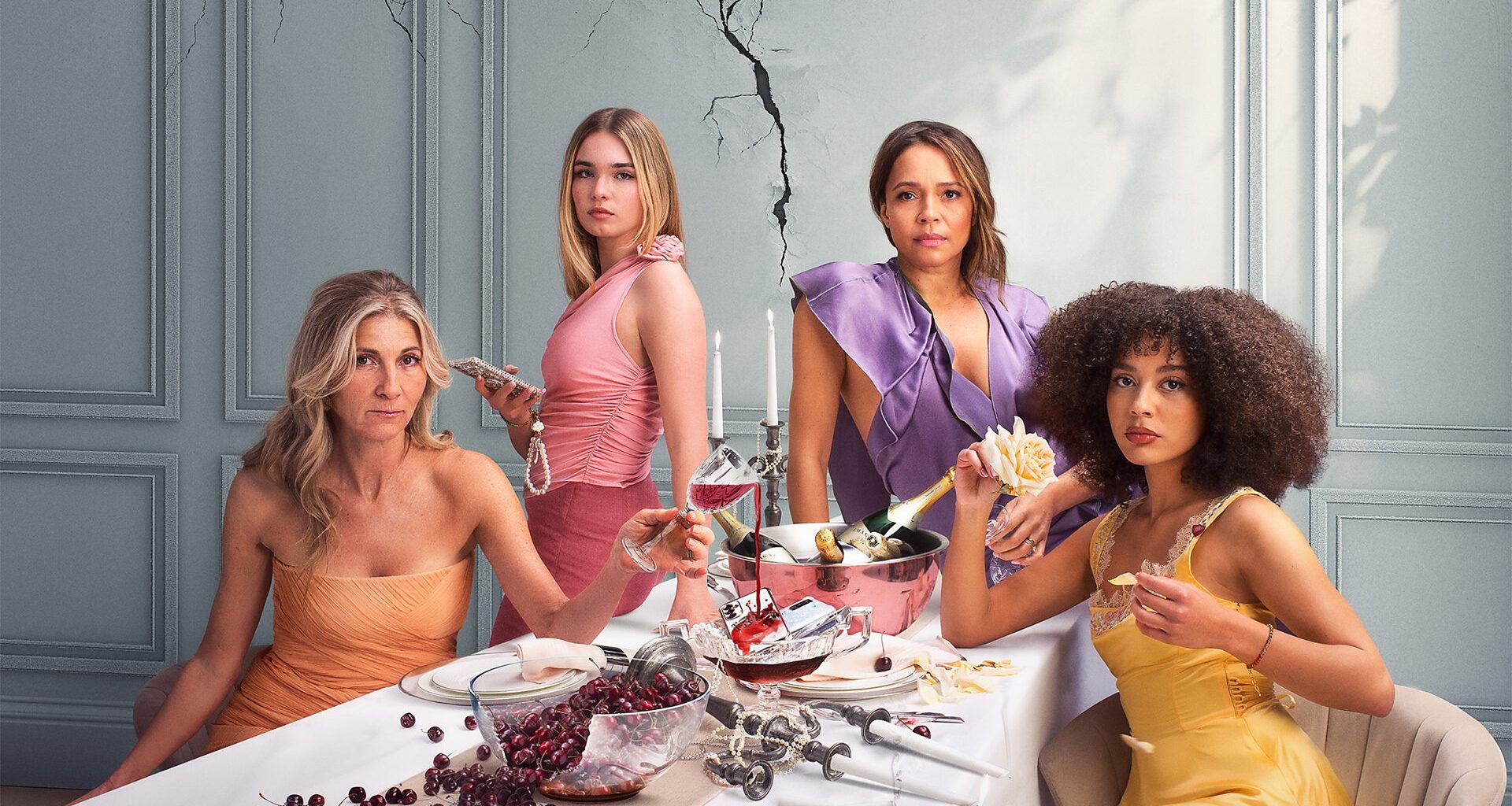
Published: 6 November 2025
(Image: BBC Studios/Lesley Edith)
In Richford Lake things appear perfect for super-mum Juliet (Eve Best) and business mogul Lorna (Carmen Ejogo), but when their teens Grace (Imogen Faires) and Allegra (Amelia May) are accused of a shocking scandal at their exclusive private school, toxic secrets and lies ripple throughout the community.
Wild Cherry is coming-of-age drama for both mothers and daughters as they navigate privilege, power and social media. “Like mother like daughter” rings loudly in a complex world, where danger and betrayal is never far from the surface – even in a perfect town.
The cast also includes Sophie Winkleman (Peep Show, Sanditon), James Murray (Masters of the Air, The Crown), Nathaniel Martello-White (I Hate Suzie, Guerrilla), Jason York (Mood, Dreaming Whilst Black), Isabelle Allen (Les Misérables, Find Me in Paris) Catriona Chandler (Rivals, Enola Holmes 2) and Tara Webb (Phoenix Rise).
wildcherry@multitudemedia.co.uk
Nicôle Lecky (Showrunner, plays Gigi)
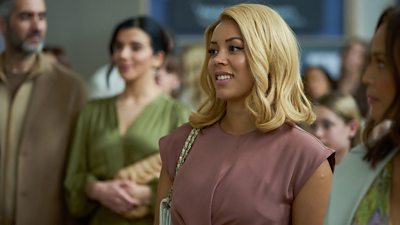
Gigi (Nicôle Lecky)
What is Wild Cherry about?
Wild Cherry is about mothers and daughters. When a scandal happens in their prestigious school, these mothers and daughters turn against each other in the town. There’s a lot of mystery and intrigue.
What inspired you to write Wild Cherry?
One of the reasons I wrote Wild Cherry is because I used to drive through this private gated community in Surrey. There are a few of those places, and I would look at these beautiful homes and mansions and think, “Who lives there?” So, I really wanted to tell a story about towns like this. I felt like we hadn’t seen this side of England before. I also knew I wanted to explore mothers and daughters and their relationships. And I thought, what better place to do it than in a town where people have so much access to privilege, wealth, and money, and yet they’re still faced with the same issues. So that was my inspiration and the jumping-off point.
Tell us about your writing process. Where do you start?
I think my writing process for this show started with a nugget of an idea. For me, it’s all about story and characters. Once I had an idea in my head of who these mothers were, who the daughters were, and what kind of themes I wanted to explore, the story just comes to you. Then you start fleshing it out. I wrote a pilot script, discussed it with the team, and then built out the whole series arc. I knew I wanted a thriller element to the drama, that it had to say something but do so in an entertaining way – and with music and fashion feeling important. It’s always having blue-sky thinking, and then it’s about finessing, honing what you want to say, and juggling all those elements together.
How has it been working as a writer, executive producer, and actor? How do you juggle all that?
I think maybe it’s not as unique anymore, but being a showrunner, writing and executive-producing the entire series is already a big role.
To make it even more fun (or harder!), I was also acting in the show, playing Gigi. It’s a lot. You’re focused on what the other cast are doing, what they’re wearing, having meetings with the director about production design, locations etc so it’s all-consuming.
But I’m so passionate about the story, the show, and the women in the show. You have your late nights, but hopefully it’s all worth it and people love the show.
Freddie Gladstone (John Marquez) and Gigi (Nicôle Lecky)
What do you want audiences to feel or take away from watching Wild Cherry?
What was key for me was just telling a story and letting the audience come to it naturally. For me, nothing in the show is linear. None of the women are bad. None of the women are good. They make terrible decisions and choices and I think that’s realistic in the modern world we live in, whether it’s because of social media, female friendships, or other pressures.
There’s often this sense that women are railing against each other, but as the show progresses, you start to realize they’re actually railing against the establishment. There are external forces putting pressure on them.
The question is: Can you ever really overcome or overthrow that? Can you push back against that kind of oppression?
By the time you get to episode six, the women make choices that raise questions: Were they pushed to it? Was it always within them? That’s for the audience to think about.
What’s been your favourite detail from Wild Cherry?
The houses are stunning and so perfect for the characters. That was really important to me.
One detail I love is what I call “cross-pollination” when characters you don’t usually see together have scenes. For example, when Juliet and Grace interact, or when Lorna has scenes with Allegra. I love it when the mothers aren’t just talking to their own daughters. It adds complexity and makes those scenes feel like a real treat.
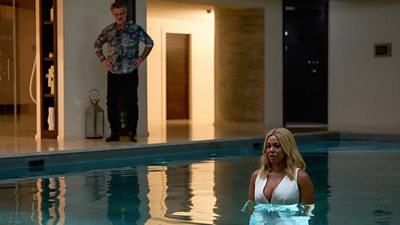
Also, one of my favourite moments is the pool scene at Gigi’s house. It’s this amazing floor that turns into a pool. I’m standing on it, and it lowers into water and then I’m just standing in the swimming pool crying. It’s tragic comedy, really. But it’s also a great representation of the wealth in this world.
Carmen Ejogo (Lorna) & Imogen Faires (Grace)
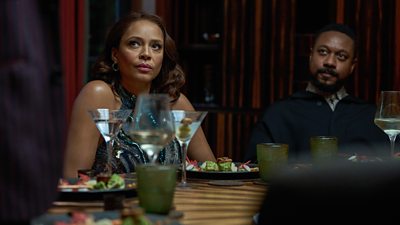
Lorna Gibbons (Carmen Ejogo) and Steven Gibbons (Nathaniel Martello-White)
Tell us about Lorna and Grace’s relationship. Where do we find them at the beginning, and what happens between them?
Carmen: Ooh, Grace is in trouble.
Imogen: Yeah, straight away.
Carmen: It’s a moment of tension and surprise – because she’s normally a very good girl. Or Lorna thinks she is. She’s always expected the best from her. There’s a lot of pressure on Grace to be excellent.
Imogen: That mindset got us to where we are. And Grace has learned not just from what Lorna says, but from what she does. It’s about action.
Carmen: And Lorna put Grace in a very exclusive school, thinking it’s the best for her. But it actually makes her feel like a fish out of water. She’s one of the few kids of colour there. It’s tricky. Grace finds a fast friend in Allegra, someone Lorna doesn’t necessarily approve of. As with many mother-daughter relationships, especially with teens, there are secrets. Lorna has secrets she’s keeping from Grace that directly affect her life.
Imogen: Yeah. And in their relationship, that tension exists – something always just under the surface, not talked about.
Carmen: Those truths are exposed as the story unfolds. Lorna is quite shut down in some ways, even to herself, to preserve a sense of control and excellence.
Imogen: She’s denied certain parts of herself – and of Grace. Her past, her identity. But she’s forced to reveal more over time.
Carmen: That unravels how much (or little) they truly know about each other. But it also shows their deep bond.
Do you think Lorna and Grace are similar or different – or a bit of both?
Carmen: Similar in dress sense, sometimes!
Imogen: That’s true!
Carmen: Lorna still has a sense of mystery – maybe even something a little scary – and that comes through in Grace too.
Personality-wise, Grace is ambitious. And that’s what gets her in trouble. She sees the money, the potential to rise above expectations – and that’s very much my story too, growing up working class in London.
Imogen: But I think the difference is… Grace hasn’t experienced not having things. There’s an expectation for Grace, but she’s still quite ignorant of what it means to come from less. There’s even a moment where Grace complains about not going on the same holidays as her friends – even though they’re still going somewhere amazing. It shows she’s been protected by Lorna.
Carmen: It’s complicated. Lorna has given Grace both aspiration and luxury, but also reminded her, “Don’t get too used to it.”
Carmen: It’s that classic dynamic of someone who came from nothing telling their kid, “You don’t know how easy you’ve got it.”
Imogen: But Grace doesn’t relate to that. She hears it but can’t truly understand unless she’s lived it. That’s where they’re different.
Carmen: Depends on the generation. I think younger viewers will relate to the way characters express themselves – whether that’s sexually, emotionally, or through their identity.
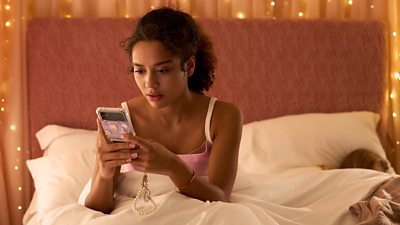
Grace Gibbons (Imogen Faires)
What makes this show unique or important?
Carmen: I think audiences will relate to a lot of subtle themes they haven’t seen much on TV – especially the experience of being Black and British in an aspirational world.
Carmen: Grace and Lorna’s stories reflect a very specific, but very real, experience – being upwardly mobile in England. We often see a polished version of that on social media, but this show unpacks the complexity of what it really feels like.
Carmen: It reveals specific, textured worlds that aren’t usually portrayed on screen. That’s what makes it special.
Imogen: Definitely. There are a lot of little things people will connect with – whether it’s about family, identity, friendship, or finding your
What’s your favourite detail from the show?
Carmen: One of my favourite details of the show is the houses that the women live in.
They match almost like a handbag to the woman in the show. Each woman has her own handbag vibe, you know? I’m a bit of a sort of Loewe kind of girl. And then there’s… I think Gigi is a Chanel girl?
There’s something quite specific about that. I love that Lorna is always in her earrings. That’s a very particular detail that works for me, getting into character.
Imogen: My favourite detail is the phones in the show. All the teenage characters have similar but different phones. Like Grace has a flip phone. It’s very “business mode activated.” And we have little details, like our initials on our phones.
In the friendship group – the Bad B’s Do It Better group – we all have similarities, especially Allegra and Grace, which really shows how tight they are. Even down to their pearl phone wrist chain.
Eve Best (Juliet) and Amelia May (Allegra)
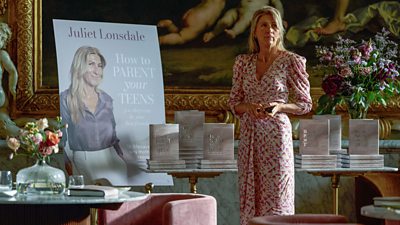
Juliet Lonsdale (Eve Best)
Tell us about Juliet and Allegra.
Eve: They have a very complicated relationship. Allegra can barely be in the same room frankly, but Juliet is desperate for her love, attention, anything.
Amelia: And I think deep down at the beginning of the show, Allegra does really crave her mother’s validation. But I think also that’s kind of underneath layers of teenage resentment and fractures. I think at the beginning of the show, her closest relationship is with her best friend. And as things move about, this bond grows stronger out of necessity.
And do you think that Juliet and Allegra are very similar? And maybe that’s why they clash, or they’re completely different?
Eve: I feel they’re very similar. There’s a line, in fact, that Juliet has, when she says, “You’re so like me. It’s terrifying.” I think that’s something quite recognizable for a lot of mothers and daughters. And that is part of the reason that that particular relationship is always so complicated. I don’t have a daughter, but I am a daughter, I recognise that sort of strange thing of seeing yourself in your child. It’s like they’re like your soulmate, but also your nemesis.
Amelia: I think at the beginning of the show in particular, they are quite similar, that’s also why there is the friction. They’re both trying to present their best selves at all times, so they’re not being their true selves, as you see in the world of social media.
Eve: That’s very interesting. They live in a world where they’re both on display. In their particular circles, they feel the need to be the perfect girl or the perfect woman. They’re privileged; they seem to have it all. Deep down, though, they very much don’t feel like they have it all.
Do you think when people watch this, they might relate to some of these themes?
Eve: Yes, I think so, I hope so. I think that all mother -daughter relationships are relatable, aren’t they?
Amelia: They’re complicated and different. I hope people don’t relate to our relationship too much, particularly the beginning. But I think people will be able to see themselves.
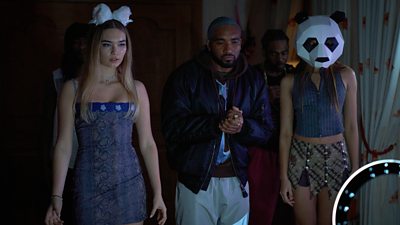
Allegra Lonsdale (Amelia May) and K Rizz (Jason York)
Have the amazing houses and costumes transported you into this community, this lifestyle, this world that these two characters are in? How has that helped?
Amelia: Some of the houses were absolutely ginormous. They’re huge. And that really feels like you’re just like walking in as if you own these places because the characters do.
Eve: They wanted the Lonsdale House to be really fabulous, so we ended up filming in about four different places to represent one house.
Amelia: No one house could live up to the style of the dream Lonsdale house. And for the costumes, I feel even just how, I never have nails on, and just having the nails, I was like, ooh! I feel like Allegra.
And then final question, do you think we learn anything from each other throughout the series?
Amelia: I would say that they learnt a lot together. Through all that they go through, they are both pushed to discover more about who they are themselves and through that, realise that they need each other more than they initially thought.
Eve: Exactly. I think they grow together, and that friction, the resistance between them, is somehow soothed by the events of the story. Something seismic between them shifts, and they’re able to start a new way of being with each other – both feeling their way. But the wall that has kept them apart, built from a whole host of things that are both understandable and often familiar, has come down.
Follow for more