

Photo courtesy of devoteam.
Opinions expressed by Digital Journal contributors are their own.
When most people think of Ocado Retail, they picture the sleek delivery vans or the company’s pioneering automated warehouses. Yet behind the scenes, the UK’s largest online supermarket is working on something equally transformative, preparing its workforce for an era defined by artificial intelligence.
Ocado Retail, a joint venture between Marks & Spencer Group and Ocado Group, has long been associated with innovation. From early warehouse robotics to algorithmic logistics, technology has shaped nearly every part of its operations. Now, as generative AI begins to reshape how people work, the company is focusing on what it can do for people.
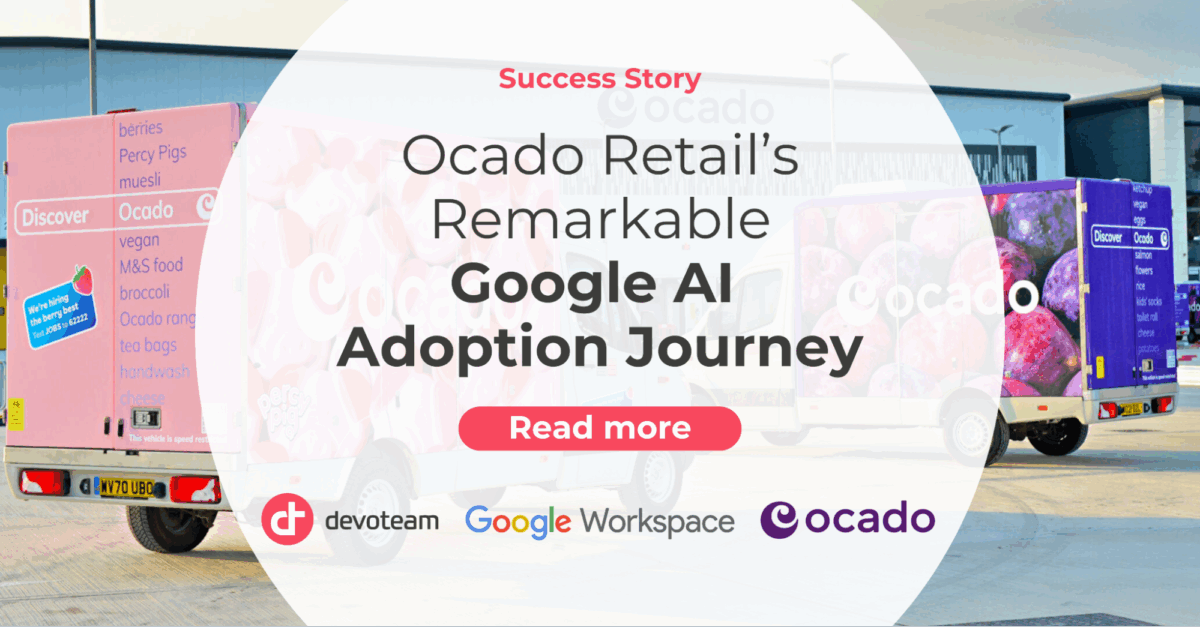 Photo courtesy of devoteam.
In late 2023, Ocado Retail began experimenting with Google’s Duet AI for Workspace, launching a small internal trial with 50 employees. The aim was to understand not only how the tools could improve productivity, but also how staff could interact with and integrate them across workflows. Early success led to an expansion in 2024, as the pilot evolved into Google’s Gemini platform and rolled out to more than 200 employees.
The company partnered with Devoteam UK, a Google Cloud partner with expertise in enterprise AI adoption, to help design a roadmap for implementation. Rather than focusing solely on software deployment, the collaboration centered on how teams could integrate AI into daily tasks in ways that genuinely improved workflows. That included workshops, tailored use cases, and guidance on change management — the often-overlooked human side of digital transformation.
By the time Google Workspace with Gemini was introduced more broadly, Ocado Retail had built a foundation for AI readiness across departments. Today, over 1,500 employees use the tools regularly, integrating features such as summarization, drafting, and data analysis into routine work. The results have been measurable in terms of time saved, but more importantly, they’ve advanced how teams think about problem-solving and collaboration.
For Kieren Johnson, Head of IT at Ocado Retail, the shift has been as much cultural as technological. He describes the company’s goal as not merely adopting new tools, but integrating AI into daily routines in ways that help teams think differently about their work. That focus has helped the company embed AI not as a one-time upgrade, but as an ongoing capability.
Devoteam’s consultants played a supporting role, working alongside Ocado Retail’s internal teams to translate complex technology into practical application. Their emphasis on hands-on learning allowed employees to experiment safely and discover where generative AI added the most value. It also revealed areas where automation was less effective, reinforcing the idea that human judgment remains essential even in AI-assisted environments.
The experience offers a useful snapshot of how large enterprises can manage AI transformation responsibly. Rather than racing toward automation for its own sake, Ocado Retail’s approach has been incremental and data-informed. It treated AI adoption as a journey involving experimentation, feedback, and iteration instead of a wholesale replacement of human processes.
As retailers worldwide explore how generative AI might reshape operations, Ocado Retail’s story stands out for its balance. It demonstrates that the real competitive advantage may not lie in the tools themselves, but in the readiness of the people who use them. The company’s methodical rollout, rooted in learning and adaptation, shows that building trust in AI starts with building understanding.