
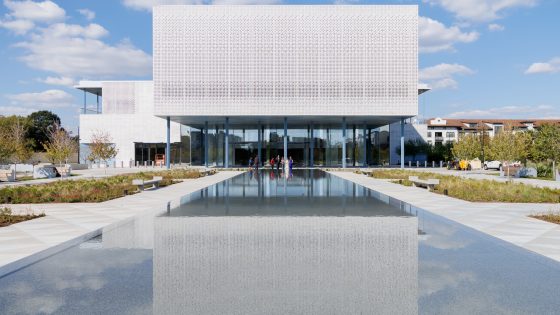
The London-based architect – working with AKT II, Nelson Byrd Woltz Landscape Architects and local practice DLR Group – won the Ismaili Centre project in early 2019 after being chosen from a star-studded shortlist which included David Chipperfield Architects, Studio Gang and OMA.
The stone-clad building, which references historic Persian design, is the first such centre to be built in the US and the seventh worldwide – each designed by leading architects.
Moussavi’s scheme occupies part of a 4.5ha site – the remainder given over to gardens – overlooking the Buffalo Bayou waterway at the junction of Montrose Boulevard and Allen Parkway in central Houston.
As well as providing a 1,100m² prayer hall (jamatkhana) and headquarters offices for the US Ismaili community, the building will host concerts, plays, exhibitions, conferences, seminars, book launches and community gatherings.
The centre houses a café, a 600-seat social hall, a 125-seat ‘black box’ theatre. education space and a parking garage for nearly 600 cars.
Houston is home to one of the largest Ismaili Muslim communities in the US. The branch of Shi Islam has around 15 million members worldwide and is led by the Aga Khan. The previous Aga Kah, who died earlier this year, founded the Aga Khan Award for Architecture in 1977.
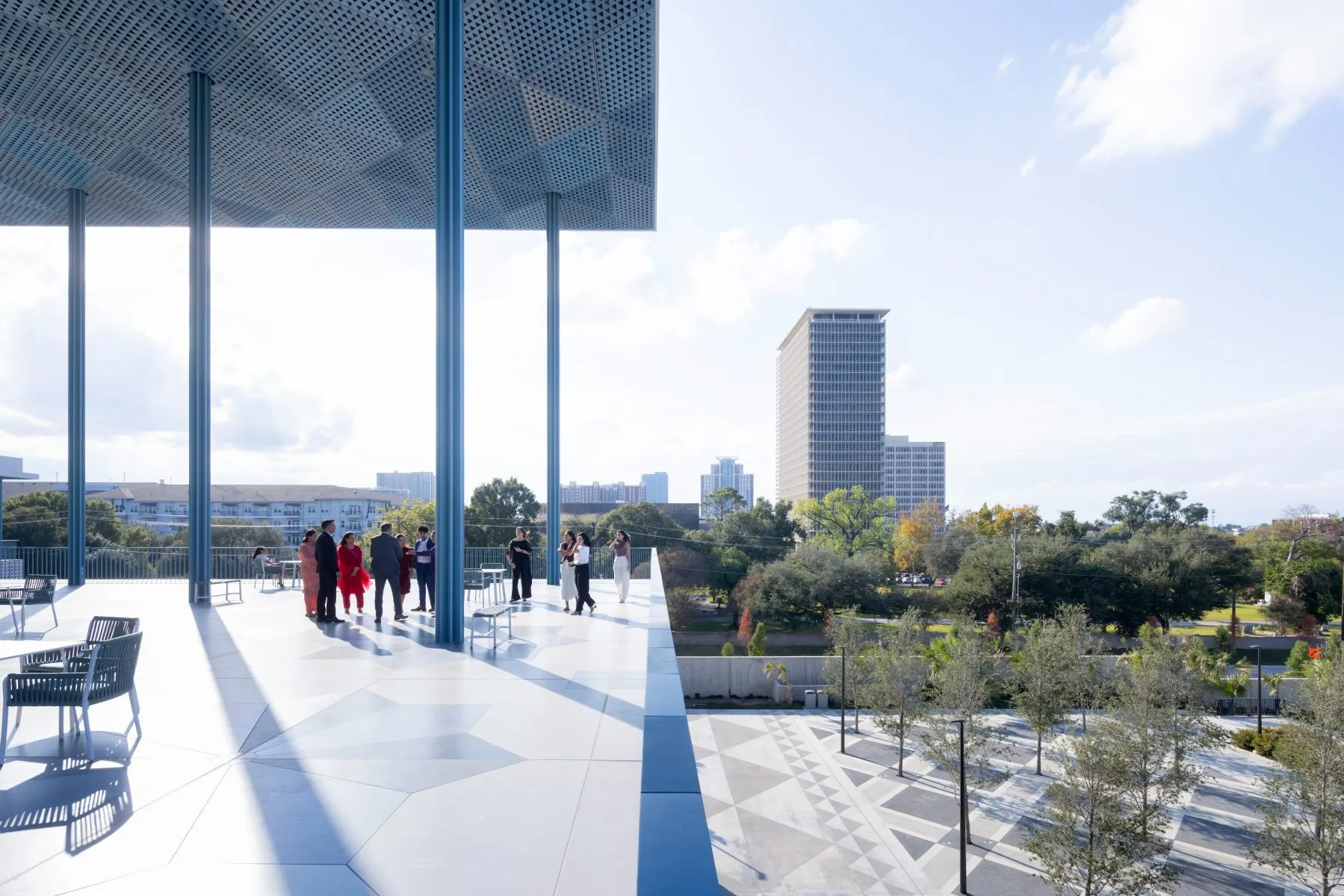
The eivans of the Ismaili Centre create indoor/outdoor connections while providing covered space for year-round social and cultural gatherings.
Moussavi previously chaired the Aga Khan Award for Architecture master jury in 2004 and was a member of the award’s steering committee from 2005 to 2015.
She said that the centre ‘embodies His Highness the Aga Khan’s vision of a space that welcomes all, fostering dialogue, learning, and cultural exchange’.
Moussavi added: ‘Its design, rooted in Islamic traditions yet responsive to Houston’s climate, combines open gathering spaces, light-filled spaces, and intricate craftsmanship to create a serene, inclusive environment that will endure for generations.’
London-based Hanif Kara, director at engineer AKT II, said: ‘From the beginning, the bar was set very high. When you consider the intent and purpose of this project – a 100-year building – it’s very difficult not to see it as something special.
‘Achieving this level of quality requires a bold client, the right team, and extraordinary collaboration.’
The Houston scheme comes 40 years after Casson Condor Partnership began working on the first Ismaili Centre in South Kensington, London. In 2018, Japanese architect Fumihiko Maki also completed an Aga Khan Centre in King’s Cross, London.
Moussavi’s project will officially open to the pubic next month.
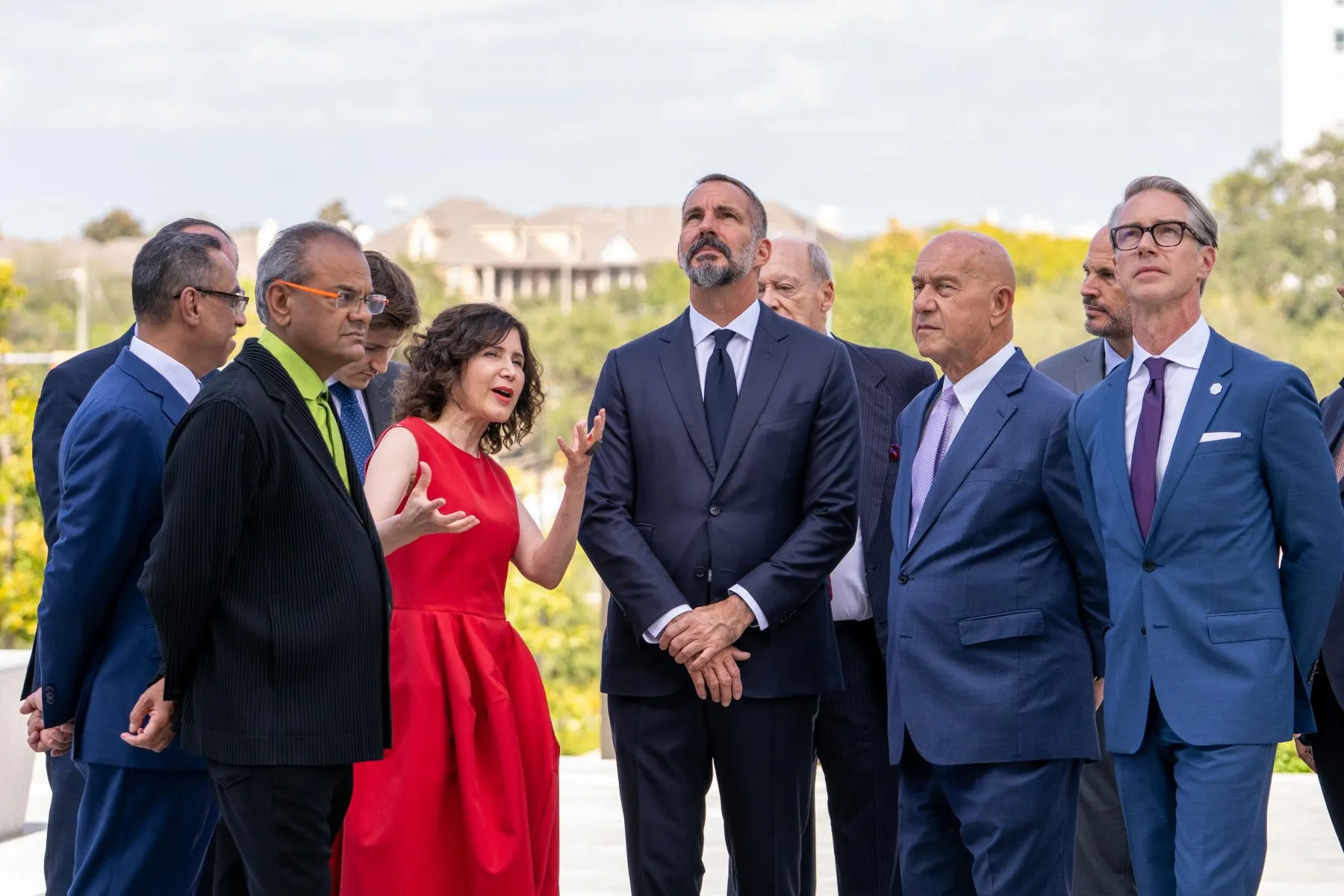
Hanif Kara of AKTII and Farshid Moussavi (pictured left) with Prince Rahim Aga Khan V and Houston mayor John Whitmire
Architect’s view
The building is designed with a compact footprint, leaving large portions of the site to be used as gardens. Given the frequently hot and humid climate of Houston and the prominence of the site in the city, it is designed with a tripartite form with each of its volumes hosting a soaring eivan (veranda) to enable social and cultural gatherings to occur outdoors throughout the year.
The eivans are supported by 49 slender columns reminiscent of those used in Persepolis and 17th-century palaces in Isfahan, Persia. In being open on all sides and visible from all approaches to the site, the eivans will make the Ismaili Centre open and inviting in every direction. At night, they will transform it into a beacon of light along Montrose Boulevard and Allen Parkway.
The scheme’s design, contemporary in its expression, is reflective of a historically rooted, rich architectural heritage. It combines contemporary architectural technology – its light steel structure – with traditional Persian forms and ornament, including ceramic mosaics and screens drawn from Islamicate traditions around the world.
Its design for sustainability includes assuring enhanced energy performance and longevity and durability of materials, by encasing exposed steel with concrete for a 100-year life cycle, and using stone for the building’s exterior walls.
Conceived as a tapestry in stone, the exterior walls will transition from solid areas to porous screens that will provide shade and privacy, and from flat surfaces to deep alcoves to permit shady repose fronting the gardens. The building exterior will therefore be defined by simplicity of form, openness, and an abstract decorative character.
The building interior will include three atriums that will act as common, non-exclusive flexible spaces between rooms dedicated to specific events. Each is located adjacent to an eivan to bring in natural light and views of the sky to the heart of the building. The central atrium’s stepped structure, clad in ceramic screens, celebrates the heritage of the cupola dating back to 3000 BCE, dominant in both the architecture of the Sasanian period in Persia and the Christian buildings of the Byzantine empire.
The west and east atriums will give access to a theatre, a large hall and learning spaces. The landscaped gardens will provide a sense of serenity and peace, offering a respite from its urban surroundings. They will include tree canopies, fountains, shaded footpaths, flowerbeds, lawns and walkways. These will be spaces of solace, providing for the rejuvenation of the mind and the spirit.
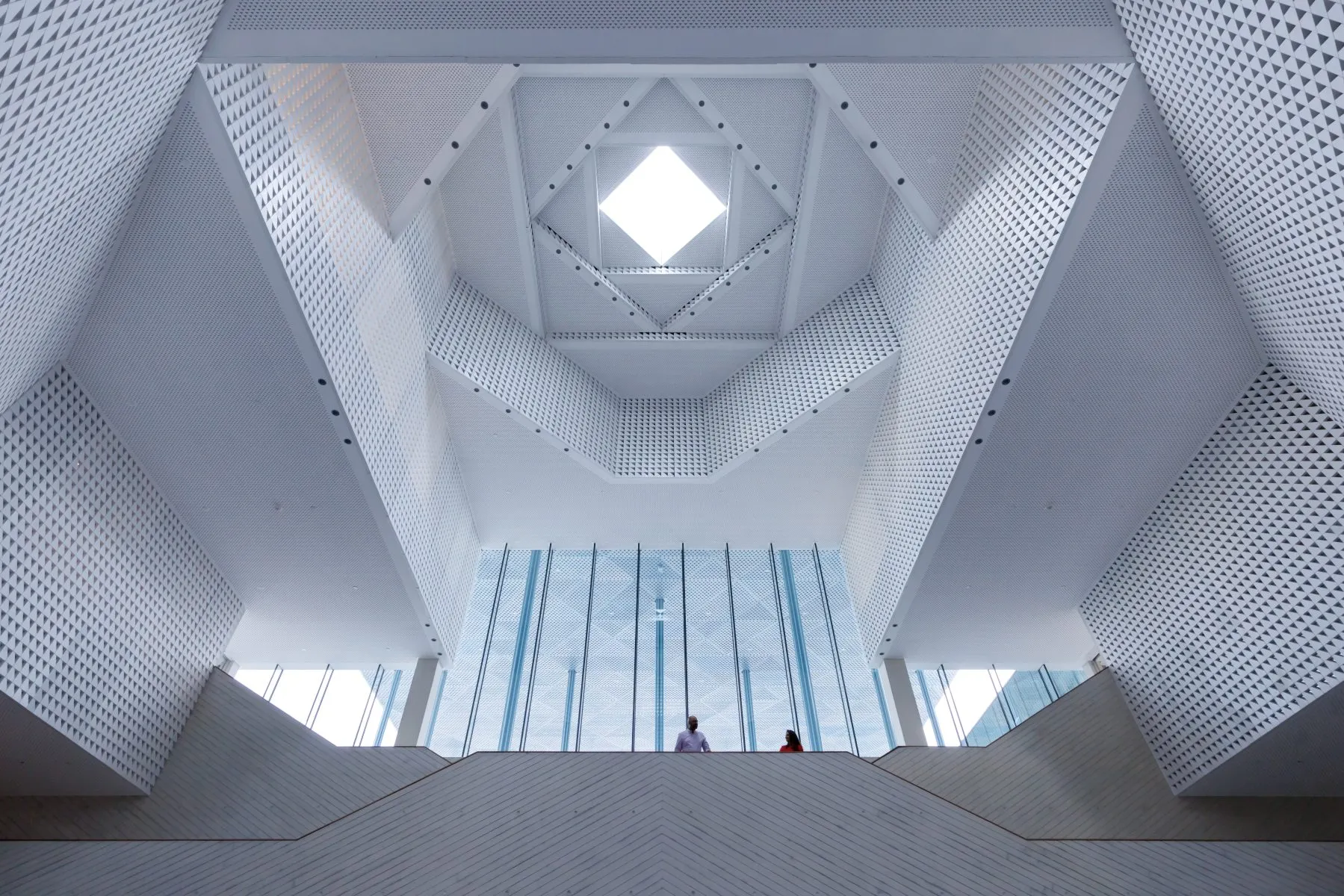
Natural light coming into the central atrium through the windows of the north eivan and the oculus (skylight) at the top.