
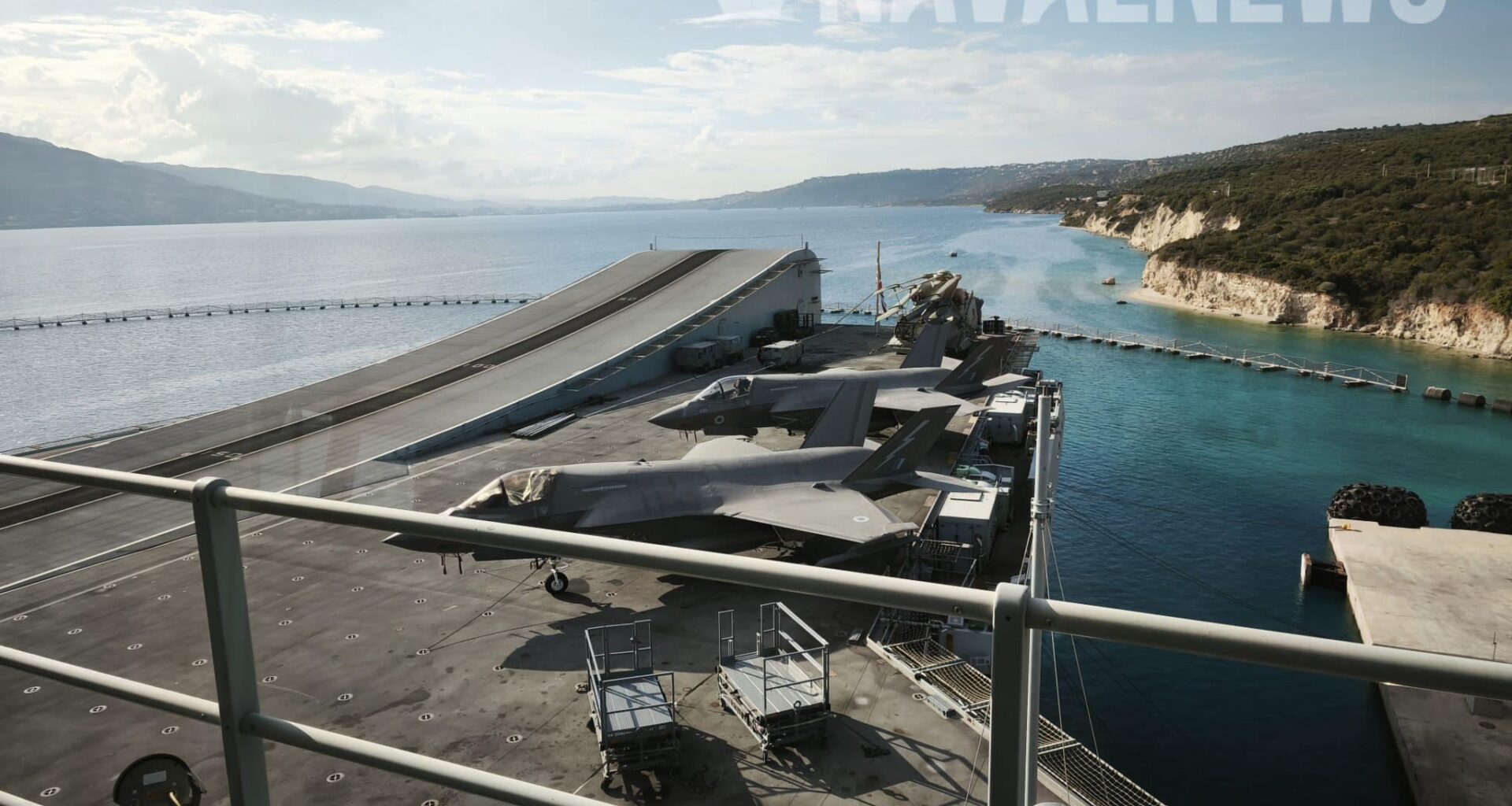
The Royal Navy’s flagship aircraft carrier, HMS Prince of Wales (R09), one of the largest and most advanced warships ever built in the UK, made a port visit to Crete, Greece, on November 1 as part of its global deployment leading the Carrier Strike Group (CSG) in Operation Highmast. Naval News went on board to bring you this exclusive report.
Operation Highmast is a UK-led multinational deployment of the Carrier Strike Group 2025 (CSG25), centered around the aircraft carrier HMS Prince of Wales (R09), designed to enhance the interoperability and preparedness of NATO and allied forces through multinational exercises and operations with air, sea and land forces, throughout 2025 in the Indo-Pacific and Mediterranean regions. The UK’s CSG serves as a significant maritime force capable of projecting power and influence on a global scale. Its goals include reinforcing the strategic capabilities of the UK and its allies and ensuring a coordinated response to global threats, while also strengthening diplomatic and economic ties with partner nations
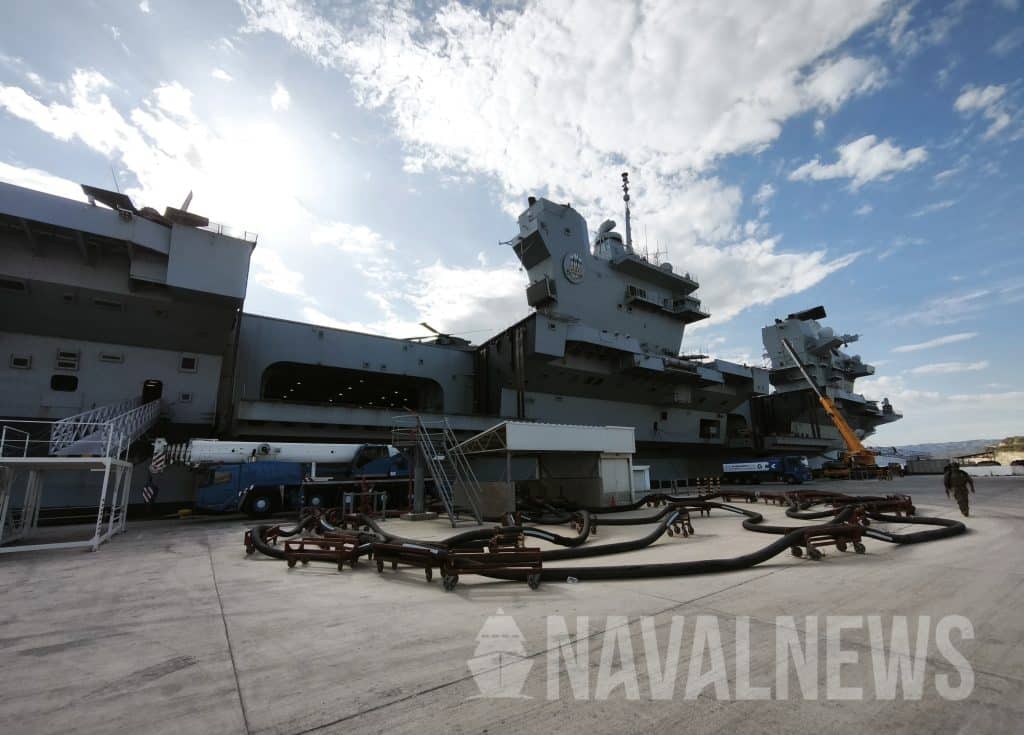
The Royal Navy’s flaghship, HMS Prince of Wales anchored at Souda Bay, Crete, with her signature twin-island layout.
Operation Highmast
Operation Highmast is commanded by Commodore James Blackmore and his staff from aboard HMS Prince of Wales. Commodore Blackmore assumed command of the UK CSG in May 2023. He is the Royal Navy’s senior fixed wing maritime strike fighter pilot, with over 2,500 hours across 3 frontline maritime combat aircraft, has served in eight aircraft carriers, and achieved over 250 deck landings. The commanding officer during the deployment until the Carrier Strike Group reached the Mediterranean was Captain Will Blackett, who, during our visit, handed over command to his successor, Captain Ben Power, for the final phase of the deployment.
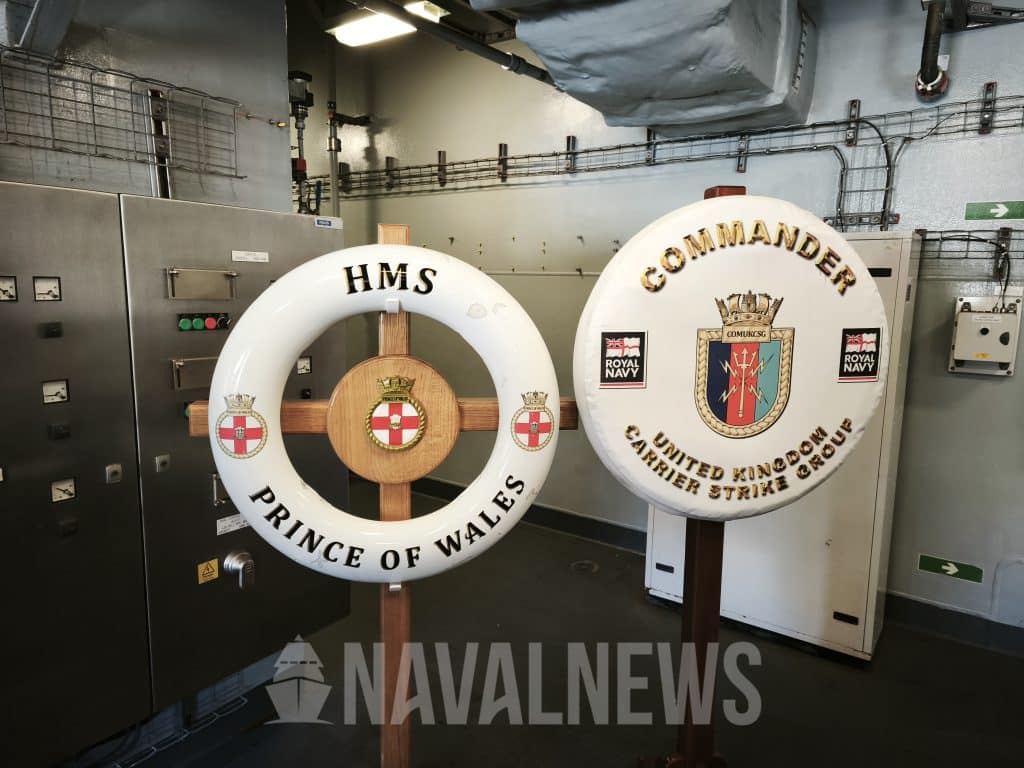
The invitation to visit HMS Prince of Wales presented a rare and valuable opportunity.
The 284-meter aircraft carrier is supported by Type 45 destroyer HMS Dauntless, Type 23 frigate HMS Richmond, replenishment tanker RFA Tidespring, while frigates and auxiliary vessels from Canada, Norway and Spain reinforce the deployment. The deployment began with around 2,500 military personnel – roughly 2,100 Britons, 200 Norwegians and a similar number of Canadians, and Spanish – rising to over 4,500 for some of the key exercises as the force reaches the Indo-Pacific. The carrier itself carries more than 1,600 people of which about 750 are the crew while the 750 are for the aircraft operations and 250 are Royal Marines.
The eight-month deployment of the U.K.’s CSG 2025 began on 22 April 2025 and is joined by several allied vessels and/or personnel from 13 nations, including Australia, France, India, Italy, Japan, Malaysia, New Zealand, Singapore, South Korea and the United States. The Mediterranean phase represents the concluding segment of Operation Highmast as the strike group makes its return to European waters, completing a global deployment through the Indian Ocean, Pacific, and Red Sea.
Visit Aboard HMS Prince of Wales
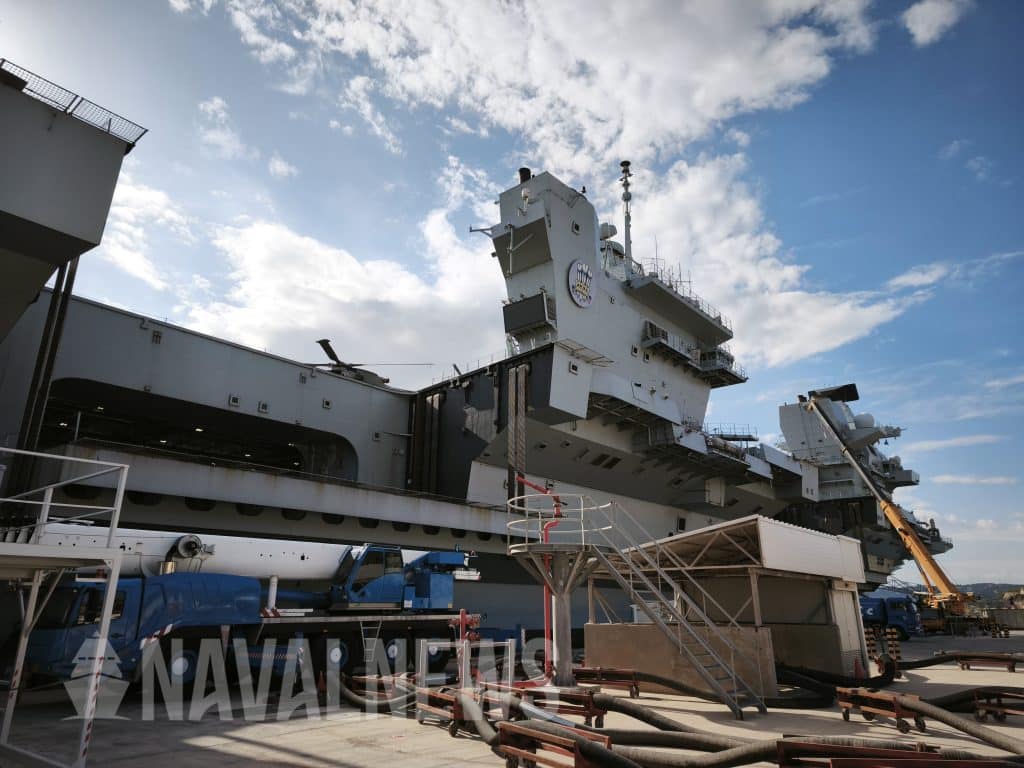 The Royal Navy’s flagship, HMS Prince of Wales, anchored at Souda Bay, Crete, just one day before beginning the final phase of Operation Highmast.
Naval News was invited by the UK Embassy in Greece on October 29 to visit HMS Prince of Wales the day after its arrival in Souda Bay, Crete, on November 4, for a 60-minute guided tour of the ship and its operations. Despite the travel required from Athens to Crete, this was a rare and valuable opportunity to visit the UK’s flagship, one of the most powerful and technologically advanced surface warships ever built in Britain, and among the most modern aircraft carriers in the world.
The visit provided a first-hand insight into life aboard a front-line carrier and offered the chance to witness the pride, professionalism, and dedication of the young men and women serving at sea.
Unlike traditional carriers equipped with catapults and arrestor wires, HMS Prince of Wales is specifically designed to operate Short Take-Off and Vertical Landing (STOVL) aircraft. The ship is configured to embark up to 72 aircraft, including a maximum of 36 F-35B Lightning II fighters, as well as UAVs, Merlin helicopters, used for airborne early warning and anti-submarine missions, and Wildcat helicopters for a variety of missions. The carrier’s design prioritizes versatility, featuring facilities to embark around 250 Royal Marines and to support amphibious operations using a range of aircraft including Chinook and Apache helicopters.
During our visit the ship carried 22 F-35Bs which were about to become 24. That is the highest number of the fifth-generation fighters ever seen on either of the Royal Navy’s Queen-Elizabeth class aircraft carriers. The jets, from 809 Naval Air Squadron and 617 Squadron, are there for Italian-led drills, named Exercise Falcon Strike, which will see allied work together on a large-scale air and maritime exercise supporting NATO.
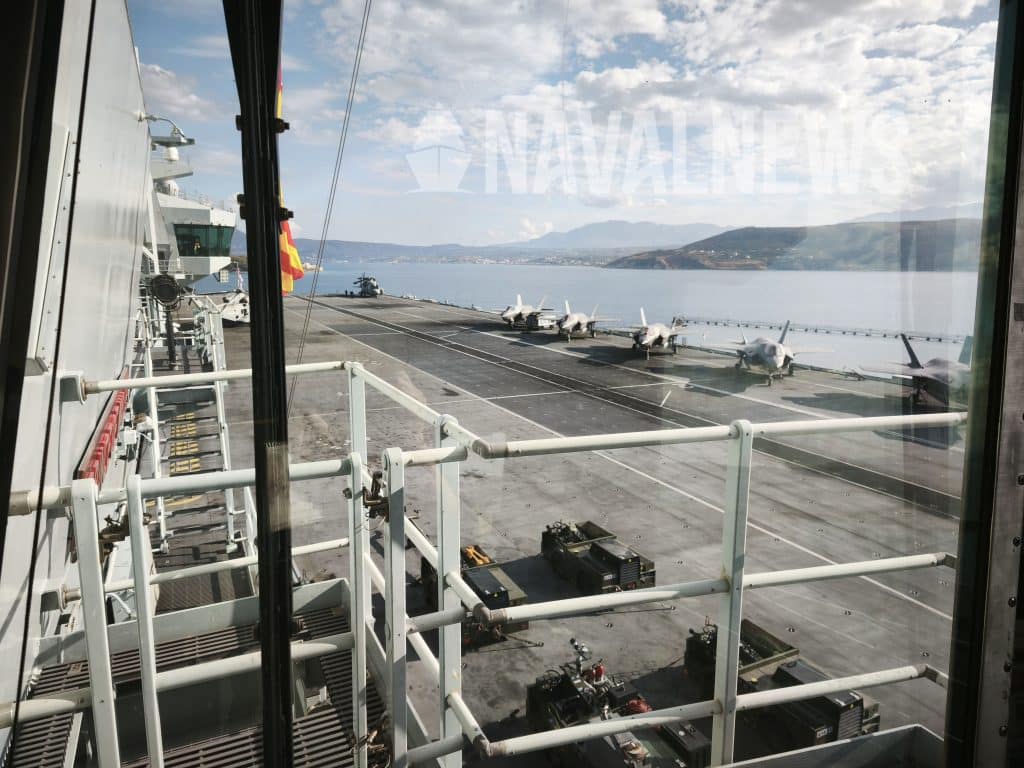
View of the deck from the forward island.
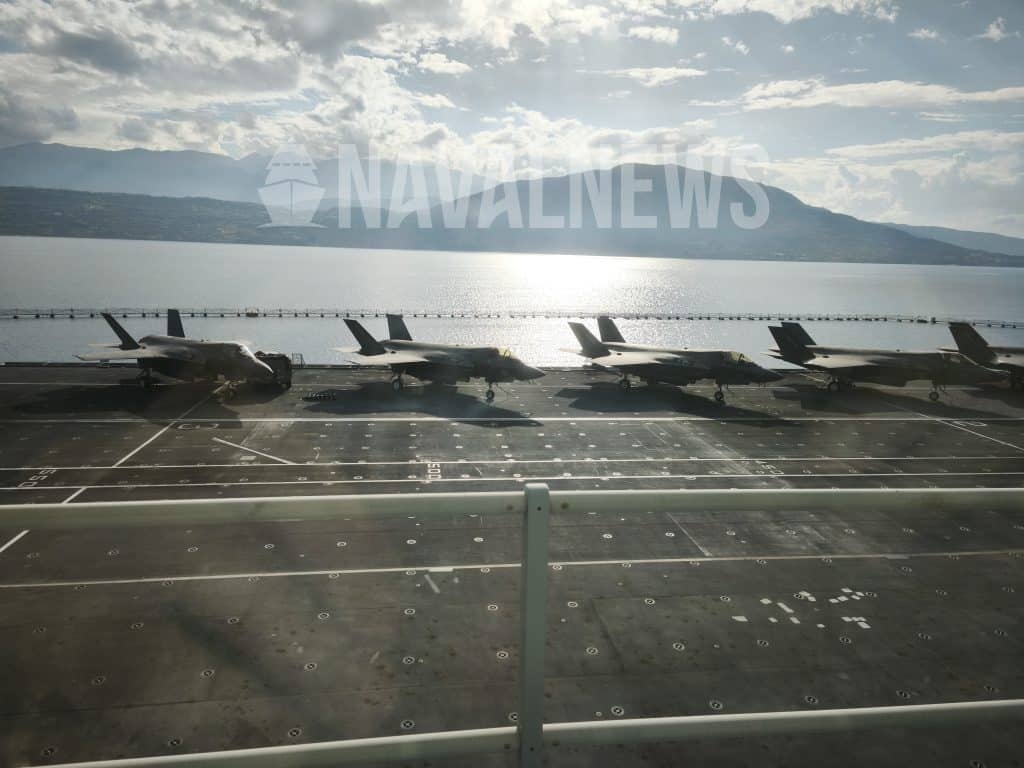
View of the deck from the forward island.
 View of the deck from the aft island.
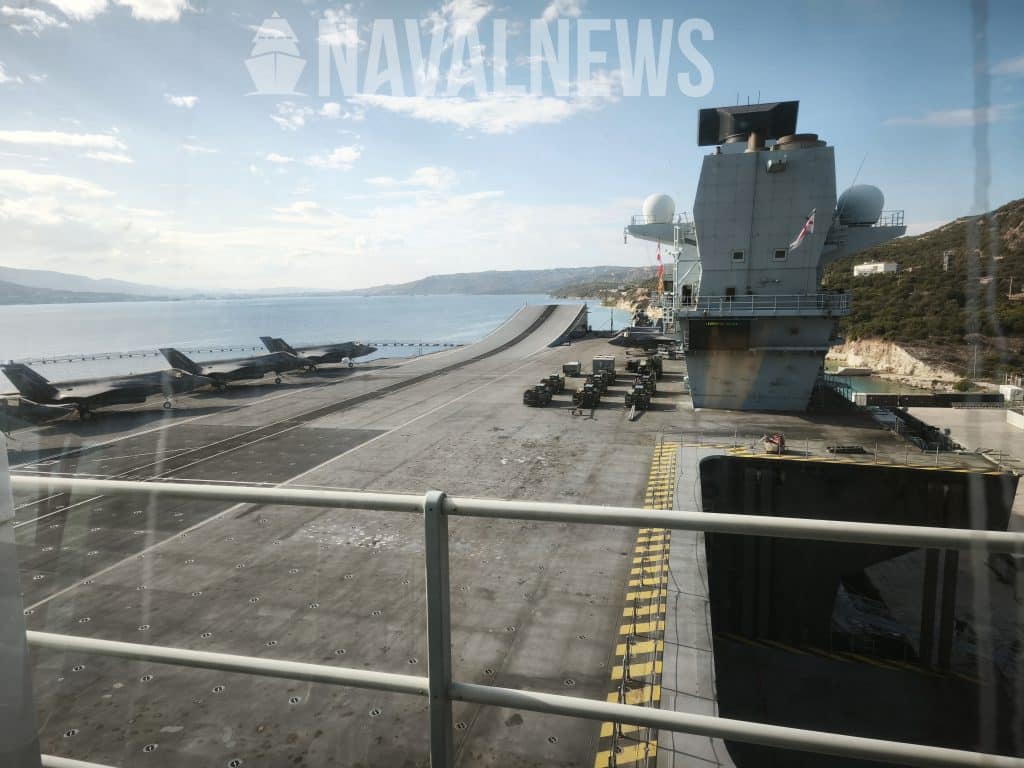
View of the deck from the aft island.
Our tour included visits to the ship’s two islands: the forward island, which houses the ship’s command center and equipped with the Type 997 Artisan 3D radar and the communications mast, and the aft island, which serves as the aircraft control tower and is equipped with the S1850M long-range radar. Unfortunately, access to the flight deck and hangar was restricted. Strict regulations were also in place regarding interior photography and proximity to the F-35B aircraft. However, what immediately strikes a visitor aboard the aircraft carrier is the spacious and comfortable corridors, lounges, and recreation areas.
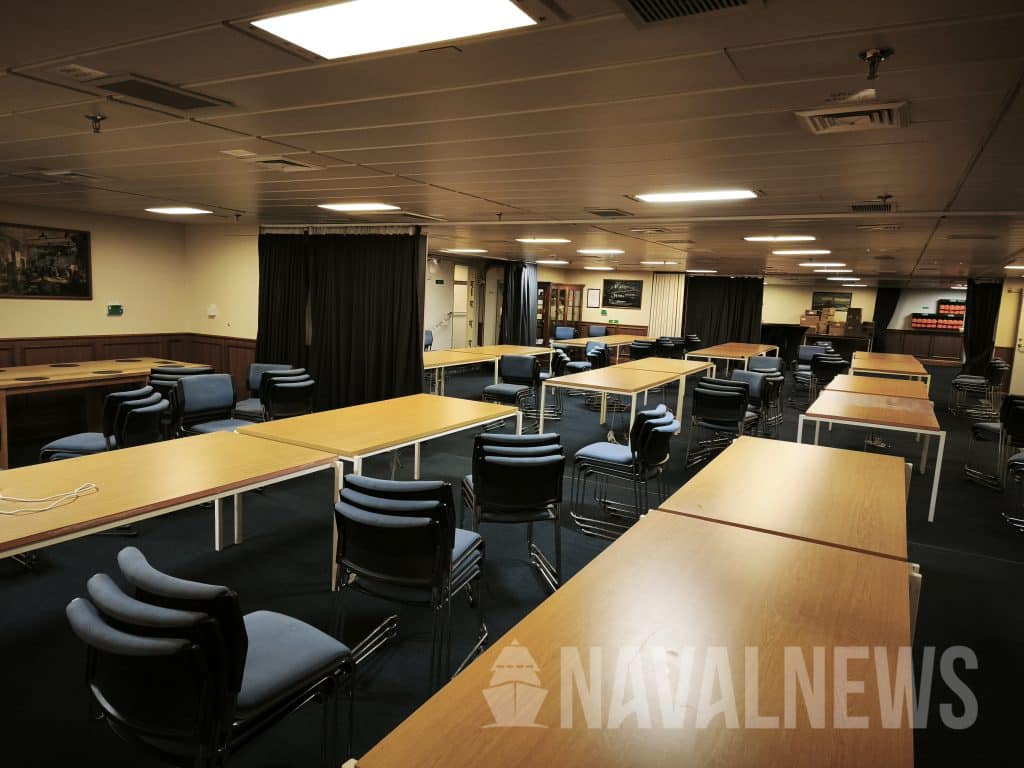
Officers’ mess
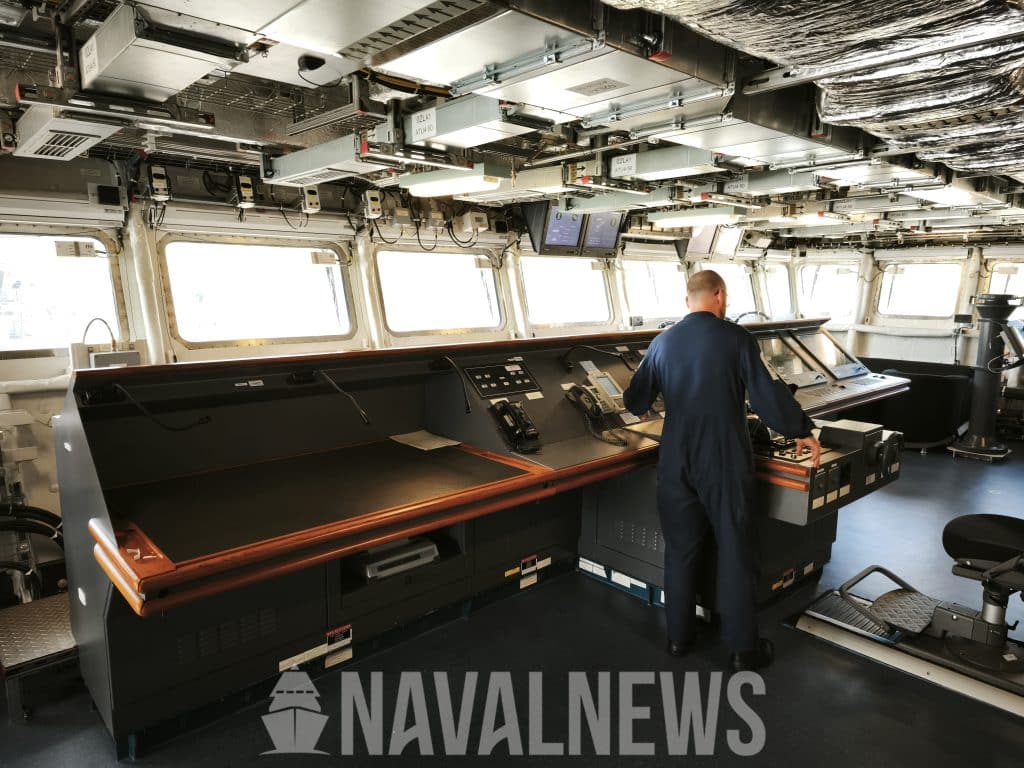
The emergency navigation bridge.
One deck below the main control tower lies another control room, simpler in design, as befits its purpose. This is the emergency navigation bridge: in the event that the primary control island becomes inoperable due to a catastrophic strike, the ship can still be steered and operated from there. When it is not used as a bridge, it operates as a meteorologic station. Likewise, the forward island also functions as a flight control tower.
The significance of Operation Highmast and Souda Naval Base
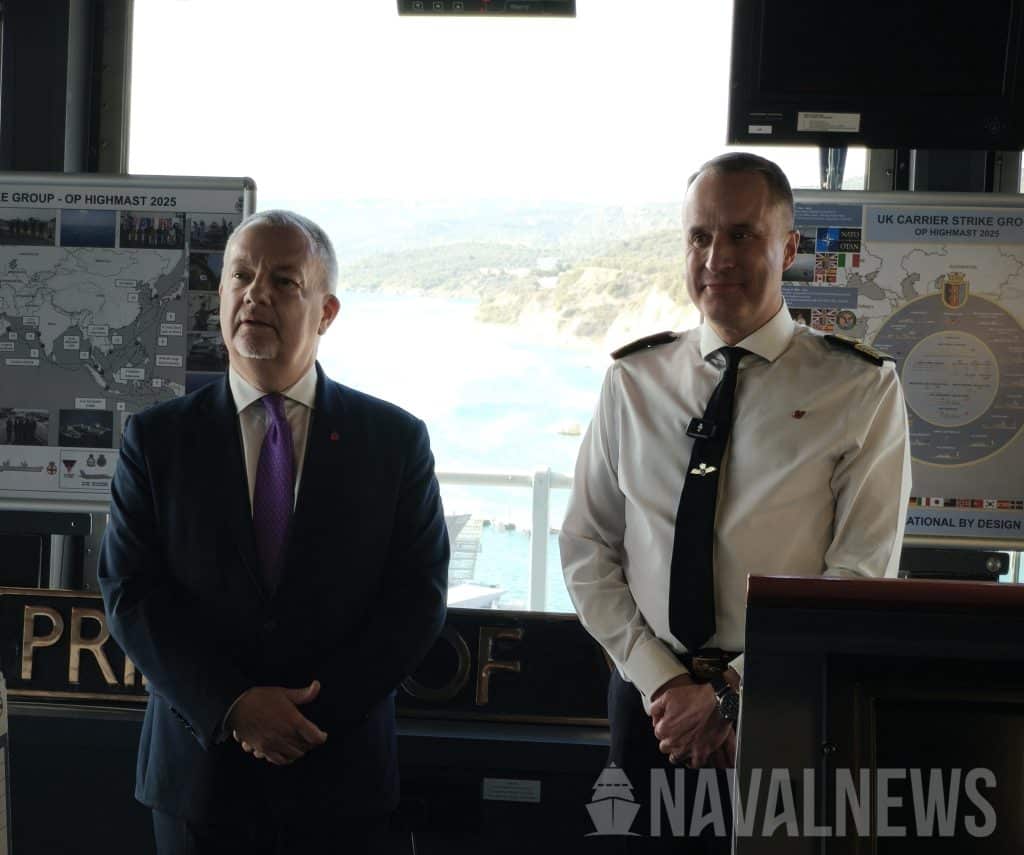
The UK Ambassador to Greece, Mr. Matthew Lodge and the commanding officer of the mission, Commodore James Blackmore.
At the navigation island, which we visited next, we were welcomed and greeted by the British Ambassador to Greece, Mr. Matthew Lodge, along with the commanding officer of the mission, Commodore James Blackmore.
After extending his greetings and emphasizing the vital role of Souda Base in providing logistical support to the Carrier Strike Group (CSG), Captain Blackmore stated:
Without it, I am absolutely convinced, we would not have been able to achieve everything we have accomplished in the Pacific. So, first of all, I would like to offer my huge thank you to Greece, Crete, and Souda Bay for their exceptional and unwavering support.
Commander of the CSG, Commodore James Blackmore
The Commodore went on to outline the three main objectives of Operation Highmast:
To declare full operating capability for restoring carrier strike capacity, following the retirement of our carriers and Harriers in 2010.
To demonstrate our firm enduring commitment to NATO and our allies.
To reaffirm our enduring support for our partners in the Indo-Pacific, highlighting that developments in that region are directly linked to security and activity in Europe as well.
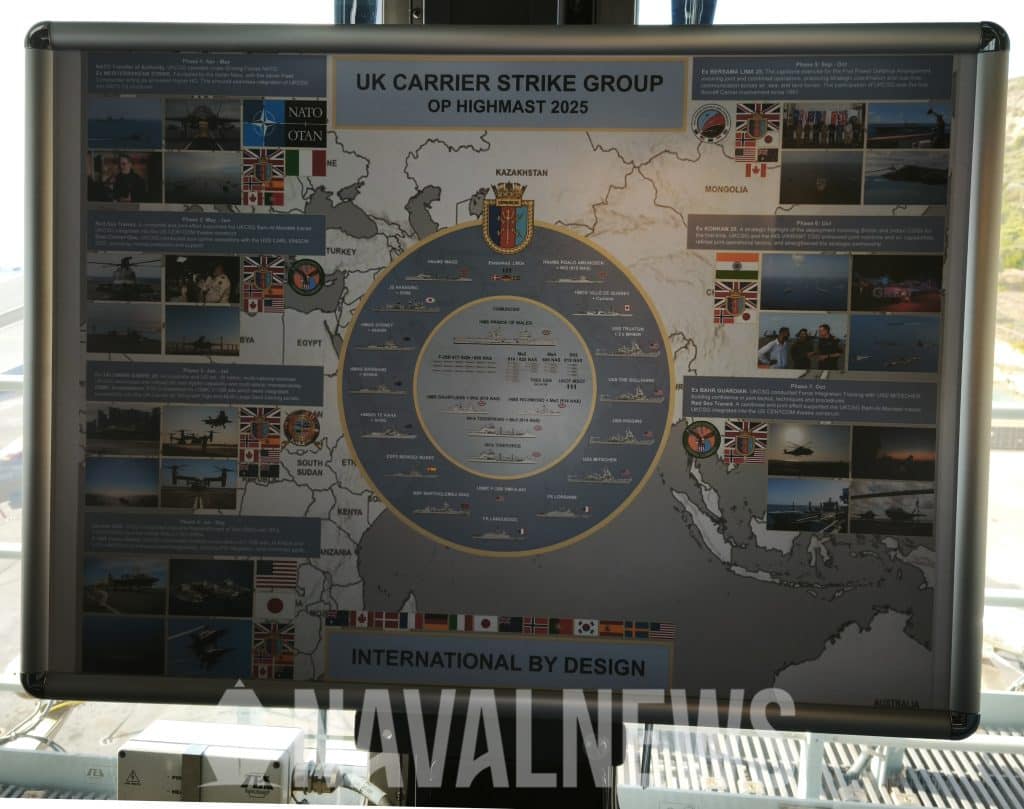
The phases of the Operation Highmast.
He then described the eight phases of the deployment, the composition of the multinational force, the personnel involved, and the participating nations. He also highlighted several notable milestones of the operation. For instance, in July, HMS Prince of Wales became the first non-U.S. aircraft carrier to participate in the Australia-hosted multilateral Exercise Talisman Sabre. She also docked in Darwin, marking the first visit of a Royal Navy aircraft carrier to Australia since HMS Illustrious in 1997. In August, a UK F-35B landed on the Japanese aircraft carrier JS Kaga, the first time a British jet has ever landed on a Japanese carrier. In October, British and Indian Carrier Strike Groups conducted joint maritime exercises for the first time in history.
Together with their Japanese counterparts, the crew also paid tribute at the site where, in December 1941, the British battleship Prince of Wales and HMS Repulse were sunk by Japanese aircraft. Finally, he noted that tomorrow the CSG will depart for joint exercises with the Italian Navy in the Mediterranean, after which HMS Prince of Wales will return to its home base in the United Kingdom in December 2025.
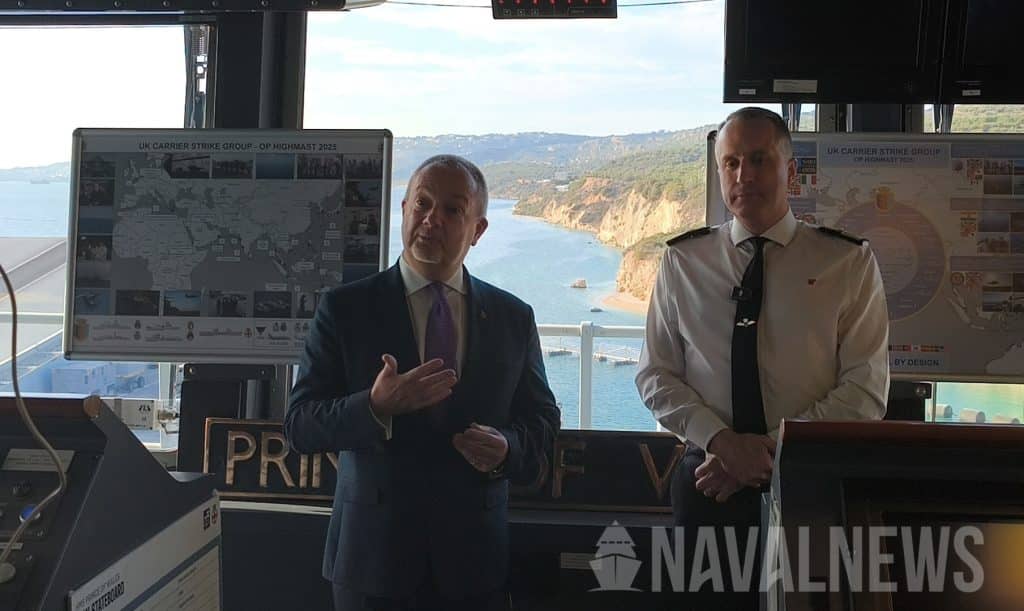
The UK Ambassador to Greece, Mr. Matthew Lodge and the commanding officer of the mission, Commodore James Blackmore.
The mission covers over 40,000 nautical miles and engages with 40 nations, integrating with ships from 10 different ships, reinforcing the UK’s standing as a leading European power capable of delivering fifth-generation aircraft and carrier strike capabilities — a primary contribution to NATO’s deterrence and defense posture. Over the course of the deployment, more than 4,500 British military personnel have taken part, including nearly 600 Royal Air Force members, 900 soldiers, and around 2,500 Royal Navy sailors and Royal Marines.
The Commodore then gave the floor to the UK Ambassador to Greece, Mr. Matthew Lodge, who stated:
We are committed to working in partnership with our allies — our NATO partners and, further afield, our international friends — as joint champions of the international rule of law, defenders of freedom of navigation, and upholders of the shared values of democracy, freedom, and liberal governance that unite the United Kingdom and Greece. The visit of the Carrier Strike Group to Crete is particularly fitting, as the base at Souda Bay plays a central role in supporting not only the UK but all NATO allies.
British Ambassador to Greece, Mr. Matthew Lodge
Naval News comments
Through Operation Highmast, the United Kingdom has demonstrated that it remains one of the few nations capable of leading a deployment of such scale, showcasing a Royal Navy that is strong, modern, and ready to meet the challenges of both today and tomorrow. The operation also reaffirmed the UK’s commitment to the security of the Mediterranean and Indo-Pacific regions, highlighting collective resolve with its allies while promoting British trade and industry.
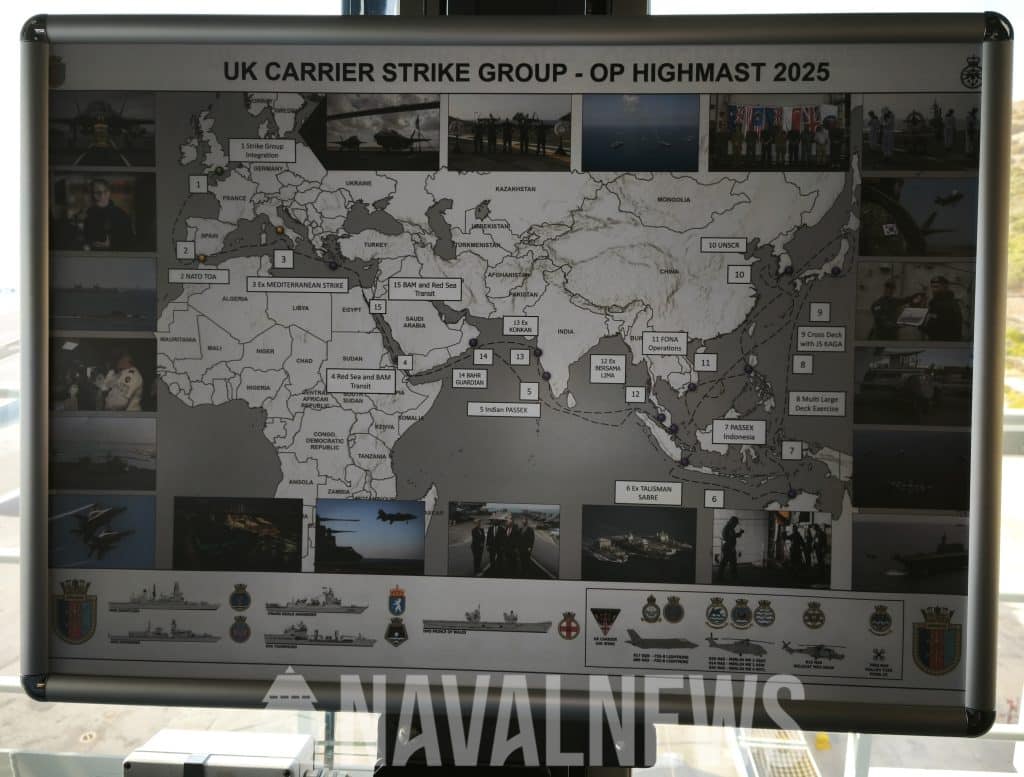
The exercises in which the UK Carrier Strike Group participated during Operation Highmast.
However, one could argue that the operation’s motto, “international by design”, reflects necessity as much as intent, given the limited number of replenishment and support vessels within the UK fleet, particularly the complete absence of solid support ships (in response to our question about the absence of solid support ships, the Commodore confirmed the observation was accurate and noted that the UK intends to commission such vessels in the coming years), and the current low availability of Royal Navy warships. As a result, the CSG has relied heavily on allied vessels for logistical support and protection. However, this is set to change over the coming years with the introduction of the Type 26 and Type 31 frigates and the new solid support ships.
Furthermore, HMS Prince of Wales has proven to be a highly capable warship, reflecting the strengths of a seafaring nation with a long naval tradition, enduring pride, and considerable maritime expertise. Yet even the once-mighty Royal Navy has not escaped the effects of defense budget cuts, which are clearly reflected in the ship’s current equipment. The carrier currently relies primarily on three Phalanx CIWS and several heavy machine guns for close-in defense. It lacks dedicated decoy-launching systems (apart from those used for anti-submarine warfare) and advanced electronic warfare suite. Notably, although provisions exist for up to four 30mm DS30M Mk2 remote weapon systems, none have yet been installed. Whether the ship’s equipment will be upgraded in the coming years remains uncertain.