
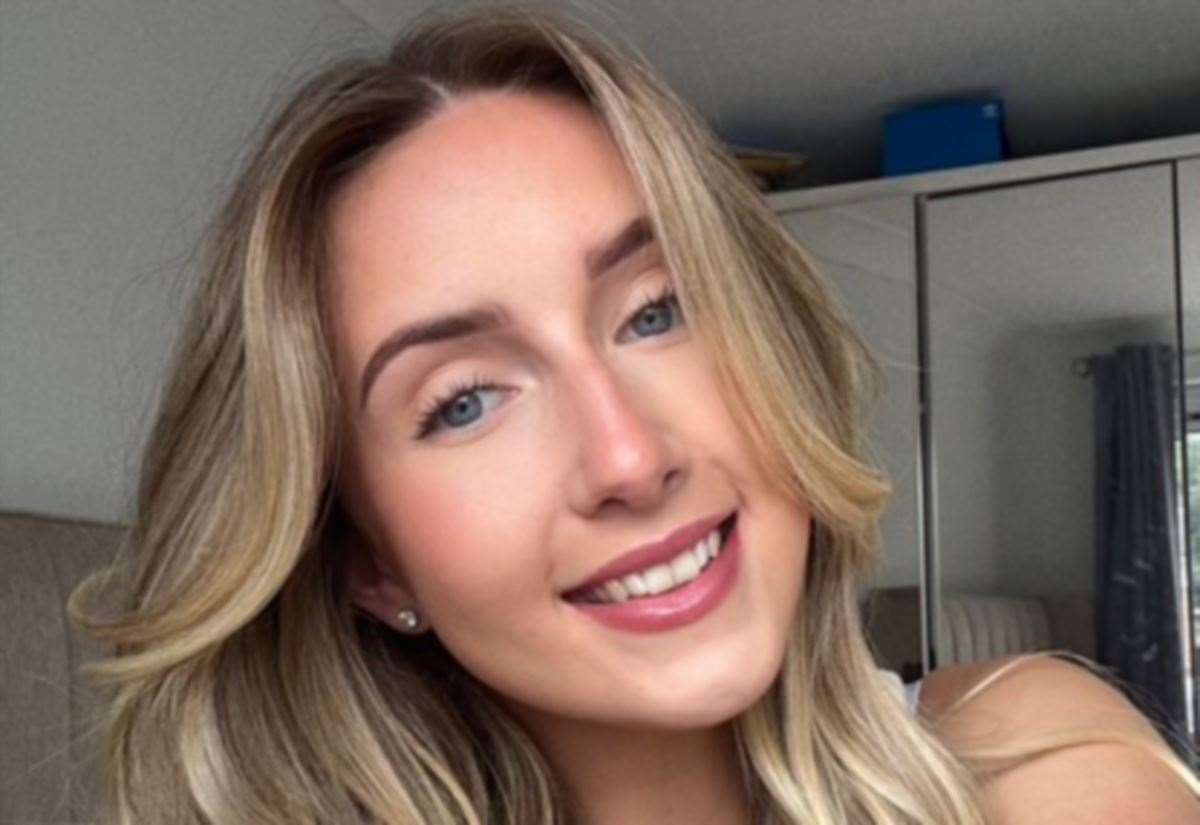
Social media sometimes get a bad rap, but Téa Cooley can credit scrolling through content for saving her life.
“Last year, I saw people on TikTok checking their moles, and I thought, ‘I best check too’,” says the 23-year-old from Dover.
 Téa Cooley can credit scrolling through social media content for saving her life. Picture: Téa Cooley/Cover
“I was on holiday in Miami at the time and did notice one mole had turned a bit darker, but I thought, ‘I’ll get that sorted when I get home,’ and thought nothing more of it.”
After visiting her GP in June last year, Téa underwent a dermoscopy and was then referred to a dermatologist who did not think the mole was one to be concerned about but recommended getting a second opinion.
The second dermatologist was also unsure. And then a third specialist advised removing the mole “to be on the safe side”.
“Even though the removal was scheduled as a suspected cancer referral, I was not concerned,” says Téa.
“I had felt relief that it was being done to be ‘on the safe side’ so I didn’t overthink it.
“I got it removed and they said I’d hear back within six weeks, but I had not heard anything in that time.
“Everyone around me said, ‘No news is good news. So don’t worry.’ But it was on my mind.
“I did try to call, but couldn’t get through. On the seventh week, after I’d decided to leave it, I got a letter to say that it was melanoma.”
Téa Cooley, 23, from Dover, was on holiday when she noticed a mole had turned darker. Picture: Téa Cooley/Cover
Melanoma is the deadliest form of skin cancer and is primarily caused by excessive exposure to ultraviolet (UV) light.
The charity Melanoma Focus notes that signs of the disease, which continues to be on the rise in the UK, are the appearance of a new mole or lesion on your body, or a change in an existing mole or lesion.
While melanoma is serious, it can be easily treated – with early detection viewed as a key element in removing the cancer.
“Three weeks later I had a second surgery,” says Téa, recounting a procedure last September to remove a wider excision around the original site on the right side of her torso.
Having been left anxious by the way she was told about her melanoma diagnosis via letter, which arrived on a weekend day with no specialists available to answer any questions, her surgeon reassured her that the procedure was to remove any potential cancer cells that may be left.
Pathology results came back clear, meaning the melanoma had not spread.
However, Téa’s surgeon noticed two other moles on her back that he felt could be suspicious, which she is now scheduled to have removed.
“There is quite a large scar where the excision was made,” she says.
Téa Cooley, of Dover, was 22 when she discovered melanoma on her back, after regularly exposing herself to sunbeds. Picture: Téa Cooley/Cover
“I have another mole on my back, which had developed a redness around it, that is also being removed to be on the safe side. My doctor warned this could also leave a large scar, but I’d rather live with a scar than risk what could have happened if I didn’t get them removed.”
Reflecting on her approach to skin care in the sun in the past, Téa admits she didn’t appreciate the risks UV light can pose.
“I’d say I was one of those people who would say I need to burn to then get a tan,” she says.
“I’m quite fair, and I’ve never really been one to catch a tan straight away. Before going on holiday, I would plan to get a base tan on sunbeds.
“My thinking was that I’d then be fine on holiday as I’d have that tan to top up from.”
Melanoma Focus shared research this May that has shown sunbed use prior to age 35 increases the risk of melanoma by 59%. Meanwhile, the International Agency for Research on Cancer (IARC) has also classified UV radiation from commercial sunbeds as a Type 1 carcinogen – making it as dangerous a cause of cancer in humans as smoking and asbestos.
“I used to work at a sunbed shop, and I got free minutes as part of the job. It is my biggest regret ever,” says Téa.
Téa Cooley’s surgical wound healing after melanoma, the deadliest form of skin cancer, was removed. Picture: Téa Cooley/Cover
“The maximum I would get was 12 minutes, and I wouldn’t use them that frequently. I was serving people who wanted 20 minutes, and others who would come in every day. I was in an environment where my usage didn’t seem so bad in comparison. I thought, ‘I’ll be fine’ and was normalising it. You truly believe it won’t happen to you.
“I still have some close friends who use sunbeds, and I really hope they can learn from my experience,” she continues.
“If they want to continue getting them then that’s up to them, but I do warn to at least keep an eye on their moles.”
Téa’s experience has changed her outlook on skin care and having fun in the sun.
“I’ve always worn SPF on my face, but now I wear SPF all over my body,” she says.
“I check the UV index every day and I’m always the one to offer sun cream to everyone else. I had a holiday booked to Egypt before all of this, but I also went to Centre Parcs and I was more excited to go to Centre Parcs than I was for Egypt, because of the weather. But I went there and I was wearing SPF 50. You can’t live life avoiding the sun, which is what I kind of had to learn.”
She is now advocating for others to check their skin and not to be afraid to be insistent with their GPs about concerns.
“I have posted about my story on TikTok. It felt right,” she says.
“The fact that I checked my mole because I saw someone else on TikTok encouraged me to put it out there. I’ve had so many messages from people that have reached out to me with their story. My dad, mum, sister, my partner, and my friends, I’ve told them all to go and get checked. A positive thing that can come out of this is making other people aware and educating them.”
For information and support on melanoma, visit Melanoma Charity for Professionals, Patients & Public or call the charity’s free and confidential helpline: 0808 801 0777.