
Unlock the Editor’s Digest for free
Roula Khalaf, Editor of the FT, selects her favourite stories in this weekly newsletter.
There are lots of ways to value a company. Tallying up its assets minus its liabilities, adding up its future earnings, or sizing it up against rivals are all respectable approaches. In the case of Skims, a crucial calculation to consider is how many times one woman can break the internet.
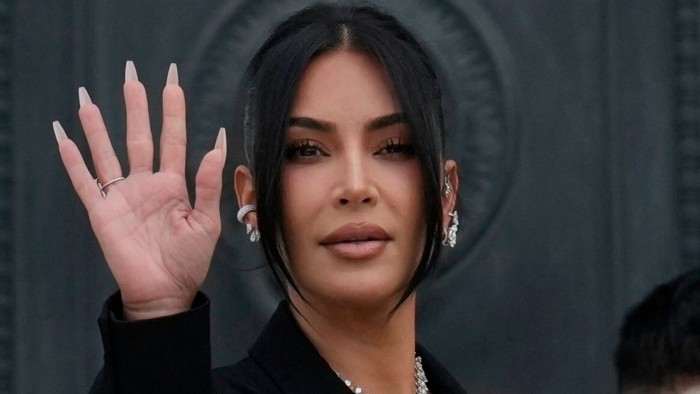
The shapewear brand co-founded by media personality Kim Kardashian and entrepreneur Jens Grede is now valued at $5bn after a $225mn funding round that included an investment from Goldman Sachs Alternatives. Some of that is down to buttery soft shapewear; a lot of it relies on Kardashian’s star power.
One way to think about this is to compare Skims with Lululemon, a company that is somewhat comparable. It too has reinvented a once mundane category — gym gear, in this case — and given it a sleek new look. Yet Lululemon’s stock, after a difficult year, trades at less than twice this year’s sales. Skims, on five times, carries a 150 per cent premium.
Growth, not celebrity, explains some of that. Back in 2012, Lululemon had the same $1bn in annual sales that Skims has now; over five years it grew at an average 22 per cent annual rate. Assuming Skims follows a similar path, it would hit about $2.7bn in revenue by 2030. Measure both companies’ enterprise values as a multiple of that year’s sales, and the Skims premium compresses to roughly a quarter, equivalent to around $1bn of value.
Is she worth it? Kardashian’s reach — with 354mn Instagram followers — is something most brands would torch their marketing budgets for. While the financials for Skims are not publicly available, its founder’s clout would presumably translate into lower customer acquisition costs and higher margins.
Brands backed by mega celebrities also have a better chance of stretching into new categories, as Gwyneth Paltrow’s candles-to-clothing Goop empire testifies. Kardashian’s skincare experiment SKKN, was bought back earlier this year by Skims, which plans to launch its own beauty line-up. And her halo effect may help attract high-profile potential partners: Nike launched an athleisurewear partnership with Skims earlier this year.
Other celebrity brands have also translated their founder’s fame into rich valuations, though not always with long term success. Hailey Bieber — fashion model and wife of Justin — sold skincare brand rhode to e.l.f. Beauty for up to $1bn on $212mn of revenue. But Jessica Alba’s Honest Co has slid from a $1.4bn IPO valuation to under $300mn.

Fame is fickle, as are consumers. Nonetheless, for a towering brand such as Kardashian’s, a $1bn premium is probably worth it. Over time, the recipe for a durable celebrity brand may be one in which the product’s own reputation outgrows that of the celebrity; think of Nike Air Jordan, which no longer sells purely because of the association with its namesake. Skims’ challenge is to inch in that direction.