
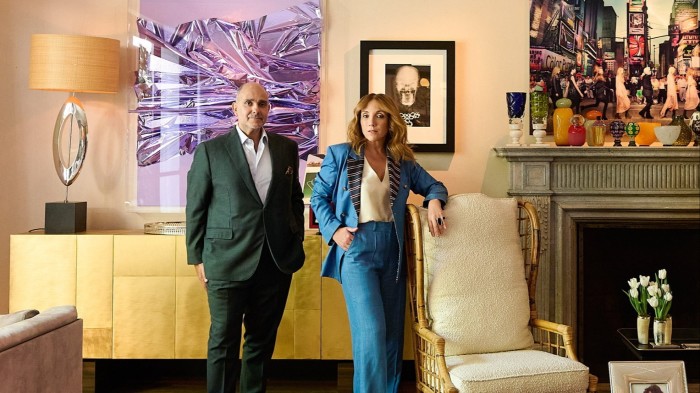
“Every time I have creative work to do, I choose this dining room,” says Paula Amorim. A fourth-generation scion of the family behind Portuguese multinational Amorim Group, she is sitting at the table, clad in tailored double denim, her surroundings colourfully eclectic. Myriad paintings, books, photographs and objets d’art crowd together, all atop a gleaming marble floor. It’s bold, and sensorily intense.
In the elegant Lapa district of Lisbon, Amorim and her husband Miguel Guedes de Sousa’s home makes a grand statement on all levels. The late 19th-century building that the couple bought in 2012 used to be the residence of the Canadian ambassador. Though they gutted much of the interior over the course of a three-year renovation, the original marble floors remain, as does the sweeping central staircase, which connects the upper three floors. The smaller back stairs that twist down to the basement have become a striking feature too, their underside painted bright orange — one of the details they planned alongside Spanish interior designer Lázaro Rosa-Violán.
From the tall stairwell windows, a glimpse of nearby Estrela Basilica’s rococo dome provides a tangible link to the Amorim family fortune. The church houses a famous nativity scene, created from cork — the material that, in 1870, António Alves de Amorim began trading in. “I was born in nature; my history and legacy are cork,” says Amorim. She began working with her father, Américo, in the family business at just 19. Today, Corticeira Amorim is the world’s largest cork producer, and the bedrock of the Amorim Group’s portfolio, which spans finance, real estate and telecommunications, and has more than 5,000 employees.
 In the dining room light streams through the windows. Above the fireplace hangs a Tracey Emin neon: ‘I don’t believe in love. But I believe in you’ © 2025 Tracey Emin. All rights reserved, DACS
In her quiet, considered way, Amorim leads me along a basement corridor, next to the wine cellar, where a series of archive black and white photographs show cork being collected and processed on the family estate. “I wanted to bring a part of my past to Lisbon,” she says, having been born and brought up in Porto, only moving to the capital after she married.
Lisbon’s dynamism and increasingly global feel was a draw. According to a 2024 Statistics Portugal report, foreign nationals now make up more than 10 per cent of the population (more than double in a decade) — and it’s good for business, says Amorim. “We’ve welcomed new residents who have fallen in love with our city, and they are actively contributing to its growth and economy.”
Amorim herself “fell in love with the Lisbon light”, she says. “Having spent all my life in Porto, which is cloudy and humid, I find the light here gorgeous.” In the dining room, it’s easy to see why; light streams through the windows behind her, illuminating the vast antique table, paired with metal-spoked Warren Platner armchairs. Above the fireplace, mirror panels are the backdrop to a Tracey Emin neon: “I don’t believe in love. But I believe in you” — pulsating in fluorescent pink.
 Much of the interior was gutted over the course of a three-year renovation, but the sweeping central staircase remains
It’s an ideal spot for working from home, says Amorim. While Guedes de Sousa tends to head out of the house — to the gym and then the office, dropping off their five-year-old son Manuel at school en route — Amorim often stays put.
As well as being a shareholder in the family group, she is on the board of directors of Amorim Investimentos e Participações — the private holding company of the Amorim family. In 2005 she acquired Fashion Clinic, which now has eight stores across Portugal. In 2010 she created the Amorim Luxury Group, which includes her eponymous womenswear collection, PAULA, and the House of Capricorn: a homeware line, launched in 2024, which celebrates Portuguese craftsmanship.
“Sometimes our house works as a lab,” says Amorim. “When we are doing things for PAULA’s collections, the models come here, we set up the clothes racks and we can go in and out of the garden to see how the colours work in the natural light.”
 One of several sitting rooms, each designed following advice from a Vastu Shastra consultant
“It’s like an embassy for our brands,” adds Guedes de Sousa, a Lisbon native. With a background in hospitality, he is now president of the Amorim Luxury Group and co-founded offshoot brand JNcQUOI (pronounced je ne sais quoi), a stable of businesses aligned under the tagline “where food meets fashion meets hospitality”.
Its roll-call of glitzy clubs and restaurants are timely additions to Lisbon’s increasingly buzzy social scene. The ripple effect is palpable on Avenida da Liberdade — Lisbon’s most chichi street, where JNcQUOI has four restaurants, including the Frou Frou private members’ club and a hotel in the pipeline. The same can be said of the seaside village of Comporta. There, a beach club and a deli will be joined by JNcQUOI’s biggest project to date: a €680mn complex of residences and a hotel, designed by Vincent van Duysen, which will open in 2028.
At their own home, the couple are frequent and consummate hosts. “I love arranging the table, inside or in the garden, choosing the flowers and the place settings,” says Amorim. It’s an area where “we compete a little bit”, laughs Guedes de Sousa. “I choose the food and wines. Could be a scarlet shrimp cocktail with pomelo, followed by fresh cod with a butter of clams. The wine might be something from our JNcQUOI label or a Condrieu from my cellar.”
 Part of the cellar: ‘I choose the food and wines,’ says Guedes de Sousa
 The striking stairwell that twists down to the basement was planned alongside Spanish interior designer Lázaro Rosa-Violán
With its geometric cement-tiled floor, dark wood and soft lighting, the cellar houses not only wines but also a selection of sakes. Guedes de Sousa’s many years spent in Asia working with Aman resorts are a lasting influence. In the garden, the planting is inspired by Geoffrey Bawa’s House No 11 in Sri Lanka, “where indoor and outdoor worlds blur”, he says.
Another takeaway is the ancient Indian practice of Vastu Shastra. The couple worked with a specialist in their home to configure living spaces in a way that is believed to bring prosperity and wellbeing. “And it works!” Guedes de Sousa exclaims. Between 2018 and 2024, Amorim Luxury Group revenues grew from €28mn to €60mn.
 In the dining room, a blue Birkin handbag embellished with crochet by Portuguese artist Joana Vasconcelos is housed in a Perspex box
 The guest bathroom features a beaded head, with green eyebrows and rope hair — a souvenir collected during Guedes de Sousa’s time in Africa
The small silver dragons you see when you step in through the front door are Vastu Shastra in action; there to attract positive energy. On the wall nearby is a large photograph by German artist Candida Höfer of an empty theatre. “I grew up surrounded by beauty,” says Amorim. “My father invested in houses and had amazing properties — in Porto, but also in the Alentejo — and my mother loved decorating them.”
Along the hallway is a cloakroom where the walls are decadently lined with brown-tipped feathers. In it hangs one of Guedes de Sousa’s souvenirs from his time in Africa, where he was general manager at Amanjena in Marrakech: a beaded head, with green eyebrows and rope hair. “I always lived in hotels,” he says, “but there are a few things that I have collected for myself”.
 Black and white photographs surrounded by paintings and drawings, titled ‘Elephant Memory, Kenya’ by American artist Peter Beard © 2025 Peter Beard / Licensed by Artists Rights Society (ARS), New York / DACS, London
Their art collection ranges from Paula Rego to David LaChapelle. In the dining room, a blue Birkin handbag embellished with crochet by Portuguese artist Joana Vasconcelos is housed in a Perspex box. Above a marble mantelpiece is a piece by American artist Peter Beard, titled “Elephant Memory, Kenya”, with black and white photographs surrounded by paintings and drawings. “It took me years to get a Beard,” says Amorim, “but it was worth the wait”. Two cheetahs topped with fringed lampshades, by House of Hackney, stand sentry either side of the picture.
Recommended

“I am obsessed with getting the light right,” says Guedes de Sousa. “We worked with lighting designers from G2J Design, bringing [its founder] Gan Leehanantakul over from New York. The lighting in this house at night gives peace, beauty and magic.”
The bold design perhaps also plays into their bold plans. From the dining room table they’ve been plotting to take the JNcQUOI brand global — specifically to Miami and Dubai, in the first instance. Where could it take them from there? Je ne sais pas.
Find out about our latest stories first — follow @ft_houseandhome on Instagram