
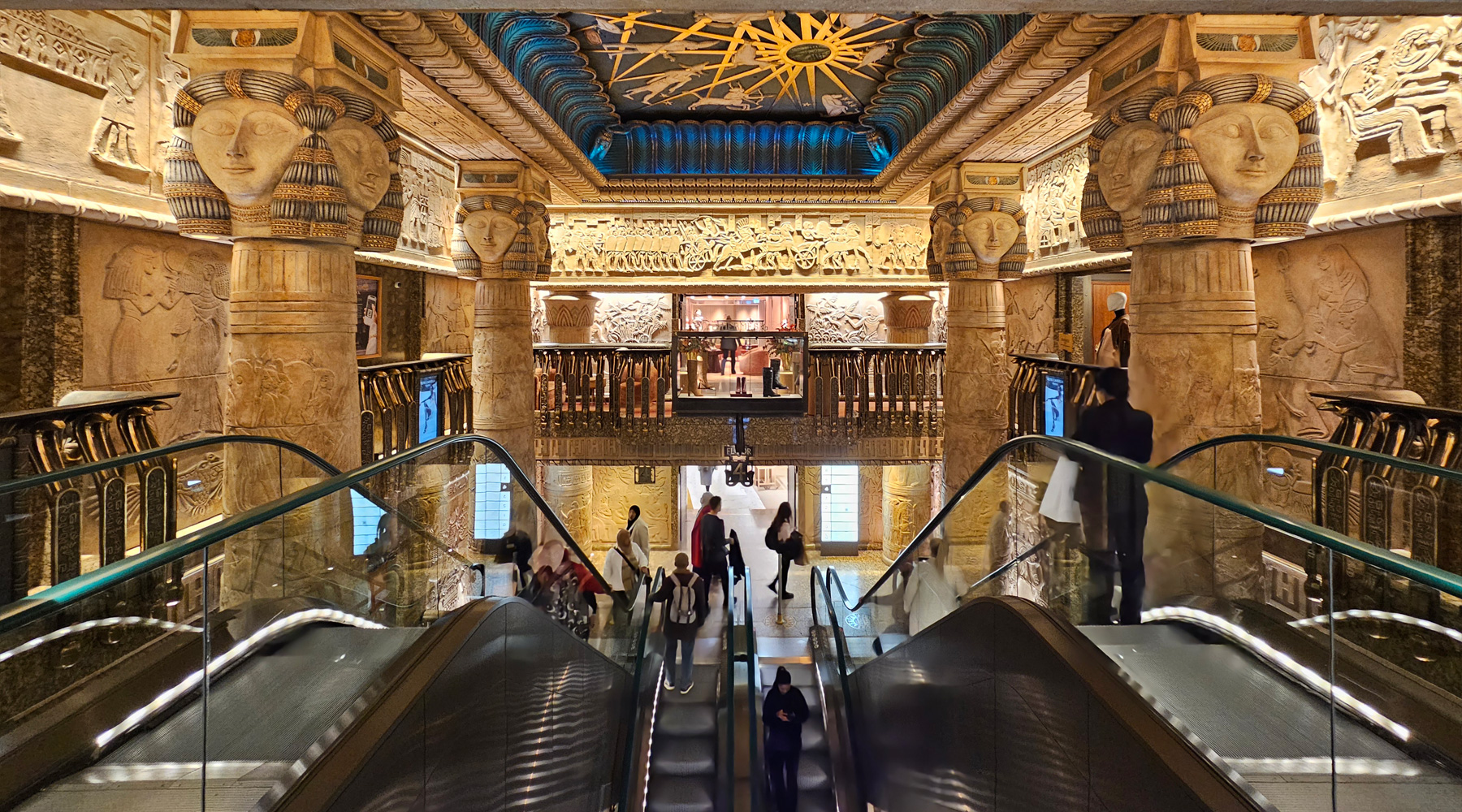
Harrod’s famous Egyptian-themed central escalators are to be stripped out and modernised, and remove the late unlamented Mohamed Al-Fayed’s face from the decoration.

The escalators in their current style are a visible symptom of much that’s wrong with Harrods.
Yes, I’m about to tell a profitable organisation where it’s going wrong.
Probably in part because of how Harrods developed, slowly expanding piecemeal to swallow up existing shops until it had the whole block, the interior of the shop has a very claustrophobic feeling about it.
For all its apparent grandeur externally and on the ground floor, once you get above the ground floor, it’s really not much more than an indoor market. No different really to indoor markets in many towns, both selling t-shirts made in Vietnam, but with wildly different price tags.
Department stores traditionally traded on their broad range of goods, all selected internally by their own buyers and displayed in grand, impressive buildings. It was hard retail that used showmanship to persuade you to part with your cash.
And it was the in-house buying that set the department store apart from the rest. You would not go into a department store and see the same brands inside it as you did on the high street. Very occasionally, a store might permit a brand in by renting them a “concession” space in a usually short-lived promotion, but it was seen as a bit downmarket for a department store to do so.
The dam broke slightly in the late 1980s and really took off in the 90s, when concessions were more widely tolerated. I worked in one for a while, and even then, there was still a certain “them and us” in the store hierarchy.
Today, if you visit a department store, it’s more of a marketplace of brands, each renting their patch of floorspace with their own staff and branding.
That can make shopping a bit of a pain.
If I, a man, want socks and shoes, I can still usually go to the socks and shoes section, but if I want trousers, they’re all over the place, displayed by brandname rather clothing type.
But that aside, even today, if you go into most large department stores, there’s still a sense of grandeur about most of them. High ceilings, perfumes by the front door, and in the middle – the grand escalator.
The escalators are not just a way of getting between floors, they are the wayfinding focus for the store, the easy to find central space around which everything revolves.
Retailers are clever, they put their best wares around the central void so shoppers going up and down are surrounded by an internal shop window of delights to catch their eye. And of course, all that “wasted” empty space is there to create the grand effect to reassure the shoppers they’re in an upmarket shopping experience.
They also serve a practical function for staff, as many have rooflights to bring sunlight into the centre of the store. Most shop staff can spend a whole day without seeing the sun, which affects their health. I worked in a few when I was younger; one had the staff room in the basement, and lots of staff would go for a walk at lunchtime to get some fresh air. The best put its staff room on the roof – admittedly because that was the only place for it – but it was so much nicer to eat lunch there.
At the time, I never understood why so many of the older female staff wore so much makeup, thinking it was probably just old people being old – but as I later learned, after decades of working indoors, they wanted to cover up their pale skin.
And that brings us to Harrods (yes, I’d get there eventually).
For all its fame, Harrods is not a nice place to visit. It’s cramped, with low ceilings and long, winding corridors lined with concessions, all sticking to themselves.

They’re all hyper-expensive brands, but despite all the marble used in the corridors, there’s no sense of grandeur about the place.
It’s a gilded rabbit’s warren of a marketplace, reminding me more of an upmarket Middle-Eastern hotel than a modern retailer.
And the escalator is the highlight of the space’s meanness toward shoppers.
It’s remarkably small for something that’s quite famous, and although it does go from the basement to the top floor, you’d struggle to notice that. It’s a dark oppressive space, more like an Egyptian tomb than a welcoming way of extracting money from people’s wallets.

Yes, it’s richly decorated, but in part thanks to the low heights of each floor, the escalators are actually quite short and bitty. The cramped effect is accentuated by the pram barrier at the top of each escalator, which just makes the whole thing feel even more claustrophobic.
If the floor heights were taller, the escalators would be longer, with more space around them. As it is, for all its decoration, the escalators feel more “back of house” facility than what they claim to be – the grand central escalators.
Cramped in with walls all around, and sparingly lit, if you wanted to show off the exact opposite of what a department store should do – this would be it.

It does seem that Harrod’s owners are wise to this, and while there are concerns that losing the art is a bad thing, some of it can be repurposed elsewhere if wanted, as was done when they stripped out the Egyptian-themed rooms a few years ago.
Fortunately, the new design will create a small smidgen of the grand staircase effect, as the plans include removing some bridges and landings, allowing them to create double-height spaces above some escalators. Removing the Egyptian columns gives them more width and spreads the escalators out a bit, creating some space to breathe and let light penetrate down into the space below.
 Concept sections (c) Make Architects / Planning documents
And that light will come from a new rooflight, which will replace the Egyptian painted ceiling.
 Level 03, view towards skylight (c) Make Architects / Planning documents
It’s still not as impressive as say Peter Jones or Selfridges or even the late Debenhams Oxford Street – but to achieve that would mean cutting into the “indoor market” space that is crammed full of shops.

The new design aesthetically will fit in with the rest of Harrods, so expect lots of marble, which is of a certain taste. Not mine, but it appeals to Harrods shoppers.
However, if you want to see the Egyptian-themed escalators, pop along soon before they are demolished.
The design is by Make Architects, who are also leading their curved escalator plans.