
(Credit: BBC iPlayer – Video Stilll)
Tue 18 November 2025 14:55, UK
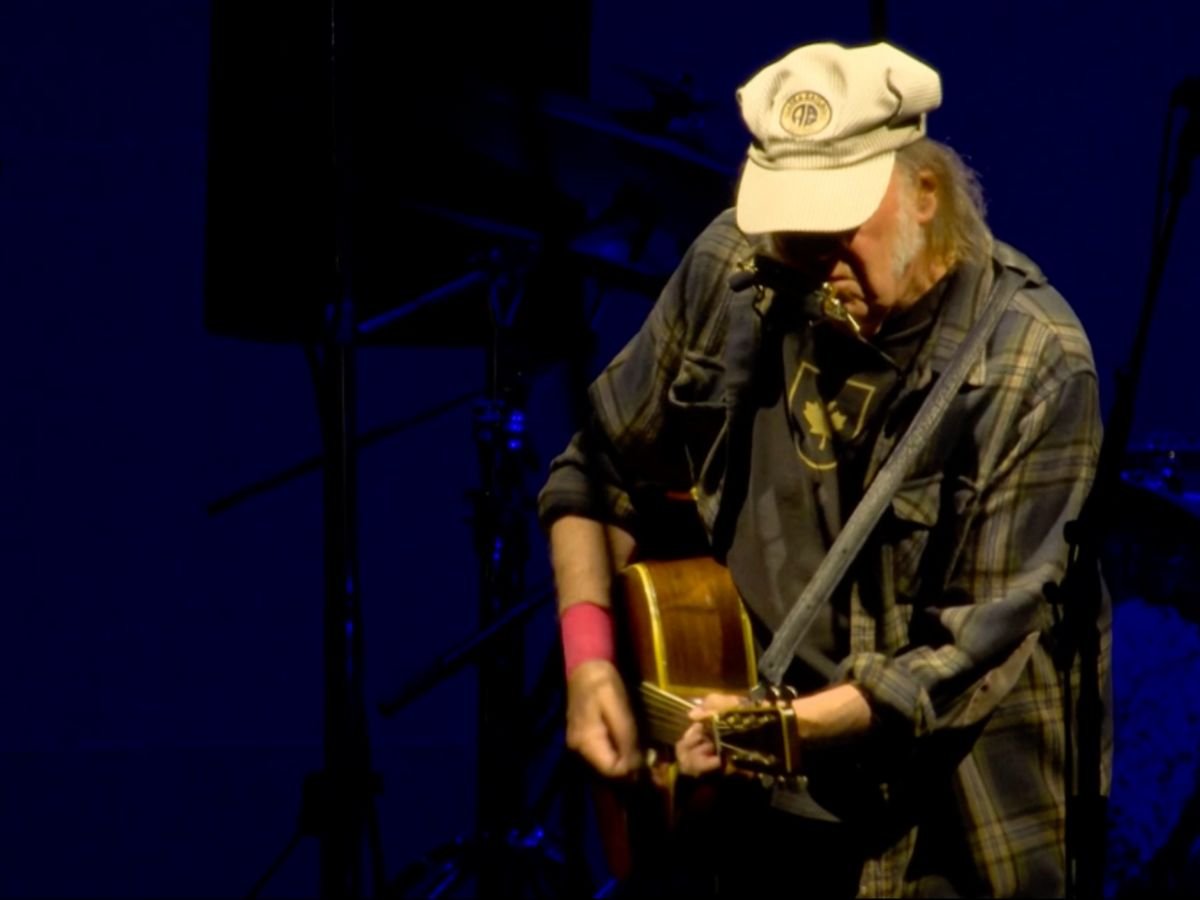
Neil Young doesn’t follow crowds even when it comes to hypothetical time-travelling endeavours.
While many folks in possession of a blank ticket stub to the past might venture to the Cavern Club for an early Beatles show or take up a spot by the front of the stage when David Bowie killed off Ziggy Stardust, the ‘Heart of Gold’ goes back to a rather less revered outpost in music history. But it’s one that shaped the world as we know it all the same.
In 1958, or there or thereabouts, in a field in Fredericksburg, Virginia, or there or thereabouts, an edgy young band full of youthful vigour were about to play at a drab country fair on the outskirts of the outskirts. This was not your typical epicentre for world-changing cultural movements
A DJ asked this naive young band to play ‘The Stroll’ by The Diamonds. Through giddy, nervous energy, this request summoned an involuntary nod. The problem was that none of the band had ever heard of the track. What they improvised in its place would go on to change music forever. The band were Link Wray & The Ray Men, and the song was ‘Rumble’.
Neil Young was dubbed the ‘Godfather of Grunge’, but he decrees: “Link Wray…he was the beginning of grunge, way before anyone you know.” There are also arguments that Wray is the ‘Godfather of Punk’ and a thousand other off-shoots spun out from the sheer atmosphere of ‘Rumble’. Necessity is the mother of invention, and placed on the spot to play ‘The Stroll’, the band went into overdrive and still has many reeling.
Wray’s brother, Doug, was on drums. He was not renowned for his subtlety, and by all accounts, his kit trembled like a flat-pack wardrobe on a fault line when he played. On this occasion, he beat out a rhythm with the wrong end of his sticks, further amplifying the wallop. Meanwhile, Wray strummed out a few heavy, sustained strolling chords laden with vibrato. Finally, in order to hear the guitar over Doug’s maelstrom, a microphone was placed in front of a punctured amplifier, and the blown-out sound caused a frenzy.
In an era of relative music conservatism, this was something to behold. The Kinks often get credit for inventing heavier forms of music because they slashed an amp with a razor, but Link Wray did this years before. When the Ray Men struggled to replicate ‘Rumble’ in the studio, the innovative band thought on their toes and punctured holes in the equipment to up the distortion. As Iggy Pop would later state when ‘Rumble’ forced him to leave college and pursue rock ‘n’ roll: ”It sounded baaad.”
With the track proving a hit, such a controversial hit, in fact, that when Steven Van Zandt introduced it to the Rock Hall, he quipped: “’Rumble,’ [is] the only instrumental in history to be banned for its lyrical content,” Link Wray & The Ray Men began to understand the power of dark ’attitude’.
So, they became legendary for the atmosphere they concocted at their live shows. They harnessed an image of rock ‘n’ roll outlaws and enamoured a cult following of fans brave enough to attend their mystic concerts. Much like the cool effortlessness of Rumble, these shows were baaad.
So much so that Neil Young said: “If I could go back in time and see any band, it would be Link Wray & The Ray Men.” That’s high praise indeed, but without them, he very well might be a labourer in some unknown Canadian industry, so old Young sees the time trip as a pilgrimage of sorts.
Related Topics