
Our solar system is speeding through the galaxy at more than three times the velocity scientists once believed, according to a new peer-reviewed study. The findings, released in November 2025, could upend fundamental assumptions about how the universe is structured and operates.
Researchers at Bielefeld University in Germany used radio telescope data to measure the motion of our solar system and discovered a velocity that starkly contradicts the widely accepted models of cosmology. The study suggests that current estimates of the Milky Way’s rotation, and by extension, those of other galaxies, may be significantly off.
Published in Physical Review Letters, the study relies on radio galaxy observations to determine the solar system’s speed as it orbits the center of the Milky Way. According to the research team, this velocity is more than three times greater than previous calculations. Such a difference isn’t just a numerical curiosity. It raises questions about the validity of the Lambda Cold Dark Matter model, a framework that has guided cosmologists for decades. The speed and direction at which our solar system moves through the cosmos could directly affect how we interpret the large-scale structure of the universe.
Radio Galaxies Reveal a Directional Imbalance
The research published in Physical Review Letters, hinges on the study of radio galaxies, which are known for their strong emissions at radio wavelengths. Because radio waves can travel through dust that blocks visible light, they offer a clearer view of distant cosmic structures. Using data from two radio observatories and the Low Frequency Array (LOFAR)—a network of radio telescopes spread across Europe—the team conducted a precise count of radio galaxies and mapped their distribution.
They found a distinct bias: slightly more radio galaxies appeared in the direction the solar system is moving, resembling a kind of cosmic “headwind.” This subtle effect has long been theorized, but the degree of asymmetry observed in this study was surprising.
“Our analysis shows that the solar system is moving more than three times faster than current models predict. This result clearly contradicts expectations based on standard cosmology and forces us to reconsider our previous assumptions.” said Lukas Böhme, lead author of the study and physicist at Bielefeld University.
The uneven distribution they observed was 3.7 times stronger than what current cosmological models would predict.
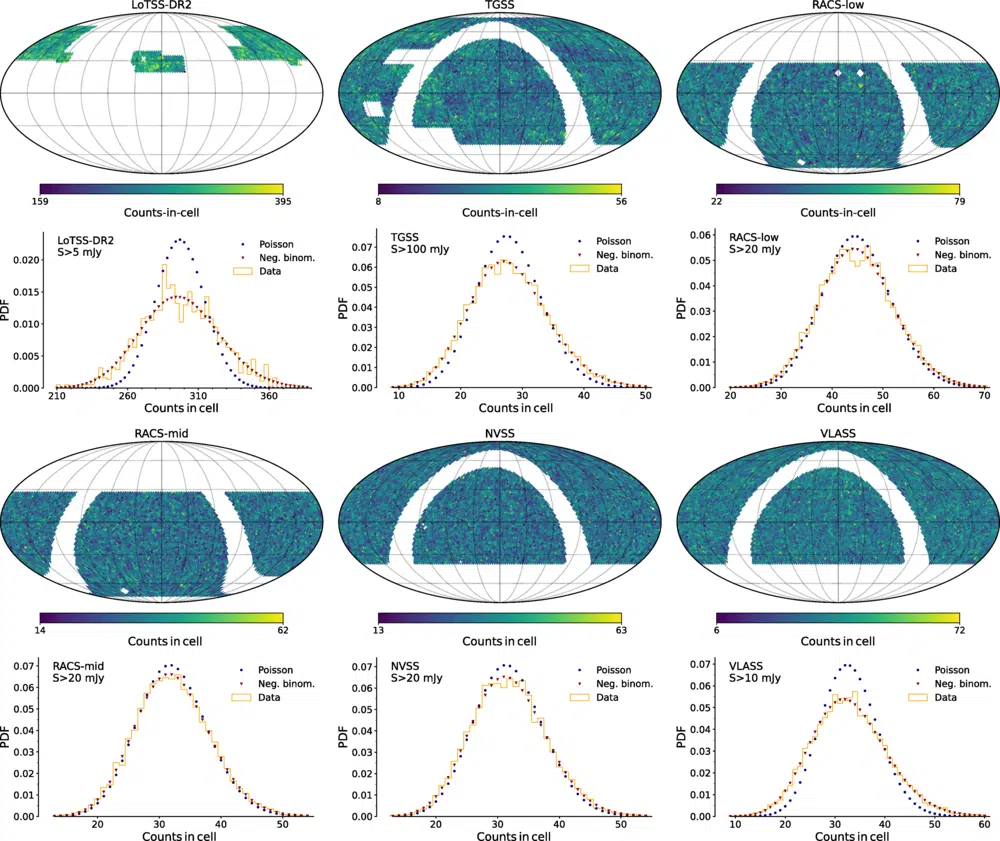 Maps (1st and 3rd rows) and histograms (2nd and 4th rows) of source counts from six radio continuum surveys, with Poisson and negative binomial distributions fitted. Credit: Physical Review Letters
Results Challenge Standard Cosmological Models
The implications of this discrepancy are significant. In the view of the researchers, if the solar system is indeed traveling at this newly calculated speed, it forces a reassessment of the cosmic microwave background dipole meaning it looks the same in every direction.
The study presents a 5-sigma deviation from the expected values, a statistical measure that indicates a result is highly unlikely to be due to random chance. As co-author Dominik J. Schwarz of Bielefeld University pointed out, such findings suggest that either the radio galaxy distribution is less uniform than previously assumed, or that large-scale cosmic structures do not behave the way current theories suggest.
“Alternatively, the distribution of radio galaxies itself may be less uniform than we have believed. In either case, our current models are being put to the test”, he added.
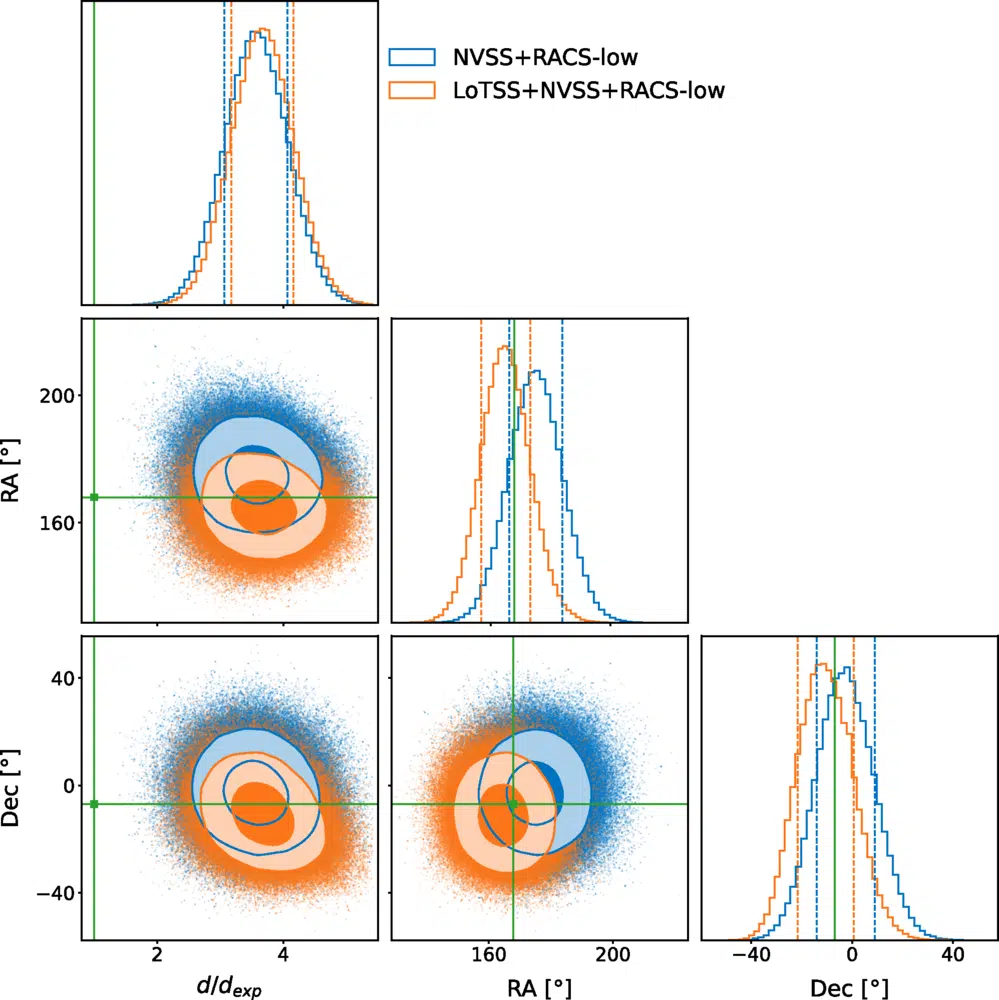 The amplitude is shown as multiples of the expected dipole amplitude, with the green lines and dot indicating the expected values based on the CMB dipole. Credit: Physical Review Letters
Motion Method Echoes Everyday Analogy
To conceptualize how astronomers measured this speed, the researchers used a familiar analogy. Just as passengers in a moving car see more raindrops on the windshield than the rear window, astronomers see more radio galaxies in the direction the solar system is traveling. According to EarthSky, this front-loaded visibility forms the foundation of their detection method, capturing the solar system’s motion without relying on internal measurements.
Unlike older approaches that inferred motion from within the galaxy, this method looks outward, focusing on external markers to triangulate our velocity. The observational clarity provided by radio data was crucial, as the signals can bypass interstellar dust and reveal deep-space structures that other wavelengths miss.
While the full implications of this discovery remain under scientific review, the findings have already sparked calls to revisit long-held beliefs about the structure and behavior of the universe.