
A few weeks ago, I sat in my local A&E waiting room nursing suspected broken ribs. It was a Tuesday night, and on arrival I was met with a scene of chaos: a packed, tense waiting room, with more than a hundred patients ahead of me, and a seven-hour waiting time projected to worsen as the night went on. People stood without chairs, others sat in clear distress, and few new names were called. Frazzled staff barked instructions as they struggled to cope.
At one point, a clearly distressed man began shouting at patients and was removed by security. Soon after, a woman with a clipboard entered and announced that anyone not on her list should leave, as they would not be seen. I listened anxiously as she shouted each name above the noise, and was relieved when mine was finally called.
A nurse assessed me and put me in the queue for a chest X-ray. Around me, people sat with serious injuries: an elderly man was bleeding heavily from the face and struggling to breathe; others grimaced with untreated fractures or wounds — fresh announcements warned of longer delays. One man who had been waiting for twelve hours refused another IV drip until he was admitted. The waiting time had risen to nine hours, and no one appeared to be moving through the system.
As tempers frayed, staff explained that only one consultant was on duty and that there were not enough doctors available to make clinical decisions. Patients began to self-discharge. The confused man with the facial injury slipped away quietly, and another woman with a severe limp left without treatment. When I asked the registrar about the X-ray queue, he told me there wasn’t one — because I wasn’t on the list at all. I would need to wait another two hours for a doctor to request it. He handed me painkillers and urged me to keep waiting.
Eventually, a doctor saw me for a consultation that lasted barely two minutes. An X-ray was deemed unnecessary for fractured ribs, which would not change the course of treatment. By then, it was 4am and I gingerly edged my way back down the corridor to ring a taxi home. It was an experience thousands across Britain now recognise: overwhelmed staff, failing systems, and a level of disorganisation that has quietly become the norm.
A&E is the visual representation of a broader crisis engulfing our healthcare system. Communication is poor or absent, equipment is outdated, and chronic understaffing has hollowed out the ability to provide timely care. People are dying. According to the Royal College of Emergency Medicine, overlong stays in Scottish A&Es alone contributed to more than 800 deaths last year. At the core of these delays is the shortage of doctors (especially overnight) who can assess, discharge, and move patients through the system.
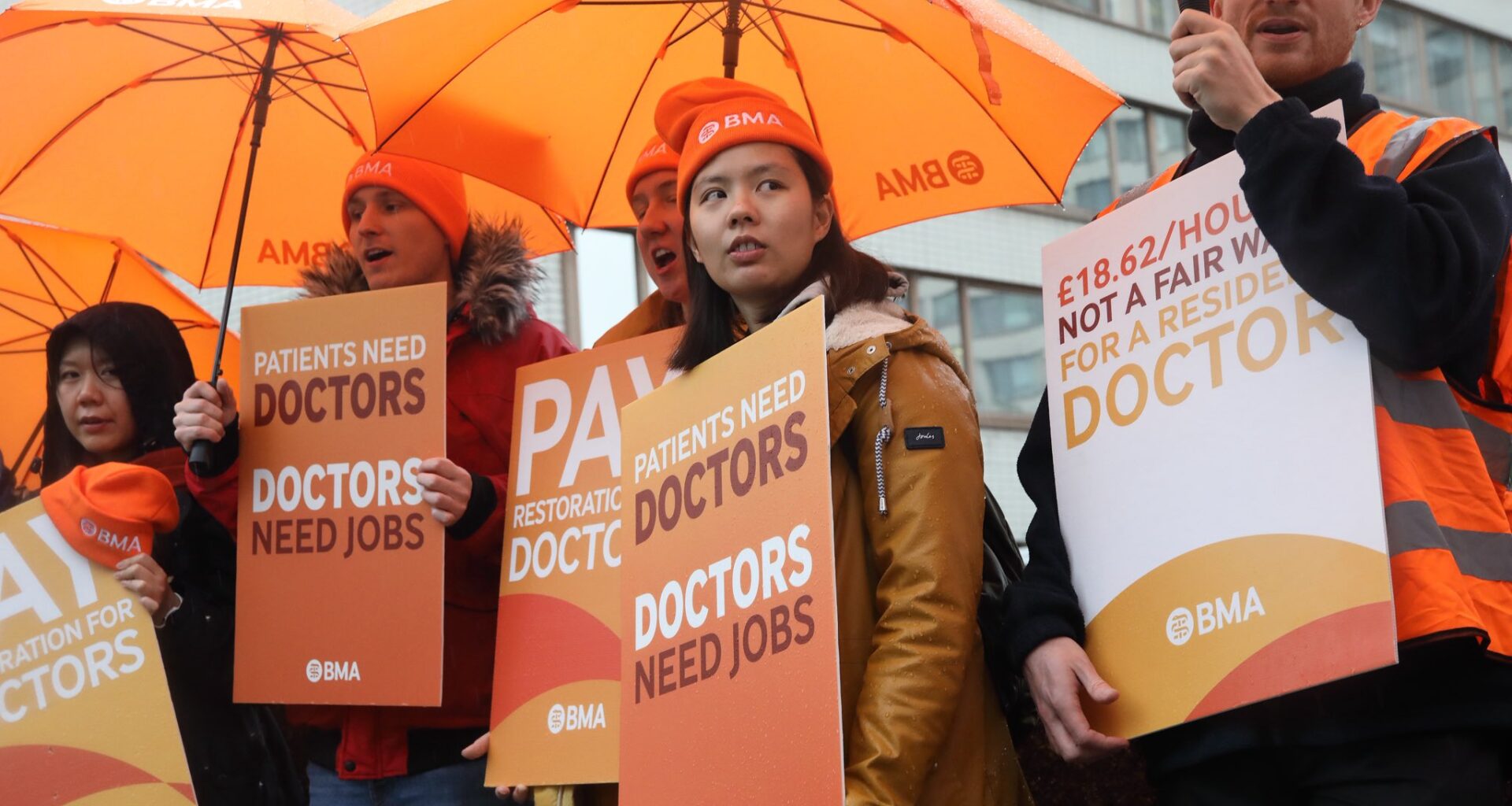
The issue of doctors’ pay restoration has now been bubbling for decades. In real terms, doctors’ salaries fell by 25 percent between 2008 and 2023. The much-vaunted 22.3 percent pay award delivered by the incoming Labour government last year was spread over two years and not adjusted for inflation. Even after the uplift, earnings for early-career doctors still lag behind 2010 levels by up to 10 percent.
These salaries remain above the national average, but that obscures the systemic dysfunction within which they sit. The UK has a severe shortage of consultants and senior medical staff. Almost 60 percent of consultant departments report at least one vacancy, and daily trainee rota gaps are widespread. The Health Foundation projects a shortfall of nearly 9,000 GPs by 2030; NHS England’s own modelling puts the GP deficit at 15,000 by the mid-2030s. The UK has around three doctors per 1,000 people — far below the EU average of 4.2 — a gap that amounts to roughly 82,000 missing doctors.
Yet despite this, the government continues to cap medical school places and limit training posts. In 2024, over 24,000 people applied for just 10,000 medical school places in England. After completing their Foundation training, doctors must compete for specialist posts to advance — but shortages mean some specialisms attract four to twelve applicants per place. A third of resident doctors had no role lined up for August this year, and more than half of Foundation Year 2 doctors lacked any confirmed substantive post.
The government justifies these caps on cost grounds, but this is a false economy. By restricting training now, the NHS engineers the shortages that later force it to rely on agency and locum doctors. The hourly rate cap for agency locums is fifty-five times higher than that of a full-time doctor. The NHS spends £3 billion annually on agency doctors alone, and more than £10 billion per year on agency and bank staff combined.
Understaffing fuels burnout, which in turn reduces productivity, worsens patient outcomes, and accelerates staff attrition. Continuity of care, which relies on stable full-time staffing, has been shown to reduce mortality and emergency admissions. Instead, rising sickness absence costs the NHS around £2.4 billion a year. Malpractice payouts topped £2.8 billion last year, with avoidable harm estimated at more than £5 billion annually.
Much of the public debate fixates on doctors leaving for Australia or Canada, where salaries are dramatically higher. But an increasing number now leave not the country, but the NHS itself — opting for locum or private work with fewer responsibilities and far better pay. It is a rational response to a system increasingly resistant to retaining its own workforce.
Rather than investing in training and retention, the government has channelled funds into the de-skilling and de-professionalisation of the workforce. In 2024, £1.44 billion was spent expanding ‘multidisciplinary roles’ in primary care, including physician associates (PAs) and nursing associates, intended to plug gaps left by doctor shortages. PAs were designed to perform limited clinical tasks under supervision. But in the context of chronic understaffing, they are routinely pushed beyond those limits. Several deaths and serious incidents have been linked to PAs acting outside their competence, and the 2025 Leng Review found that PAs are now directly competing with resident doctors for scarce training opportunities. Seventy per cent of doctors report that the introduction of PAs has harmed their training.
The trend extends beyond PAs. Since 2010, the number of unqualified clinical support staff — healthcare assistants, support workers, assistant practitioners — has risen by 40 percent. These roles are cheaper and quicker to train, but they are not substitutes for fully qualified doctors or nurses. The result is a workforce stretched to breaking point, where responsibility is increasingly shifted onto people without the training to safely carry it.
Public support for doctors was high during their initial campaign for pay restoration, buoyed by the solidarity of the pandemic. But that support has softened, in part because the term ‘junior doctor’ (officially renamed ‘resident doctors’ in 2024) misleads the public into imagining inexperienced trainees rather than the broad category that includes nearly all doctors below consultant level. Many will spend their entire careers under that label. Without pay that reflects the realities of the job, the NHS will continue to bleed talent and lose experience it cannot replace.
None of this can be fixed by pay alone. A sustainable workforce requires long-term planning, stable training pipelines, and a commitment to retaining experienced clinicians. Yet government fiscal rules — aimed at reducing debt by year five — push ministers toward short-term fixes rather than long-term investment. Training more doctors will take years, but without it the crisis will deepen. In the meantime, the government relies on temporary staff and non-clinical roles to paper over structural cracks.
Wes Streeting, the Health Secretary, repeatedly points to private healthcare as a solution to NHS waiting lists. But private hospitals draw from the same workforce as the NHS; they do not have a separate pool of doctors. This was laid bare during the pandemic, when private hospitals were block-booked, yet many beds sat empty because there were not enough staff to operate them. Government policy appears to have forgotten the lessons from decades of outsourcing and public-private financing which already left the NHS burdened with escalating costs for minimal improvements in clinical outcomes. Perhaps there is a simpler reason that Streeting fails to grasp the dynamics of the situation, having received £372,000 in donations from interests linked to private healthcare.
Crucially, without pay restoration and a wider process of reforming and investing properly in the NHS and its workforce, the crisis in our healthcare system is only likely to deepen. For anyone who cares about the future of the NHS, the doctors need to win.