
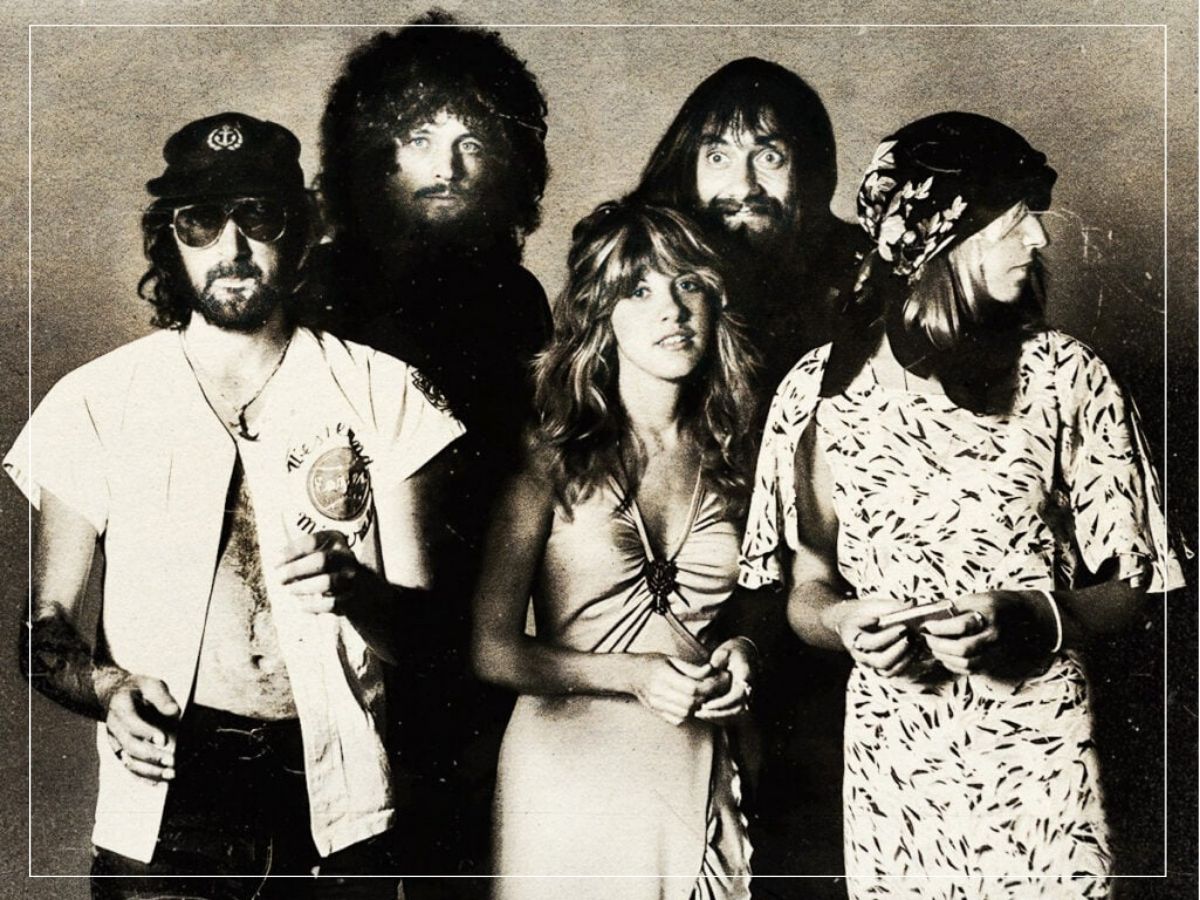
(Credits: Far Out / Alamy)
Tue 18 November 2025 18:54, UK
Like many families all over the world, despite sharing the same name, the various lineups of Fleetwood Mac had almost nothing in common.
Drummer Mick Fleetwood and bassist John McVie, the band’s two titular figures, remained consistent throughout each incarnation, but that’s where most of the similarities end. Across seven decades, Fleetwood Mac has shuffled members, genres, lawyers, and popularity levels, all while doing whatever was necessary to survive.
The original version of Fleetwood Mac was helmed by blues guitar god Peter Green, creating a bluesy sound. After Green left the band in 1970, no fewer than 11 guitar players would come and go from the official lineup. Many times, these poor departing members would do so under an air of unfortunate tragedy.
The band’s other founding guitar player, Jeremy Spencer, would follow Green out the door in 1971, while third guitarist Danny Kirwan would do the same in 1972. Green’s departure left a void in the band, but it did open up a space for McVie’s wife, Christine Perfect, to join as a keyboardist and co-lead vocalist.
Throughout the early 1970s, three different singing guitar players vied for the role of band leader: Brits Bob Weston and Dave Walker, plus American Bob Welch. It was Welch who would eventually land the job, however, pushing Fleetwood Mac into a jazzier adult contemporary sound that foreshadowed their next genre shift. When Welch left the group at the end of 1974, Fleetwood stumbled on a young Californian guitarist named Lindsey Buckingham. When asked to join, Buckingham agreed on the condition that he was able to bring his partner, Stevie Nicks, into the fold as well.
 Fleetwood Mac in the 1960s. (Credits: Far Out / Columbia / Sony BMG)
The Buckingham-Nicks lineup of Fleetwood Mac would be the one that propelled the band to global superstardom. Taking on a more pop-friendly approach that was miles away from their original blues sound, Buckingham and Nicks held little reverence toward the original sound of Fleetwood Mac. Still, especially during their pre-Rumours concerts, Fleetwood Mac had to try and hang on to the fans they had accumulated over their first decade.
Buckingham dutifully took on material that had been written by his predecessors during live shows, including Welch’s ‘Hypnotized’ and Green’s ‘The Green Manalishi (With the Two Prong Crown)’. But when he also decided to integrate Green’s ‘Oh Well’ into shows, Buckingham was continuing a tradition that had filtered through each Fleetwood Mac lineup.
Originally written and released as a single in 1969, ‘Oh Well’ was a number two hit in the UK, giving Fleetwood Mac their second-highest charting single behind the chart-topping ‘Albatross’. The riff-heavy first part of the track was a live staple, and when Green stepped down as band leader, Welch took over the riff and continued to play it in live shows. Walker briefly took the reigns on ‘Oh Well’ before Buckingham was given the responsibility.
When Buckingham left Fleetwood Mac in 1987, the band hired two different guitarists to replace him: American Billy Burnette and Rick Vito. To bridge the gap between lineups, Burnette opted to incorporate ‘Oh Well’ into the band’s sets, even though the song was well over 20 years old at that point. Former Traffic guitarist Dave Mason joined the lineup in 1993, doubling up on the ‘Oh Well’ riff as Burnette continued to sing it until Buckingham returned in 1997.
When the Buckingham-Nicks lineup reunited for 1997’s The Dance, ‘Oh Well’ was given a more-or-less permanent retirement from setlists. That would be until 2009, when Buckingham decided to once again reintroduce ‘Oh Well’ into the band’s repertoire. The song was played more than 80 times that year alone, giving ‘Oh Well’ its most frequent exposure since Burnette sang it at almost every Fleetwood Mac show throughout 1990.
Buckingham was fired acrimoniously in 2018, and Fleetwood Mac once again brought in two separate guitarists to replace him. Crowded House singer Neil Finn handled most of the vocal duties, while former Tom Petty & the Heartbreakers guitarist Mike Campbell was brought in to cover Buckingham’s lead lines.
During some of their final touring years, Petty and the Heartbreakers often covered some of their favourite rock classics in concert, and ‘Oh Well’ was one of those songs. When Campbell joined Fleetwood Mac, he took on ‘Oh Well’ as his spotlight song, making it the only song to have been played by every incarnation of the band.
It makes it all the more ironic that Mick Fleetwood went as far as to be that the song would be a flop. Not only has it been a live staple, Mick was proved wrong in plenty of other ways too, with it being covered endlessly, by everyone from Haim to Deep Purple, and becoming the composition that somewhat cracked America for the group under Green.
Check out the original version of ‘Oh Well’ down below.
Related Topics