
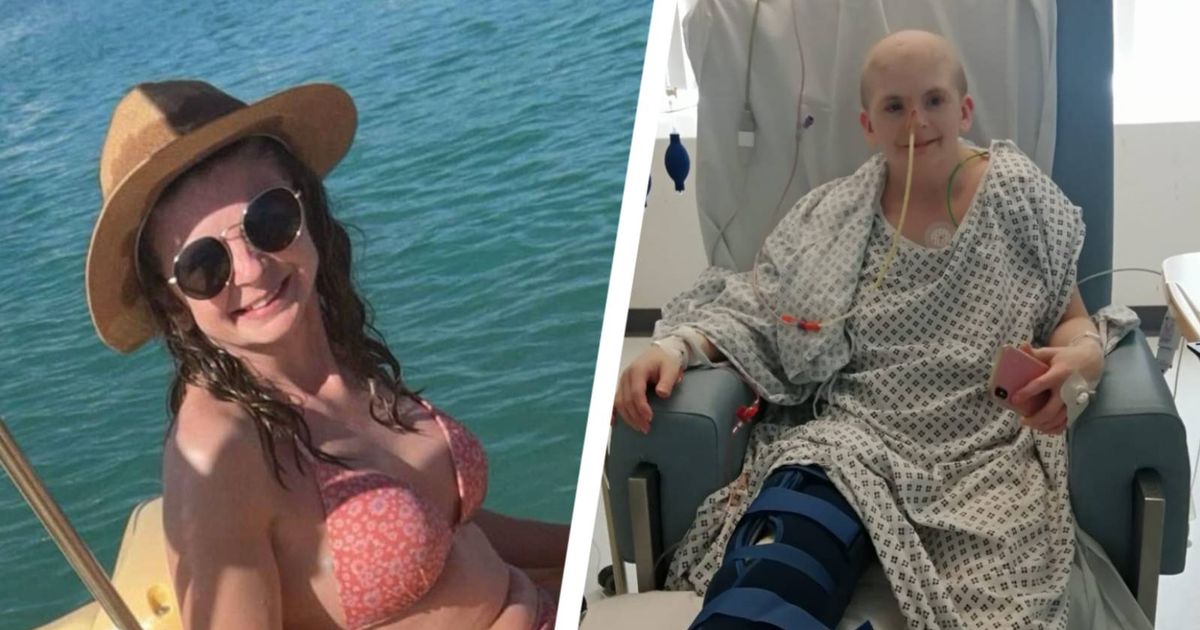
Amy Newton, 36, was told she had bone cancer after a date left her with two fractured femurs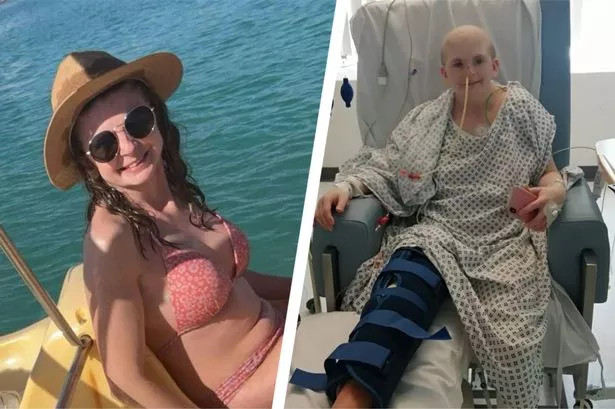 Amy Newton, 36, fractured her right femur in two places while on a date climbing
A woman learnt she had cancer after breaking her leg in two places whilst on a date. Amy Newton fractured her right femur in two places whilst indoor climbing in January last year.
What the 36-year-old believed was simply a painful accident turned out to be the beginning of a life-altering experience. She explained: “I probably shouldn’t have gone on that date because my leg hadn’t felt right for a few months.
“It felt like a pulled muscle, but if I hadn’t climbed that wall and fractured my leg, I’d never have discovered the tumour in the bone. But one thing’s certain, no matter how much I try to forget that date, I never will because it probably saved my life.”
Whilst in A&E, Amy anticipated a broken bone, however X-rays showed the bone was cracked in two places and something else had appeared on the image, requiring an MRI scan. Later that evening with her best friend beside her, Amy learnt the MRI had identified a tumour on her bone which had caused the bone to weaken, meaning any pressure on her leg could cause it to break.
Amy, from Middlesbrough, recalled: “When they said it was a tumour I couldn’t breathe. I kept saying you’ve got the wrong person. It’s not me you need to be talking to. To say I was heartbroken and devastated is an understatement.”, reports Teesside Live.
Amy had to remain in hospital that night, beginning a two-week stay, during which she started breaking the devastating news to her nearest and dearest. Amy said: “Telling my parents and close family and friends was the hardest part, especially as I knew it would turn their lives upside down. My mum was living in Fuerteventura and had to drop everything to fly home.”
On 15 February last year, biopsies confirmed Amy had osteosarcoma, a form of bone cancer. She commenced a chemotherapy combination known as MAP, comprising the drugs methotrexate, doxorubicin and cisplatin, which target rapidly dividing cancer cells.
The day before chemotherapy was scheduled to begin, Amy suffered a freak accident in a park whilst getting some fresh air with friends. Whilst being pushed in her leg extender wheelchair, a dog collided with Amy’s already fractured leg and snapped it completely, compounding an already traumatic situation.
Amy, who was living in Cirencester at the time of her diagnosis, said: “I’d always said I’d never move back to Middlesbrough after building a new life in Cirencester. But when I found out I had cancer, everything changed.
“My mum relocated from Fuerteventura to care for me, and I knew she needed a strong support network around her. That’s when I decided to move back to Middlesbrough and transfer to a new hospital.
“My family and friends supported me throughout and I can never thank them enough. My mum stayed with me throughout it all and moved back from the Canaries to be with me.
“After starting my chemotherapy in Bristol, I was then transferred during a seven-hour ambulance journey to the Northern Centre for Care at the Freeman Hospital in Newcastle, where I had my leg operation and was in hospital for 100 days on Ward 35.”
Following her second course of chemotherapy, Amy underwent limb-preserving surgery to extract the tumour and replace the affected bone with a metal implant and knee replacement.
Amy received three courses of chemotherapy in total, less than initially anticipated owing to serious side effects that resulted in sepsis and complications linked to Diamond-Blackfan anaemia (DBA), a pre-existing condition. The rare blood disorder re-emerged during treatment, necessitating weekly blood transfusions for Amy.
The management of DBA introduced additional challenges to Amy’s cancer treatment. The condition develops when the bone marrow fails to generate sufficient red blood cells for the body’s requirements.
Amy had undergone treatment for the disorder during childhood, and it had remained dormant for many years, necessitating only regular monitoring appointments. Regrettably, the chemotherapy interfered with her bone marrow’s functionality, triggering the recurrence of DBA and the requirement for continuous transfusions.
Amy said: “My only mission during treatment and recovery from the operation was to stay alive, but after treatment I had to learn to walk again and I had physiotherapy for a year to regain my strength and confidence in my leg. I was continually worried that my leg would give way.
“The emotional impact of the diagnosis also hit me, and I had to reframe it in my mind and try to find purpose in my diagnosis and experience.”
Amy finished treatment in October last year and recently marked her one-year cancer-free anniversary.
She now walks without assistance following a year of physiotherapy with an “incredible physiotherapist” and attends regular check-ups every three and six months with her oncologist and surgeon. Despite her ordeal, Amy maintains a positive outlook.
She said: “It would be easy to let this diagnosis define me, but I won’t. I started journaling, meditating, and therapy to stay in a good mindset. I didn’t just want to sit at home and dwell on the negatives.
“Although I absolutely had my dark days, I want to give hope and help others going through cancer and to show that positive stories can come out of cancer.”
Amy now says she’s ‘still standing’, thanks to the power of research, and is sharing her experience to help raise funds for the joint fundraising campaign from Cancer Research UK and Channel 4.
Stand Up To Cancer takes developments from the laboratory and accelerates them into new tests and treatments. With cancer cases rising, Amy recognises the urgent need to make faster advances.
‘Behind every statistic is someone like me’.
Over the next 15 years, more than an estimated 340,000 new cancer cases are anticipated in the North East, and by 2040, projections suggest one person in the UK will receive a diagnosis every two minutes. Amy said: “Behind every alarming statistic is someone like me.
“That’s why I’m taking a stand. Being diagnosed with cancer was a huge shock, but I owe everything to developments in research and better treatments.
“I was part of the SarcoSight trial, which uses fluorescence guided surgery (FGS), to show the tumour’s precise location during removal. I’ll be forever grateful for what they have been able to do for me and I’m so conscious others aren’t as fortunate.
“I want to give hope and show that there can be positive stories to come out of cancer. Cancer can affect anyone’s life, at any time, so we really have no choice other than to unite against it and help support the scientists to keep making new discoveries.
“I have raised over £2,500 for two cancer charities, I volunteer at a wellness centre and am currently writing a children’s book. I’m just always looking for ways to embrace my life and live life to the fullest. I have just got the go ahead from the local council to put Kindness Postboxes in my local community hub to help spread kindness with positive quotes and notes.”
Thankful for the care she was given, she’s now urging residents throughout the region to back Stand Up To Cancer. Since launching in the UK in 2012, Stand Up To Cancer has generated over £113m, supporting 73 clinical trials and research initiatives involving more than 13,000 cancer patients.
Amy added: “Success stories like mine show that there is hope. Every action, big or small, could make a difference in beating this devastating disease. That’s why now is the time for everyone across Middlesbrough to Stand Up To Cancer.”
The initiative is helping to revolutionise cancer treatment. Significant research achievements include the CaPP3 clinical trial, which discovered that taking 75–100mg of aspirin daily can reduce bowel cancer risk by half in individuals with Lynch syndrome – a hereditary condition that increases disease likelihood.
Doctors may soon be able to prescribe low-dose aspirin to help safeguard those with the condition.
Cancer Research UK spokesperson for the North East, Lisa Millett, said: “Thanks to our supporters, our scientists are trailblazing new and better ways to help more people like Amy survive. From using AI to optimise radiotherapy treatment for rectal cancer to creating lollipops that could detect mouth cancer, we’re at the cutting edge of research. But we must go further and faster.
“Almost one in two of us will get cancer in our lifetime.**** All of us can help beat it. If thousands of us stand together, we’ll speed up the progress of vital research – meaning more people live longer, better lives, free from the fear of cancer.”