
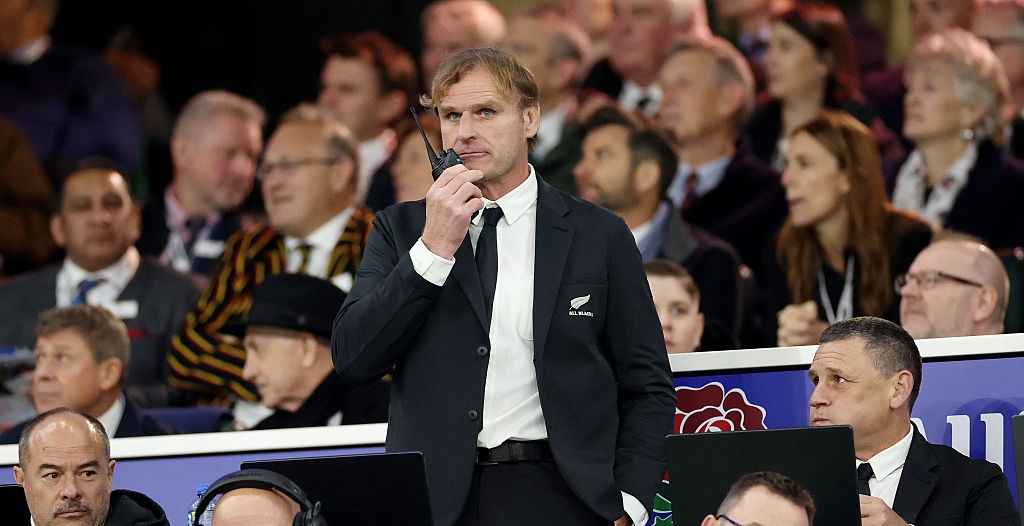
Before I say what I’m going to say, I want to be clear that I’ve been in Scott Robertson’s position. I’ve been head coach of a rugby-mad nation, and I’ve had to face the music, after being flown back for an audience with the SARU board. Pressure was put on me to fire my coaches, Allister Coetzee and Gert Smal but I was steadfast and said no, and the following year, we lifted the World Cup. If you look over to the Land of the Long White Cloud, Ian Foster was asked to do the same, and he reneged, replacing John Plumtree and Brad Mooar with Jason Ryan and Joe Schmidt. That coaching team took the All Blacks to within two points of winning the World Cup. Stick or twist is the perennial teaser in elite sport.
One aspect I’ve always been envious of is how New Zealand always seem to get their succession planning right, and I say that in a respectful way. The methodical, thorough way in which they pick their coaches is to be commended. The thinking goes that you have to serve your time and work your way up the coaching hierarchy. They won’t just parachute in say, Richie McCaw or Sean Fitzpatrick, just because they were revered captains, and I like that — not that I’m criticising any unions who have fast-tracked ex-players before time.
Anyway, as a coach who went through the system, I admire how they reward those who have gone through the right channels and worked their way up. As South Africa coach, when I went into the sheds and saw Sir Jock Hobbs, Sir Brian Lochore and Sir Graham Henry holding court, I saw an elite calibre of individual integrating with players and passing on their coaching IP. In James Kerr’s Legacy, there is a deep dive in how they go about their business, which has gone into folklore.
However, if you fast-forward 21 years to the modern day, maybe, just maybe, it has become outdated. We live in an era where fans crave instant success, patience is a precious commodity and more rugby coaches are fired without getting a chance to turn things round.
Having listened to the musings of former All Blacks in recent weeks, I would say one of the aspects the hierarchy have to reassess is their process in appointing coaches.
To my understanding, as an aspiring head coach, when you present to the New Zealand board, you present your masterplan, you name the coaches you want to work with and you explain why.
If there are three or four coaches vying for the head coach, they can’t pick the same assistant coaching staff. For me, if you look back seven or eight months, I’d have seen merit in that, but with the benefit of hindsight maybe that’s the problem, because results have dipped, and they may need to bring in fresh blood if they are to have any chance of winning the 2027 World Cup.
Look at what Lee Blackett has done for England or Tony Brown has done for the Springboks. Both coaches joined mid-term. If the head coaches are forced to cement their coaching set-up to the final day of their tenure, maybe that fixed model is no longer fit for purpose and more flexibility is required. It’s a question, not a statement and I’d love to know what fans think. Over the close season, they may privately admit their processes need modernising.
Blackett has transformed England’s backline, even faster than he transformed Bath’s. Take George Ford. Many were writing him off, but he went on tour to Argentina, hurting, having missed the Lions, and he’s come back and is getting picked ahead of Fin Smith, Marcus Smith and Owen Farrell. Seemingly Blackett improves players and he gets the best out of them, so you have to credit England Rugby for getting their man.
Under the New Zealand model, he wouldn’t have been part of the first-choice coaching staff. He’d have been part of another coaching ticket with Jamie Joseph or Leon MacDonald and having to wait years for his turn. To my mind, if they pinpoint the right guy, they just have to make room for him.
I raised an eyebrow at one quote Razor made about his coaches ‘still learning on the job’, which is not something you’d historically see with an All Blacks coaching team. That’s not a maxim etched into high performance. It’s the same for the players. I saw Richie McCaw saying last week you have to be ready in an All Blacks shirt and it’s the same for coaches. That wouldn’t have been said 10 years ago, I can assure you. It would have been sacrilegious. Their win record in that stellar period under Steve Hansen was 93% and now it’s down to 69% so their slide is irrefutable. The problem is they were seen as the benchmark to excellence. Rugby’s cognoscenti told us that they were considered not only the most successful rugby team of all-time but one of the best sporting teams ever. It’s a bit like Grey College in Bloem. They have a 90% win record over the last 100 years, and if their standards dropped like that, there would be questions.
So, what’s happened? Is it because Super Rugby has changed? Is it because the player pathway isn’t quite as good? As outsiders, we’re still boxing in the dark in trying to answer those questions, and now the All Blacks hierarchy will have to solve them. It’s funny, when you create a dynasty, as fans, you think it will go on forever. Look at Manchester United. When Sir Alex Ferguson was carried off after winning the league for a record 13th time, few would have thought they would be craving another title 14 years later. There is no God-given right for any sporting side to remain successful. That aura you build up can come crashing down with a few egregious decisions. To sum up, this is a watershed moment for them in their 122-year history. I have no doubt they will become leaders again and they will turn it around because there is no way a rugby-mad country like that will not find answers, but it won’t be easy.
So, what of the chasing pack behind the Springboks? Well, it’s clear England have turned a corner, but a note of caution. They must be wary of crowning themselves World Champions before they’ve got there. They can’t start believing their own press. Saying that, they’ve won 10 on the spin and are looking like genuine contenders. I saw Austin Healey saying Borthwick’s got a lot of flak in the last couple of years for getting things wrong, but now he’s got it spot on with his coaching appointments and using a ‘Pom’ squad — he deserves a pat on the back.
As for France, they need Antoine Dupont back but even with him back in situ, there are more questions than answers before the Autumn Series.
Of the other World Cup contenders, I would say Argentina are in a very good place as dark horses. They are starting to drum up significant wins. That comeback against Scotland was one of the greatest ever in Test rugby, so chapeau to Felipe Contepomi.
As for Ireland, they will be under the spotlight until they get past the World Cup quarter-final. I’m not sure how much that win over a fatigued Wallabies tells us, and despite a huge game with the Springboks this weekend, we’ll only really know where Farrell’s men are after the Six Nations, when they’ve played England and France.
I want to make one final point about red cards and body height, especially with locks. The average rugby fan will say, ‘oh, that isn’t so bad’ when a card comes out and of course, there will always be a country bias to whether you agree or disagree with decisions, but let’s take the Lood de Jager example when he tackled Thomas Ramos and saw red. If you replicated that incident in a schoolboy game and an 80kg lock cleaned out a 50kg full-back, parents would be saying, ‘get that player off the pitch’. You see, the laws aren’t made for professional players who are conditioned to contact sport, law changes have been brought in to make the game safer from the bottom up, not from the top down. I hope the rugby public will one day see the bigger picture and not just blame conspiracy theories that officials are out to get players and forever blaming inconsistencies.
As ever, I’d love to know your thoughts.