
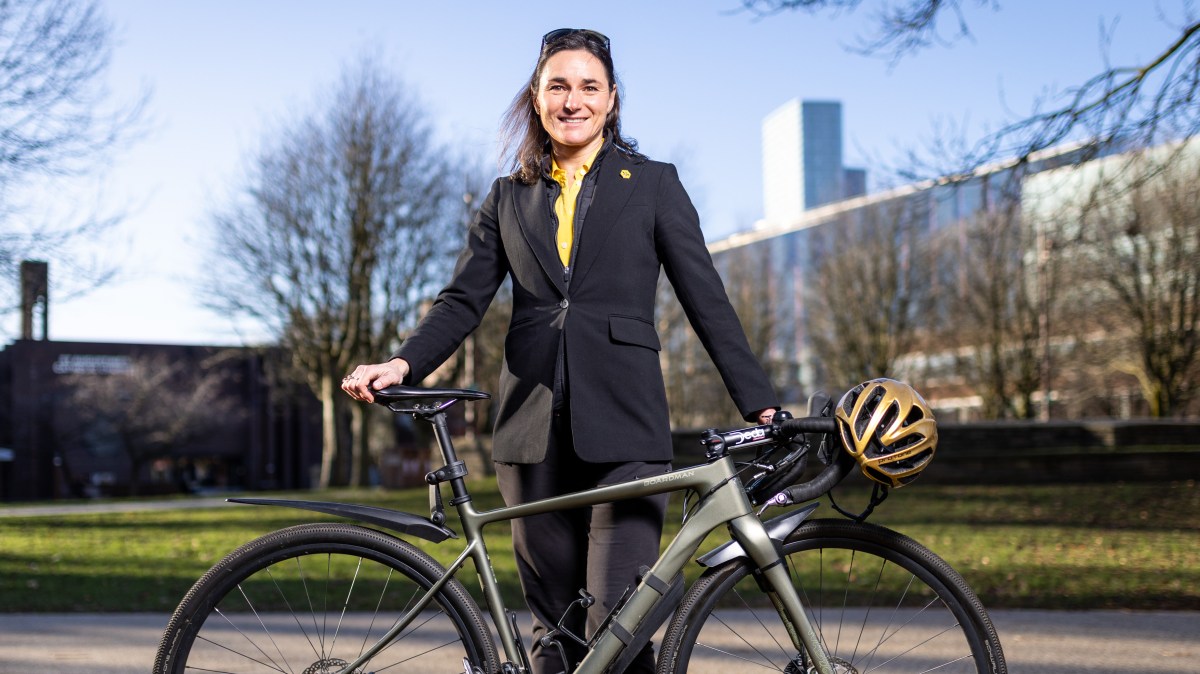
Dame Sarah Storey is passionately outlining the benefits that can be brought to a society that recognises the true value of a bicycle. As a cyclist herself, one with the small matter of 19 Paralympic gold medals to her name, she would like to see more bikes on the road and to see those roads made less intimidating by the ever-expanding size of cars. But she also believes that wider recognition of how many journeys can be made by bike could prevent many families from buying a second car that they may struggle to afford.
“We have over 400,000 journeys a day across the Greater Manchester region that are one kilometre or less and still done in a vehicle — a huge number of vehicle journeys that could otherwise have been walked or cycled,” Storey says. “We’re not saying cars aren’t needed, they definitely are. But where people can’t afford cars, bikes can solve so many problems.”
Storey, 48, is talking at the launch of The Times and Sunday Times Christmas Charity Appeal 2025 in support of World Bicycle Relief, an organisation founded in response to the Indian Ocean tsunami in 2004, when more than 24,000 bicycles were distributed to displaced survivors in Sri Lanka. This year, the Christmas appeal is supporting World Bicycle Relief; Switchback, a prisoner rehabilitation charity; and Kissing it Better, a charity working to end loneliness by bringing young and old people together.
• Donate to The Times and Sunday Times Christmas Appeal
A key element of World Bicycle Relief’s success has been its signature Buffalo Bike, designed to be durable in extreme weather conditions, and with a rear rack that can carry cargo of up to 100kg.
More than two decades on, the charity has distributed more than 950,000 Buffalo Bikes across Africa, southeast Asia and Latin America. Its mission has expanded to 21 countries, providing bicycles, spare parts and mechanical training to people that would otherwise be unable to go to school, find medical treatment, fetch water or operate businesses.
Storey extended her record as Great Britain’s most successful Paralympian in Paris last year, winning gold medals in the road race and the time trial. She has competed in nine Paralympic Games, four as a swimmer and five as a cyclist.
She intends to return to competition after recovering from an ankle injury, but she also works as the active travel commissioner for Greater Manchester, campaigning for the infrastructure and accessibility for bikes that would incentivise more people to travel on two wheels.
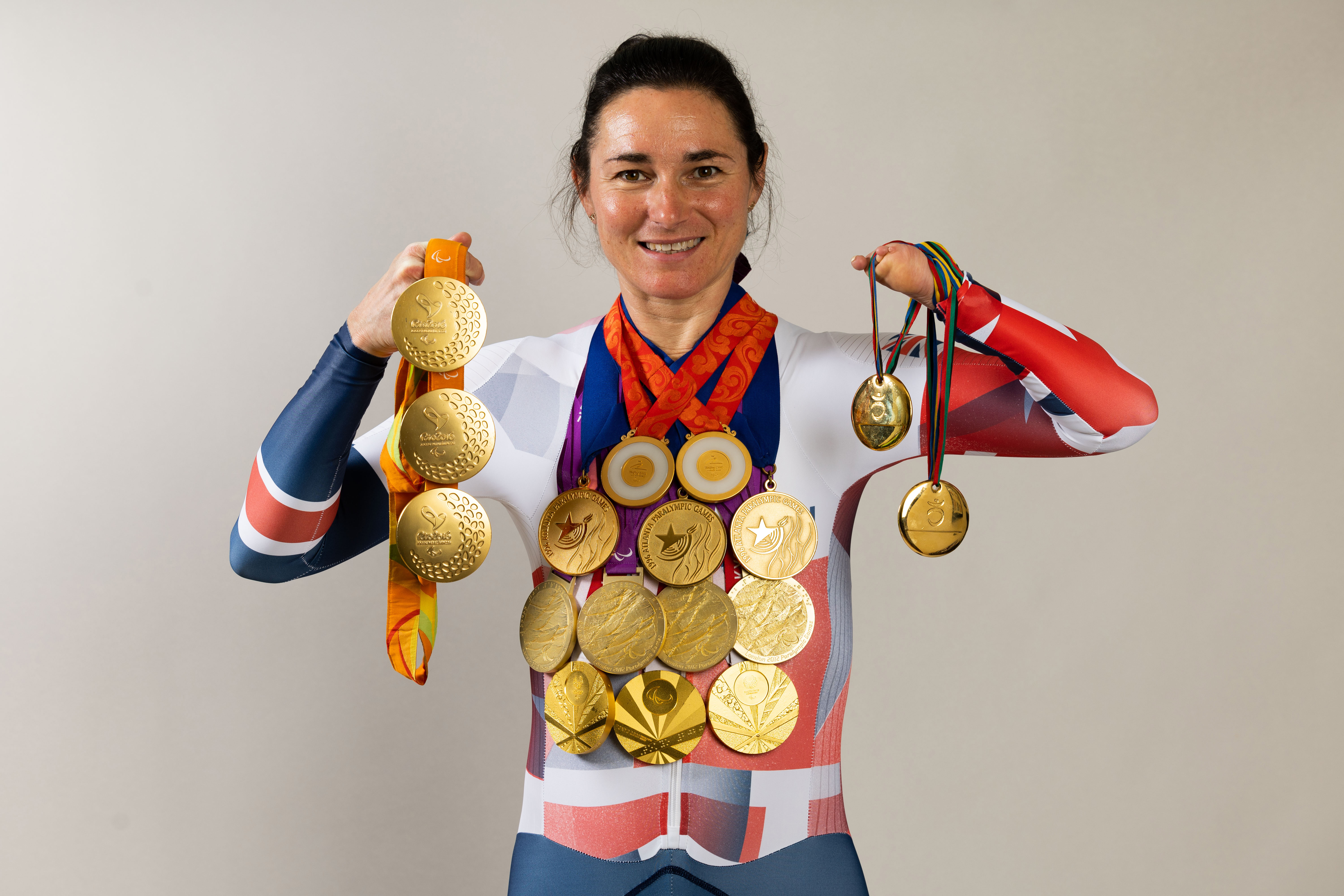
Storey with 17 of her 19 gold medals from nine different Paralympics
MICHAEL STEELE/GETTY IMAGES
A recent conversation with her aunt made Storey realise that the readiness to ride a bike had diminished in recent generations.
“My auntie’s 82 now and she was talking about how she regularly used to cycle from Romiley to Poynton [a 16-mile round trip in Cheshire] with one of her friends on a weekend when she was young,” Storey says. “Children had a much bigger circle of roaming, bikes provided that roaming ability and I think other [road users] looked out for cyclists with more care. We need to be aware of how many more people would benefit if it was easier to cycle more often.”
The simple value that can be added to a community by a trustworthy bike is vividly illustrated, Storey feels, by the work of World Bicycle Relief in rural areas around the world. A bicycle can turn a two-hour walk to school into a 20-minute ride, community health workers equipped with bicycles are able to conduct 45 per cent more home visits, and a bicycle can increase income for farmers and traders by 30 per cent or more.
World Bicycle Relief is providing crucial access to healthcare in rural Malawi
“The Buffalo Bike looks amazing, it’s almost bulletproof,” Storey says. “One of the barriers to riding a bike is that people feel they can’t carry their kit or their luggage and that cargo bags are too expensive. But a bike that’s able to carry 100kg on the back pannier is fantastic. It’s inspiring to see what World Bicycle Relief are doing to enable people to cycle in some of the underserved communities across the world.”
Another fundamental aspect of the charity’s work is that it trains and equips thousands of local mechanics, ensuring bicycles can be repaired locally and remain on the road for years.
“A bike is much more simple to maintain than many people realise and I know that can be another barrier to cycling,” Storey says. “The Buffalo Bike looks really sturdy and easy to maintain, and if you have mechanics trained to show others how simple it can be, that’s another way to encourage people to ride their bikes.”

World Bicycle Relief’s Buffalo Bikes
GARETH BENTLEY
Storey feels that there are lessons to be learned from the robustness of these bikes in shared bike schemes closer to home, such as the Bee Bikes in Manchester or Santander Cycles in London. “We see how challenging it can be for shared hire schemes, with frequent headlines about the brakes not working or that they’re not suitable for hills,” she said.
“We can take inspiration from what’s happening around the world in less connected communities. They might have extreme temperatures or monsoon conditions and the Buffalo Bike has been shown to work in those areas. Just getting a bike that people feel confident using, and that they know they can look after themselves, is a big step forward. We could look at that closer to home, especially in rural communities in the UK where there’s a huge amount of reliance on a vehicle.”
In urban areas, meanwhile, the mindset shift towards cycling more often could be harder to achieve with larger vehicles roaming the roads. “Our vehicles have got bigger and bigger, you only have to see that famous photo of two Minis sat next to each other, the model from the 1960s versus the [wider] one of today, and it’s a metaphor for what’s happened to all vehicles.
“Sadly, for so many people on bikes the presence of larger vehicles does feel intimidating. By trying to make life more convenient at one end, with bigger cars, what we’ve forgotten is that the vast majority of people would previously have had a bike to do some of those journeys. Access to a bike and safe cycling can change people’s lives, whether that’s abroad or closer to home, and that’s something we should all be interested in.”
Find out more about the Christmas appeal and donate by calling 0151 286 1594 or by clicking the button below.