

After more than a decade of having sand kicked in its face by the American markets, the FTSE 100 has finally discovered some of its inner Charles Atlas. It was knocked on its backside in April by Trump’s “liberation day” tariff threat but since then has had a good run, zipping up from about 7,700 points to about 9,500 and regularly posting record highs over the past two months.
This is an overdue revival and a measure of vindication for the hardy City types who run UK-focused funds. For years they have been stuck records, pointing out how London was undervalued and how a renaissance was surely just around the corner. But a prophet is without honour in his or her own country and their ranks have thinned appreciably as investors have had enough of waiting for a revival and gone in search of tech razzle-dazzle in the US.
Fans of the UK should not crow too much. The FTSE 100 has done well this year but you can’t say the Americans have been utterly routed. Over the past 12 months, the FTSE 100 is up 17 per cent. In the same period the S&P 500, the broadest US stock index, is up 10 per cent. The Nasdaq-100, the FTSE 100 equivalent in the tech-heavy Nasdaq market, is up 16 per cent. If you go back five years, to when the pandemic had cast a shadow over all markets, this trio are up 50 per cent, 84 per cent and 102 per cent respectively.
• What’s more important — the budget or the Bank of England?
That is not the whole picture. The FTSE 100 does better on total return — that is, including dividends paid to shareholders and assuming they were reinvested in the index. Then the relative five-year performance of the trio is 80 per cent, 97 per cent and 110 per cent. London is still behind, but not by as much.
There seems an obvious reason why the FTSE 100 has woken up. Investors’ biggest worry is a bubble in AI companies. Worry is the wrong word; it is a growing conviction. The Magnificent Seven tech companies that so dominate the US stock market have set out plans to sink about one trillion dollars into AI kit. To believe there will be a decent return on all of that requires some big assumptions about AI uptake, people’s willingness to pay for it and the availability of sufficient electricity.
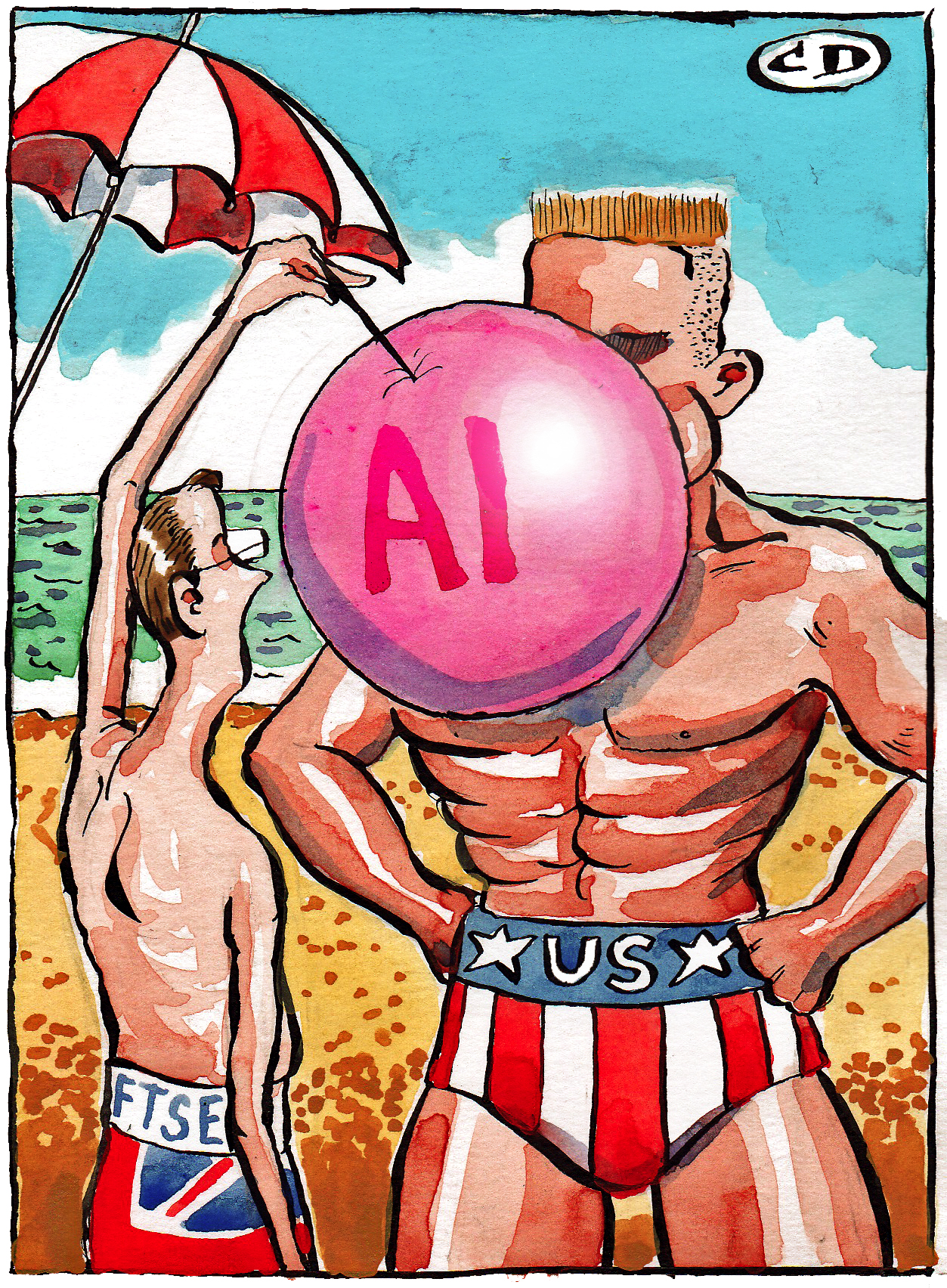
The bubble argument is strong, but so is the fear of missing out. There have been warnings of a bubble in tech stocks for more than a decade and yet they continued to go up. If you had baled out of Nvidia in January last year, for example, rejoicing that the share price had tripled over the previous 12 months, you would have missed out on it tripling again. To bastardise John Maynard Keynes, bubbles can stay inflated longer than you can stay solvent.
If you wanted out, however, the FTSE 100 should be a good alternative. It doesn’t have the Magnificent Seven but it does have banks, miners, oil and gas companies, drugmakers and a whole bunch of other organisations that are not running flat out on the AI treadmill. London should be that wonderful thing of which money managers dream, the uncorrelated asset; something that will move independently of another big investment.
• Early Shawbrook IPO trading points to new confidence in London
Events of the past week make you question whether this anti-AI argument is true. US markets sagged as fears about the dreaded bubble gained the upper hand, then rallied strongly, albeit briefly, after Nvidia, the bellwether AI stock, turned in better than expected results. It was short-lived and both the S&P 500 and Nasdaq took fright again. Up until Thursday, London moved almost exactly in sync with the US markets. Post-Nvidia it parted company, ending a smidgen up on Thursday.
That’s not conclusive either way. There was another snippet of evidence against correlation from the latest instalment of Bank of America’s regular fund manager survey, out this week. It found that in the past three months, managers had cut their exposure to the UK by the most in three years. That doesn’t speak to their buying the AI protection argument.
Lots of factors influence markets and it is probably wrong to look at the FTSE 100 solely through the lens of seeking shelter from AI. That said, if you are fearful of a burst bubble and want to stay in equities, it makes sense to go where AI is not. That should help keep the FTSE 100 away from the beach bullies for a while.
PS
The closure of the Mossmorran chemicals plant with the loss of 200 jobs isn’t much of a surprise — particularly if you read my recent interview with the Ineos boss Sir Jim Ratcliffe, or listened to it on The Business, our podcast. Ratcliffe said it was likely to close soon, thanks to high North Sea gas prices and carbon taxes. He was right.
He went on to make another warning, however. The closure of Mossmorran leaves the UK with just one cracker, a chemicals facility that takes oil and gas and turns it into the building block materials for making plastics. The last one standing is at Grangemouth, Ineos’s chemicals plant on the Firth of Forth. Ratcliffe regards it as a good plant, one that should make money but which doesn’t — for the same reasons that Mossmorran is to shut.
Grangemouth closing would be a serious blow for the Scottish economy, but it comes with an even bigger threat. It takes the feed from the Forties pipeline system, the only outlet for much of the North Sea’s output. Shut Grangemouth, Ratcliffe said, and you shut 60 per cent of the North Sea.
Dominic O’Connell is business presenter for Times Radio