
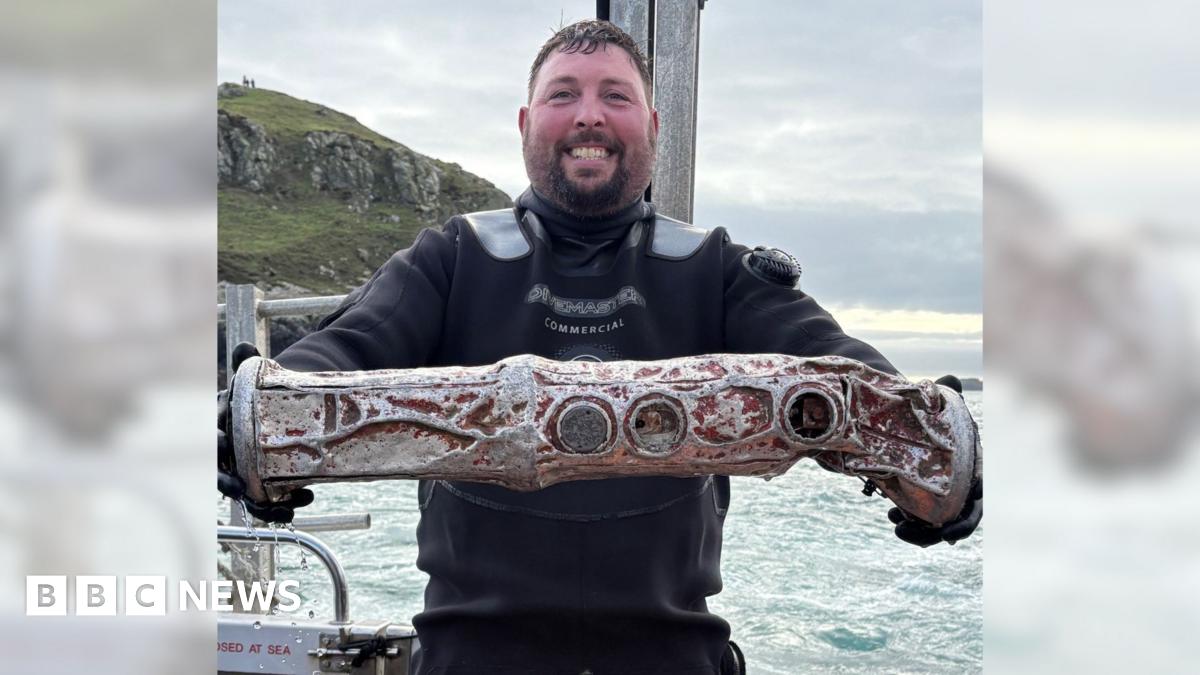
Though the diving group said it had not found anything similar before, the BBC understands it is not unusual for such items to be found on the seabed around the UK given the decades of naval activity in these waters.
A Royal Navy spokesperson said: “We do not comment on specific underwater activities or individual finds due to operational security considerations.
“The Royal Navy continuously monitors and protects UK waters with a range of maritime assets and work closely with allies and partners to maintain maritime situational awareness and deter threats to UK interests.”
An independent defence analyst and submarine expert, who did not wish to be named, said he was “confident” the recovered object was a Russian RGB-1A sonar buoy, a type typically deployed by Russia’s Tu-142M long-range maritime patrol aircraft.
He added: “Although there are suggestions that the device is no longer in active use, several of the same model have been found on beaches in UK, Ireland and Lithuania in recent years.
“Their presence, and relative lack of marine growth, suggests that they were likely dropped recently.”
Dr Andy Scollick, a strategic defence consultant, also identified the device as a “Russian hydroacoustic buoy of type RGB, probably RGB-1”.
He highlighted the similarities between the newly recovered device and previously identified examples, including three vertically aligned hydrophones and signs consistent with deep-water implosion.
He said the device was missing a sleeve, which would have been painted orange with a serial number marking.
Reports of comparable devices washing ashore have also emerged from Russia’s Novosibirsky region in 2023 and Lithuania in 2024.