
A boy of three with a devastating inherited disorder has shown an ‘amazing’ response after groundbreaking gene therapy at a British hospital.
Oliver Chu – who has Hunter syndrome, which can be life threatening and mainly affects boys – was treated as part of a trial at Royal Manchester Children’s Hospital.
His father Ricky, from California, said his son’s response had been ‘amazing’.
Doctors are now cautiously optimistic the therapy could help others.
The condition is caused by a faulty gene that prevents the body from making a vital enzyme that breaks down sugar molecules.
These accumulate in organs and tissues, causing everything from joint stiffness to heart problems and cognitive decline.
Most patients typically live for between 10 and 20 years.
The only medication is Elaprase, a weekly infusion taken for life that replaces the missing enzyme.
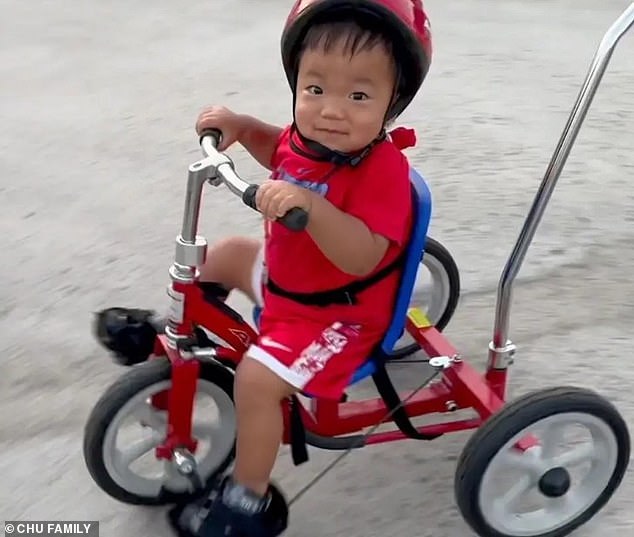
Oliver Chu, three, pictured, who has Hunter syndrome, has shown an ‘amazing’ response after groundbreaking gene therapy at a British hospital
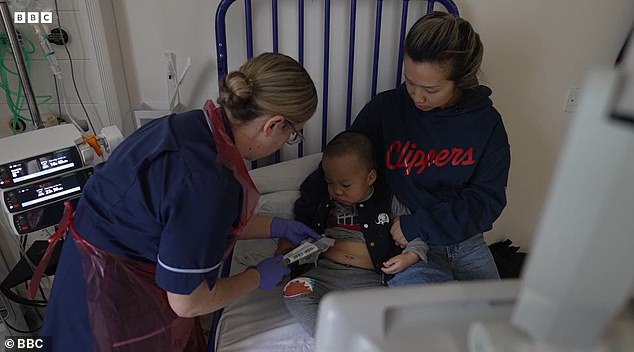
He was treated as part of a trial at Royal Manchester Children’s Hospital. His father Ricky, from California, said his son’s response had been ‘amazing’
However, it costs about £375,000 a patient and cannot prevent cognitive decline.
For the gene therapy, doctors collected stem cells from Oliver’s blood and replaced the faulty gene with a working copy.
These were then re-infused into his bloodstream, causing his body to create high levels of the enzyme.
Speaking to the BBC, Mr Chu said: ‘I don’t want to jinx it, but I feel like it’s gone very well. His life is no longer dominated by needles and hospital visits.’
Share or comment on this article:
Boy, three, with devastating inherited disorder shows ‘amazing’ response to world-first gene therapy