
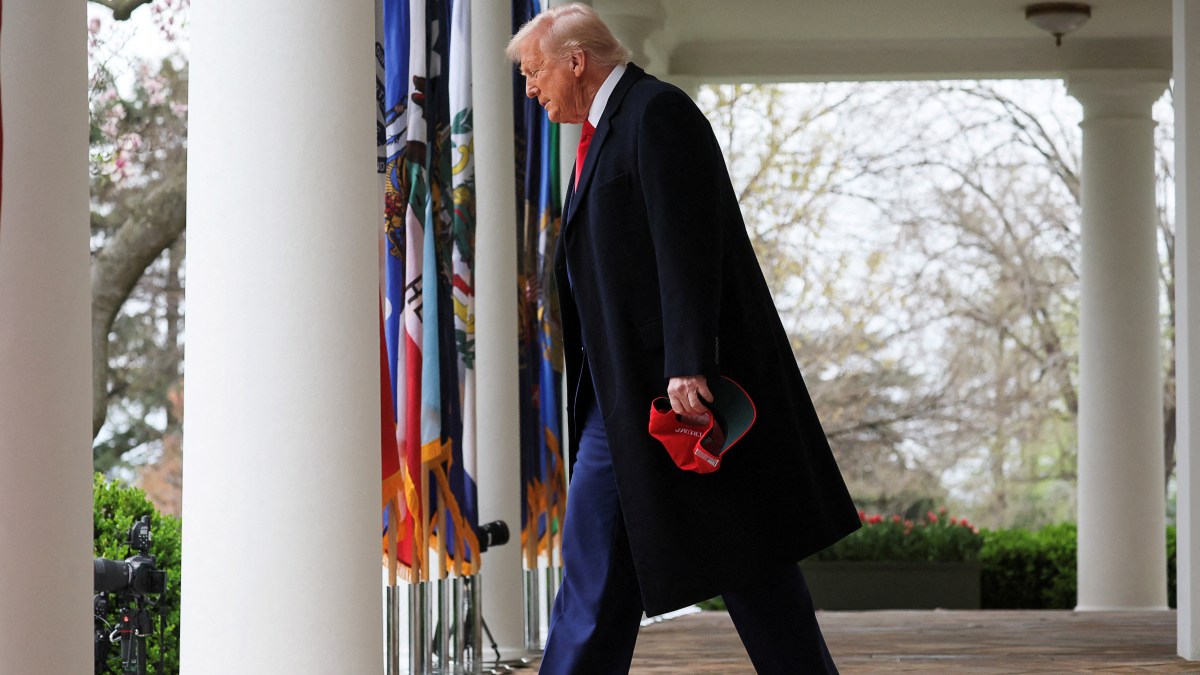
President Trump’s initial move to impose tariffs on almost every country meant Britain’s economy got off to a better-than-expected start in 2025, although forecasters still expect America’s trade war to be a longer-term drag on growth.
The UK economy is expected to grow 1 per cent this year, according to the EY Item Club, which had previously anticipated a rise in gross domestic product of only 0.8 per cent.
The forecaster attributed its upgrade to a “flurry of business spending” at the start of the year as companies tried to complete purchases and ship orders before the implementation of US tariffs in April.
• Live: Trump to greet Starmer at Turnberry for Gaza, trade and Iran talks
“There was some activity and some additional exports brought forward and that lifted [the economy] in the first quarter, but you can see from the size of the upgrade that the outperformance wasn’t massive,” Matt Swannell, chief economic adviser to the EY Item Club, said.
He expected “relatively meagre momentum” in the economy for the rest of this year and next. The “persistent uncertainty” created by trade wars, actual wars and the prospect for further tax increases meant the UK economy would “remain subdued”. The club anticipated that the economy would expand by 0.9 per cent in 2026 before growing a further 1.5 per cent, which Swannell called the economy’s “cruising speed”, in 2027.
“There are [likely to be] continued headwinds over the next couple of years,” he said. “There is uncertainty swirling around the economy that will affect businesses’ large investment decisions; the government will continue to tighten fiscal policy; and there are still some effects from past interest rate rises — a lot of households on fixed mortgages will be refinancing at higher rates.”
The weak economic growth is reflected in the labour market, where the club expected the unemployment rate to hit 5 per cent at the end of this year, up from 4.7 per cent. “We’re expecting a further loosening in the labour market, but an orderly loosening,” Swannell said. “We’re seeing that firms are slowing hiring but they’re not going through large-scale layoffs.”
• UK economy is at risk from global tensions, Bank of England warns
However, data published on Monday by Adzuna, the job search website, shows 875,546 job vacancies in the UK, which is 2.7 per cent more than at this point last year — the strongest annual growth it has seen since July 2022.
Andrew Hunter, co-founder of Adzuna, said this may be a “potential turning point for the UK job market”, although he did note that demand from employers to add to their headcounts “remains patchy” and that the number of vacancies remained below pre-pandemic levels.
The EY Item Club said that “elevated labour costs”, notably the rise in the national minimum wage and employers’ national insurance contributions, were why businesses are being more cautious with their hiring. Those extra costs, alongside a rise in household energy bills, were expected to keep inflation at 3.4 per cent this year, higher than the 3 per cent it had predicted in the spring.
That “persistent inflation” would lead to the Bank of England cutting interest rates in August, November and February, taking the bank rate down to 3.5 per cent, which is where Swannell and his team expect rates to stay in the near term.
“While the MPC appears more concerned about cutting interest rates too quickly rather than too slowly, a softening job market and cooling pay growth should provide reassurance that domestic inflationary pressures are set to fade, albeit gradually,” Swannell said.