
‘My parents met here in this ballroom at a dance in October 1961. I owe my life to this building!’ says Lee Craven, as we contemplate the pearlescent mirrors and Art Deco plasterwork of the freshly refurbished space at Bradford Live, the huge newly transformed venue in the city centre that has just opened. Craven has been instrumental in saving the building, having set up the eponymous Bradford Live not-for-profit company 11 years ago, working together with friends Kirsten Branston and Chris Morrell with the aim of finding a viable future use for the building as a venue – as well as the capital funding to restore it.
All three are still clearly passionate about the building when we meet in its enormous restored auditorium – despite admitting it has been an ‘arduous’ journey to get to this point. And during the conversation, several other memories of the building’s past bubble up, indicating just how knitted in to so many Bradford lives it has been in its previous incarnations – as the New Victoria, Gaumont and Odeon – over the last 95 years.
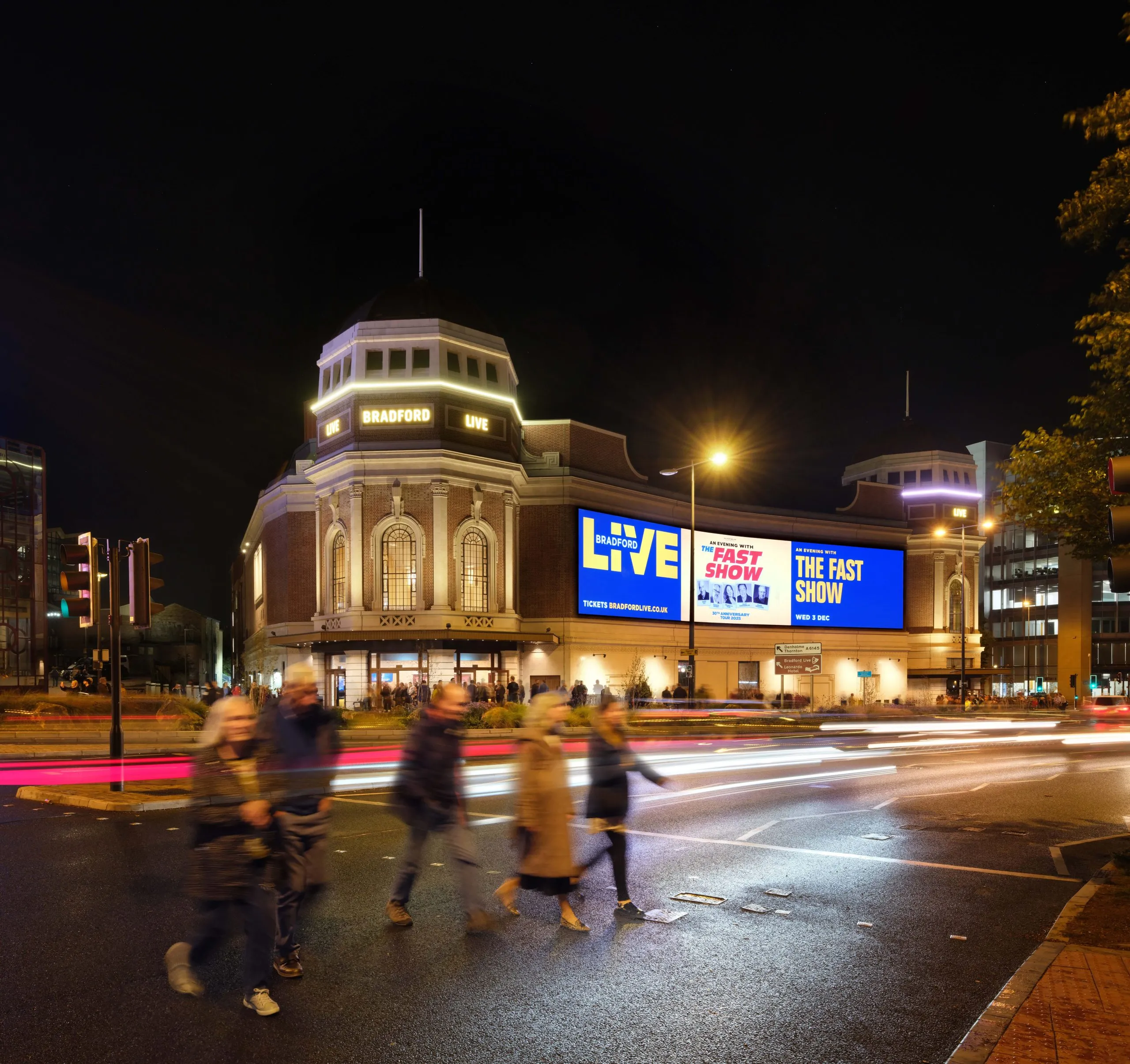
Built on the site of a brewery (which drew its water from the culverted Bradford Beck which still flows underneath), the building opened in 1930 as a so-called ‘super-cinema’. Its main auditorium was designed to hold 3,318 people, while the building also contained a ballroom and 200-seat restaurant. It was one of a new generation of huge cinemas cashing in on the popularity of film as mass-entertainment as the talkies took over from silent movies.
The steel-frame building was clad in relatively plain brown brick with stone-dressed plinths and cornicing, more elaborate Classical detailing being reserved for the octagonal domed corner turrets that marked the entrances. Inside, things were more appropriately show palace, the interior spaces cloaked in OTT Art Deco plasterwork and gilding.
When it opened, it was the UK’s largest cinema outside London, its opulence also reflecting Bradford’s affluence at the time, still wealthy from its Victorian wool trade boom days – a nouveau-riche vibrancy that led TS Eliot in his 1922 poem The Wasteland to include the line ‘as a silk hat on the head of a Bradford millionaire’ as a sniffy simile mocking social aspiration.
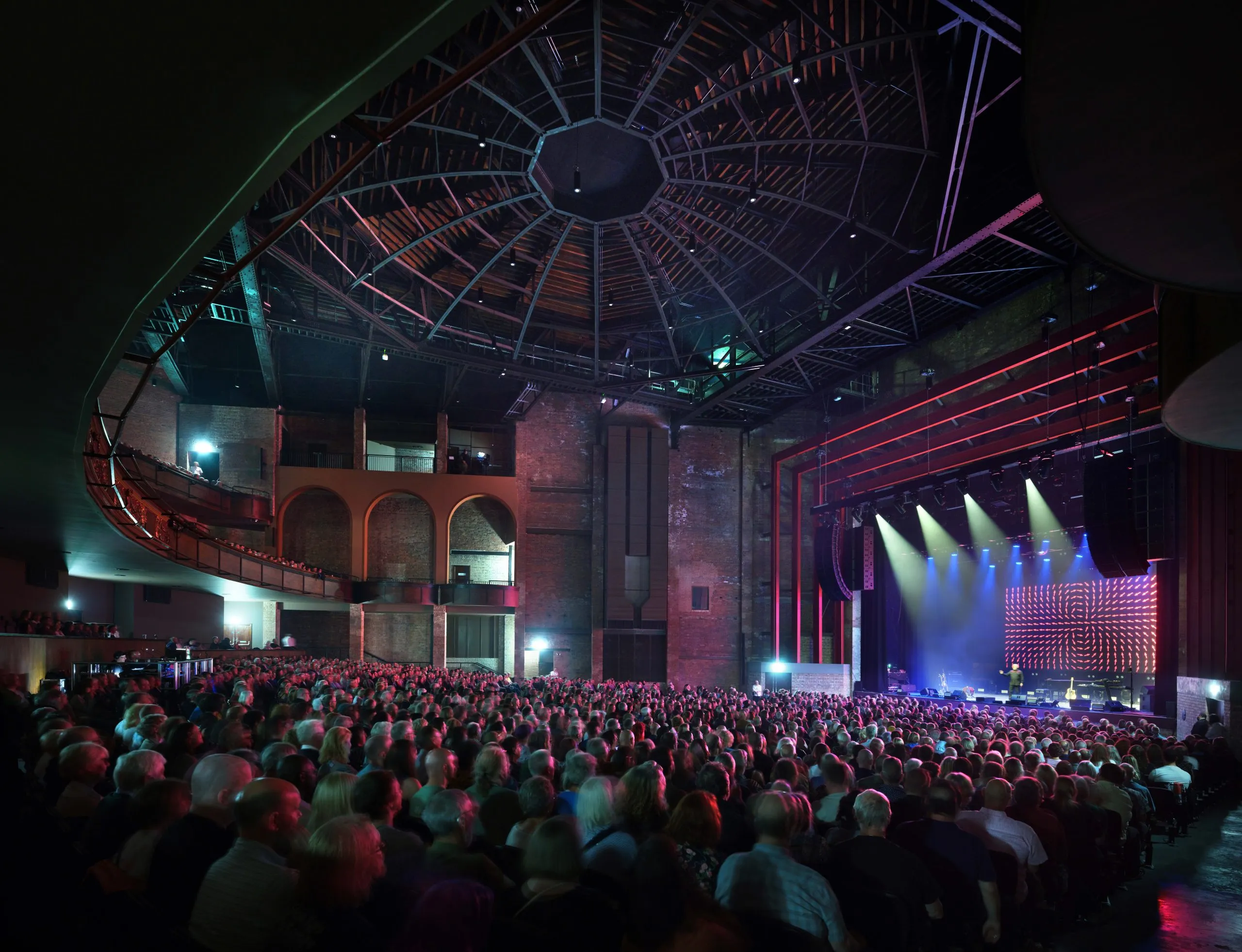
The auditorium
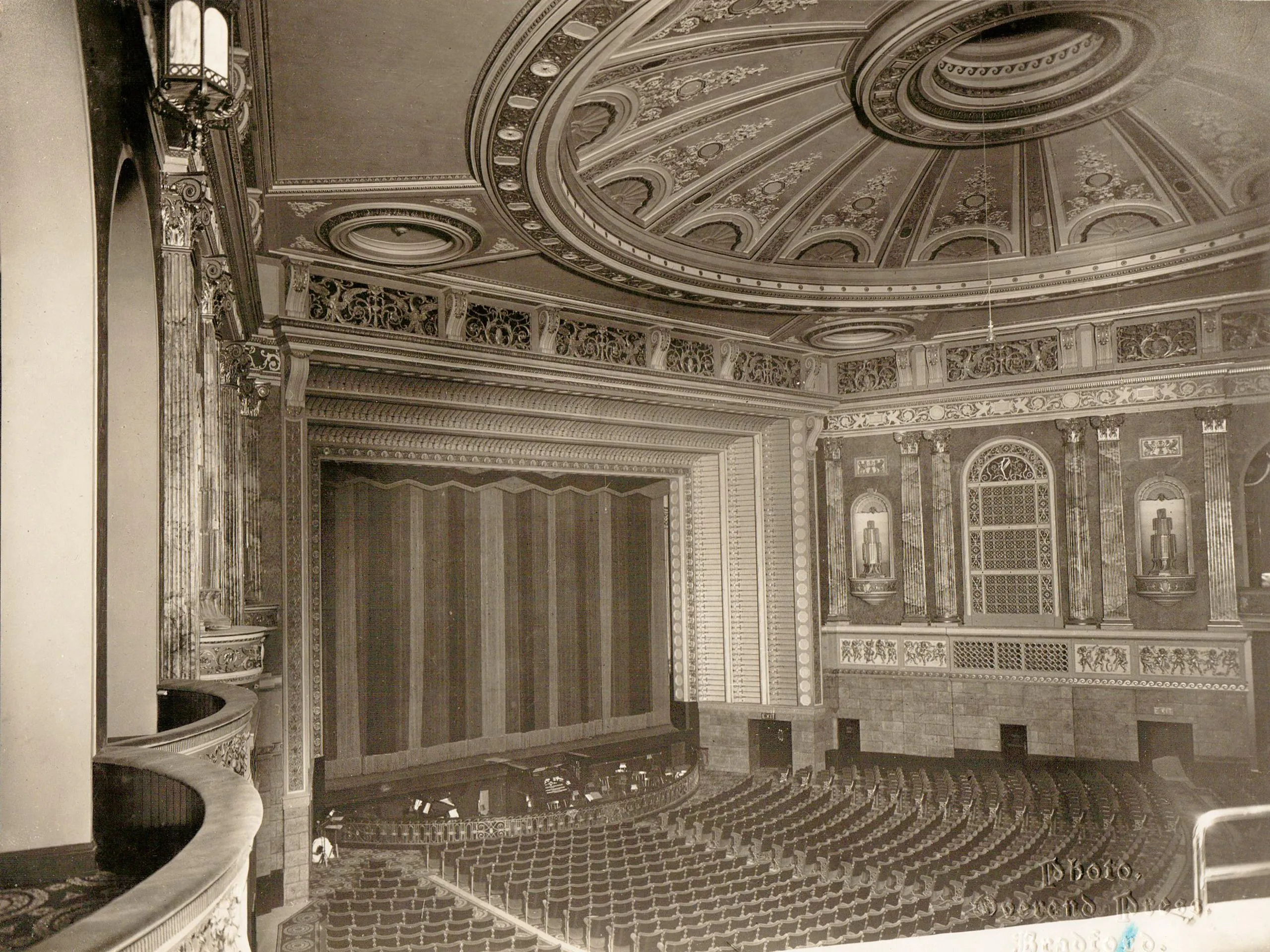
As well as film screenings, the venue was also able to stage theatrical performances, variety shows and concerts. It had a full stage and proscenium, fly tower, orchestra pit and Wurlitzer organ.
In the 1950s and 60s, as mass audiences for single film screenings began to falter with the emergence of TV, it increasingly became a music venue, hosting everything from the London Symphony Orchestra to Buddy Holly, the Beatles and the Rolling Stones.
This era came to an end in 1968 when the Odeon chain, which had taken over running the building, decided to divide the auditorium into three, creating two smaller screens and a bingo hall. Three concrete boxes were crudely inserted in a bish-bash-bosh conversion that tore through the original fabric, destroying much of the decoration.
The Odeon finally closed in 2000, moving out to a 13-screen edge-of-town venue, after which the building was left to rot for a few years before being bought by the regional development agency Yorkshire Forward. The agency proposed demolishing and redeveloping the site as a hotel, housing and offices.
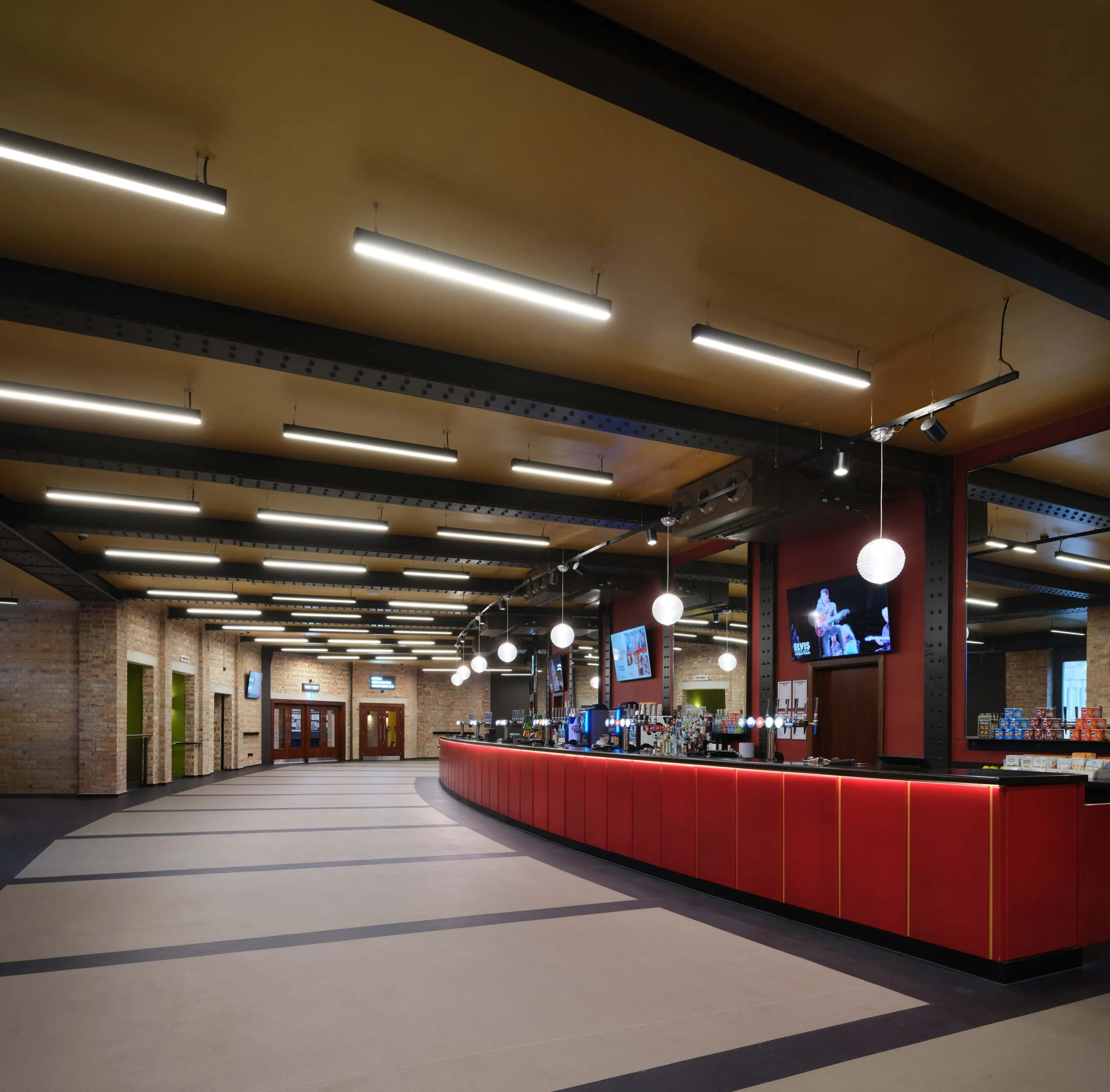
Stalls foyer
Local opposition to this plan and support for the building’s reuse led to the founding of the Bradford Odeon Rescue Group (BORG), which notably staged a hug-the-Odeon event in 2007 when 1,000 people encircled it in a human chain. The 2008 recession put paid to immediate redevelopment, and the building later passed to the Homes and Community Agency which, in 2013, sold it on to the city council for £1 on the basis that the council invested over £1 million in its upkeep and repair. The council then invited commercial bids to renovate and run it as a venue – the winning one being that of Craven and Bradford Live.
Craven, Branston and Morrell are open about having been ‘enthusiastic amateurs’ at the time with no experience in the field of fundraising, building refurbishment or indeed running arts venues. But their combined energy was clear from the start. They assembled an experienced team to advise on the bid including Tim Ronalds Architects (TRA) which had a long experience of retrofitting theatres such as Wilton’s Music Hall and Hackney Empire; engineer Price & Myers; and theatre consultant Carr & Angier. Crucially, they also quickly lined up a commercial operator, NEC, interested in taking over and running the venue once the capital funding had been found to restore it.
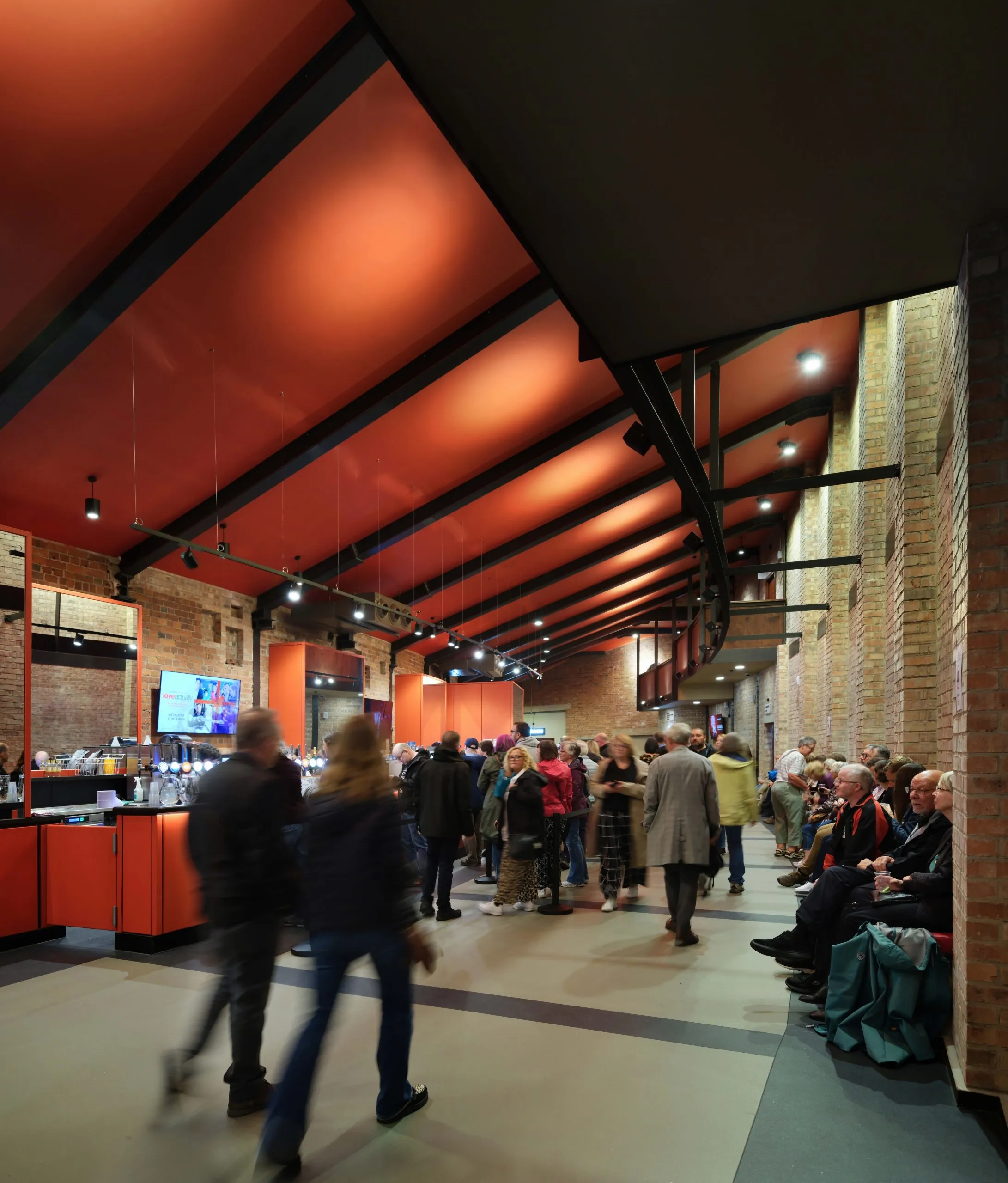
Circle foyer
Dozens of stakeholder groups were consulted and a clutch of key funders secured, including the council, the Department for Digital, Culture, Media & Sport, the National Lottery Heritage Fund and West Yorkshire Combined Authority. But it has clearly not been a straightforward journey. Challenges included those thrown up by the pandemic, and then the Ukraine war, which pushed building costs through the roof – increasing from £23 million to £50 million over the course of the project.
There was also the difficulty of surveying the auditorium effectively before the 1960s additions were demolished, and checking that their removal wouldn’t weaken the whole structure. Only after their demolition was the full condition of the original fabric revealed, including extensive water damage which had partially rotted away elements such as the stage and auditorium floors. Pockets of asbestos were also discovered, while the culvert structure over the stream was near to collapse and had to be replaced.
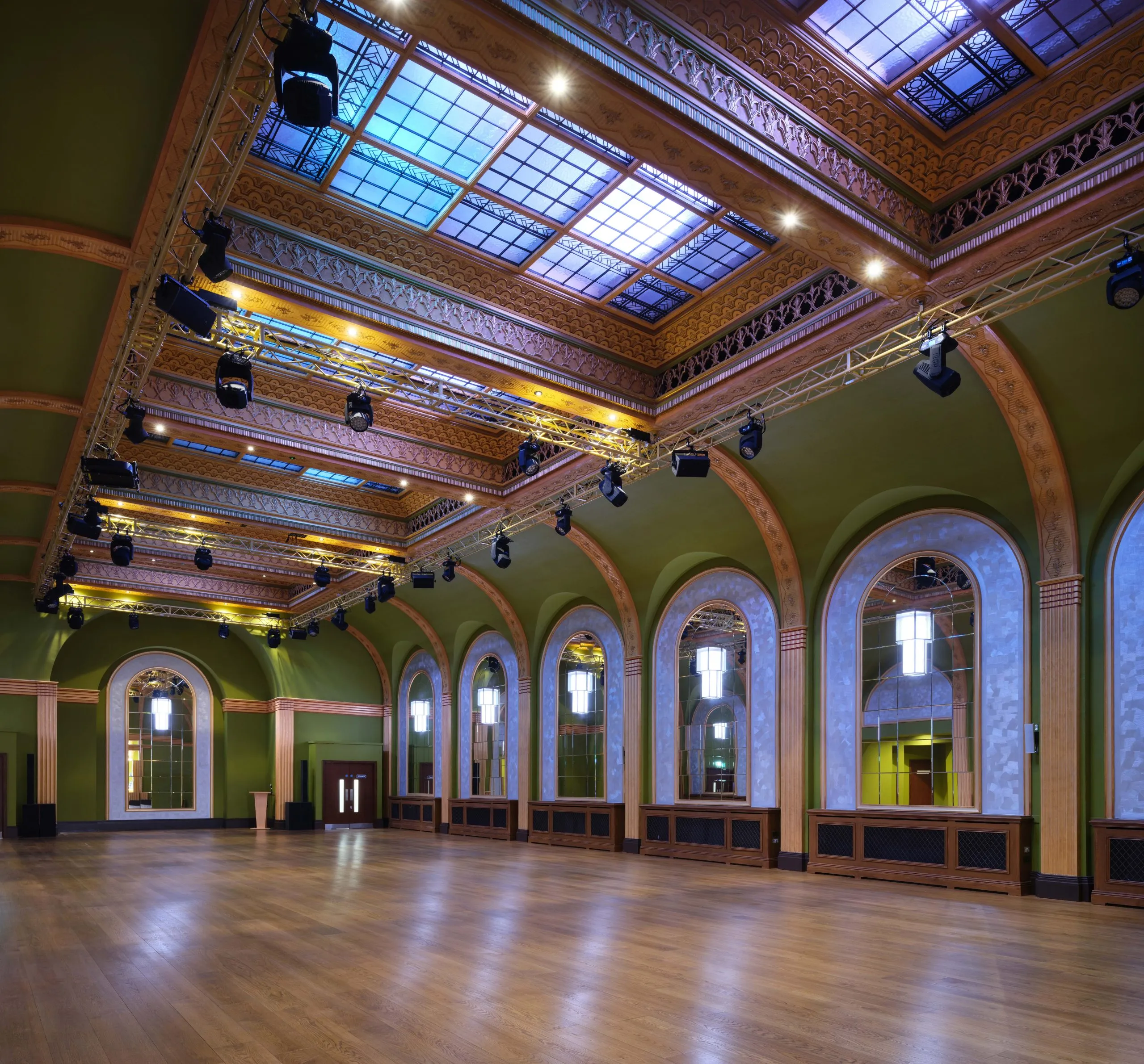
Ballroom
Another blip occurred when the project had to be competitively retendered in 2018 because of the element of public funding involved. International practice Aedas won the job, replacing TRA, but when Aedas’s London office went into liquidation in 2022, TRA agreed to come back on board – a relatively seamless process given Aedas’s design was pretty much in line with TRA’s original scheme – although founding director Tim Ronalds says he insisted his practice redesign the Aedas interiors, which he describes as mostly ‘teal-painted MDF’.
Even up to the wire, there were hiccups. When practical completion was reached in September 2024, the NEC suddenly pulled out as the commercial operator. ‘There was suddenly no one to hand the keys over to,’ says Craven.
Thankfully, in February this year, Trafalgar Entertainment stepped in to run the venue, putting in an extra £3 million. It was able to open, albeit later than planned, to coincide with the second half of Bradford’s City of Culture year. The opening event was a sold-out evening with comedian Bill Bailey, and coming attractions range from the Kaiser Chiefs to Rob Brydon and Elf the Musical.
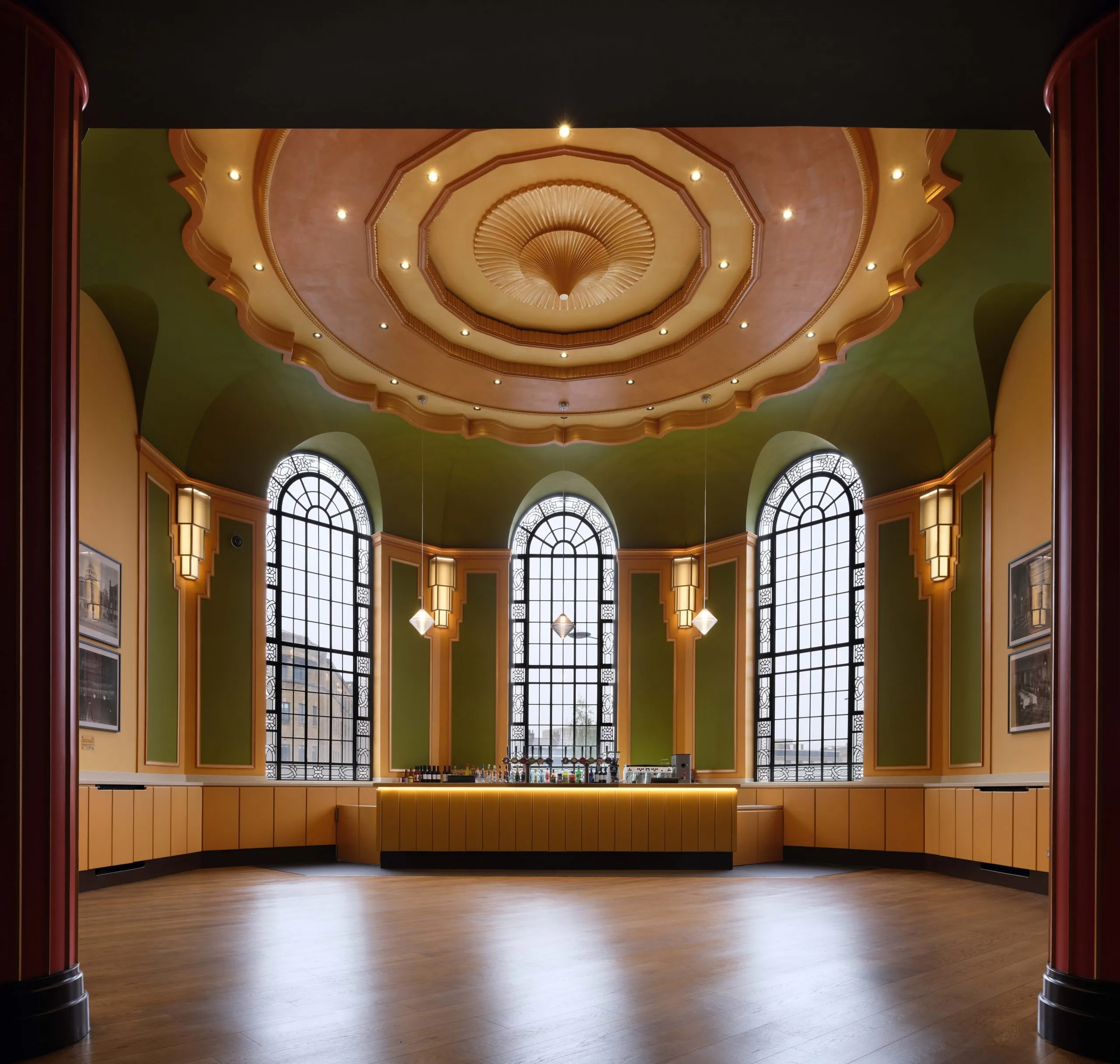
Ballroom Bar
From the street, while the building’s main frontage has undergone a subtle repair job, the architecture in truth plays second fiddle visually to a vast elongated LED screen occupying its curved central section – designed originally as a blank panel as it faced on to a narrow side street hemmed in by a long-demolished block to the east. It clearly presented a no-brainer opportunity for a screen – promoting the venue’s events while taking advertising that helps support the venue’s business plan. It also acts as a backdrop to the city’s main public space, City Park, which is dotted by water fountains and can be flooded to create a shallow pool – a popular if pale imitation of the lake proposed by Will Alsop in his 2003 Bradford Centre Masterplan.
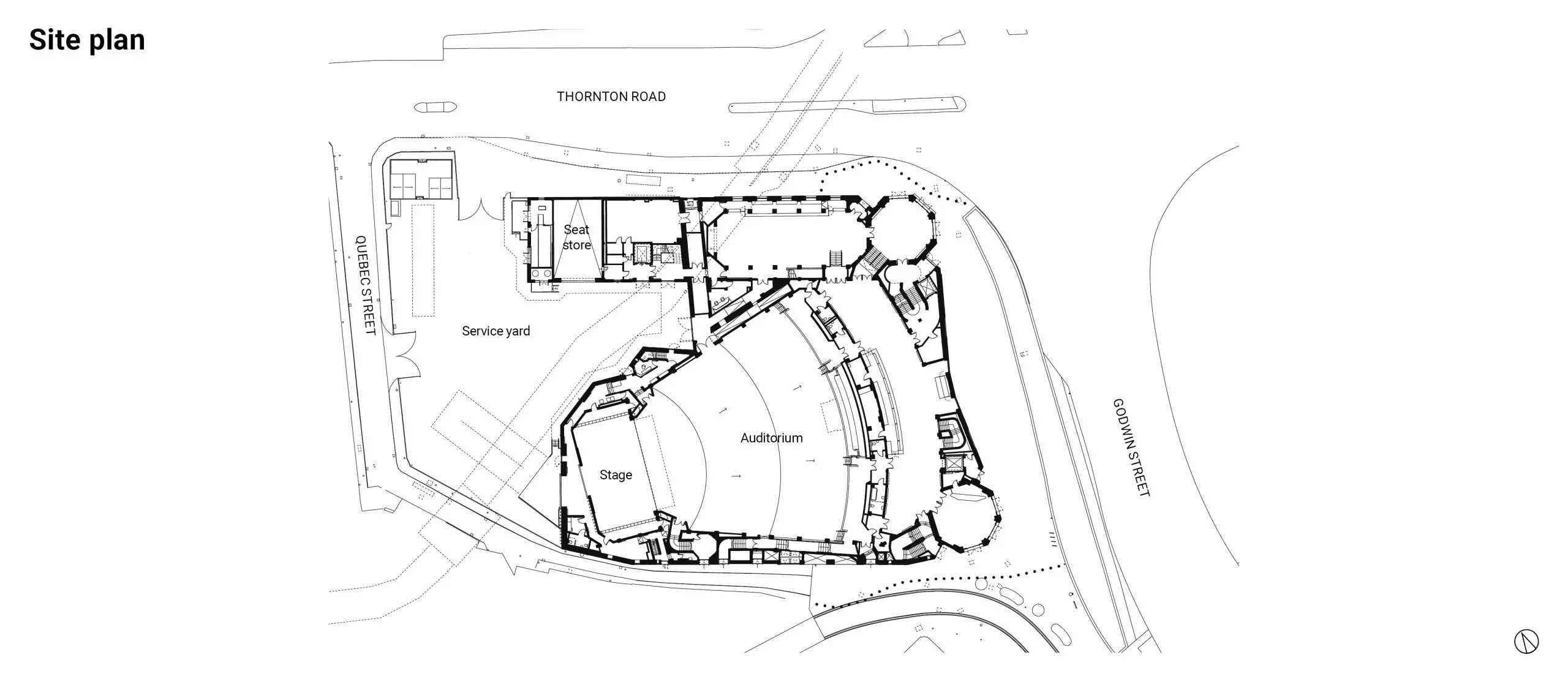
The only visible addition to the building is tucked around the side, a new service wing leading off the back of the ballroom and accessed from the service car park. Designed and detailed by Aedas, its metal cladding already looks somewhat dated but it provides a practical plug-in to augment and add all the upgraded service functions necessary for the venue, including new kitchens, offices and seat storage for when there are standing events.
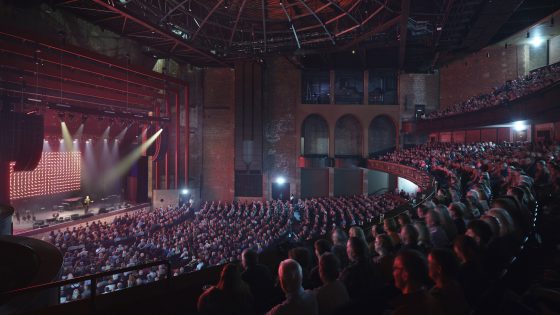
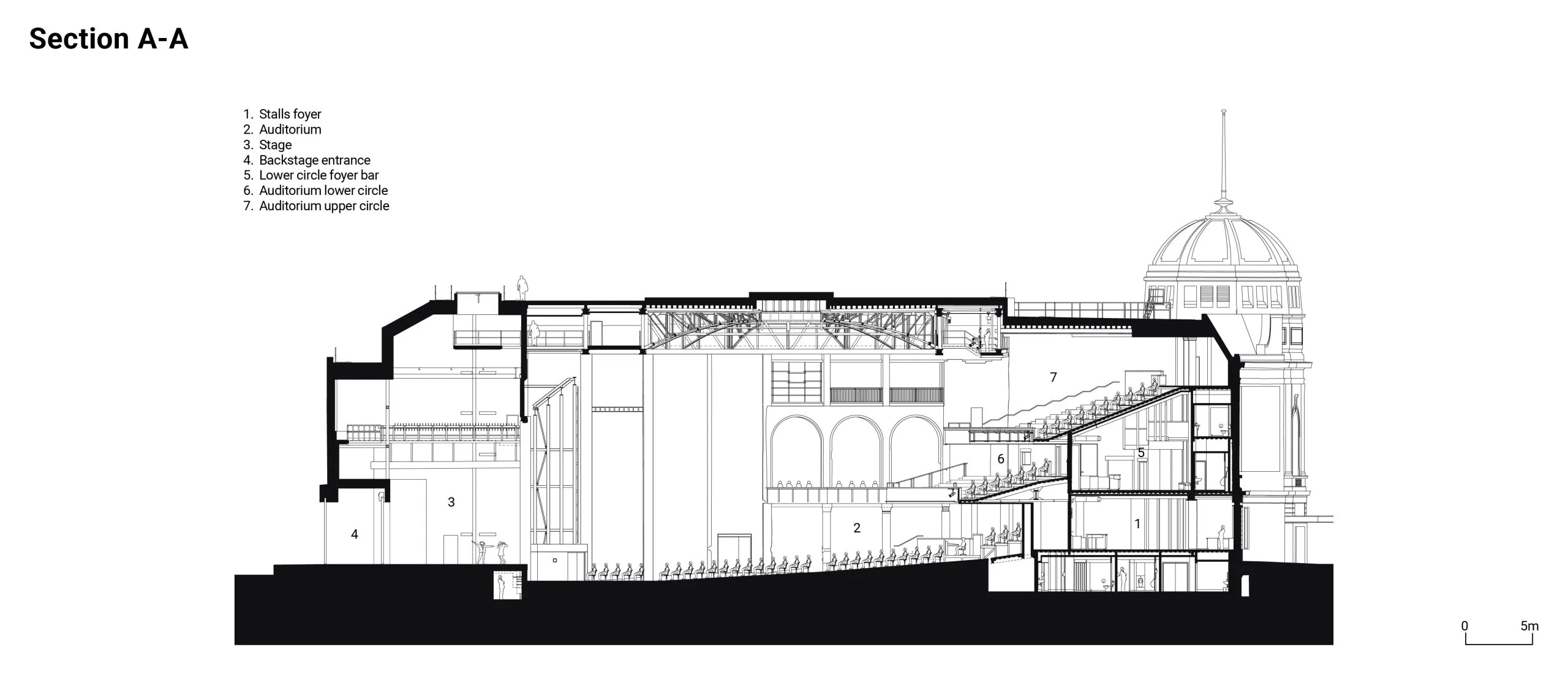
Inside, the once resplendent auditorium is now a vast bare brick shell. The exposed structure of 43m-long riveted trusses and bald brick arches – part raw industrial, part Piranesi – lends it a lofty battered grandeur. Only a single patch of original decorative plasterwork remains on the balcony, the rest lost in the 1960s conversion or unsalvageable after years of untreated water ingress. The exposed riveted steel joists splaying out from the 21m-diameter dome make the space feel something akin to a circus top. The showtime feel is accentuated by LED lighting, which creates the pre-show pizzazz for audiences.
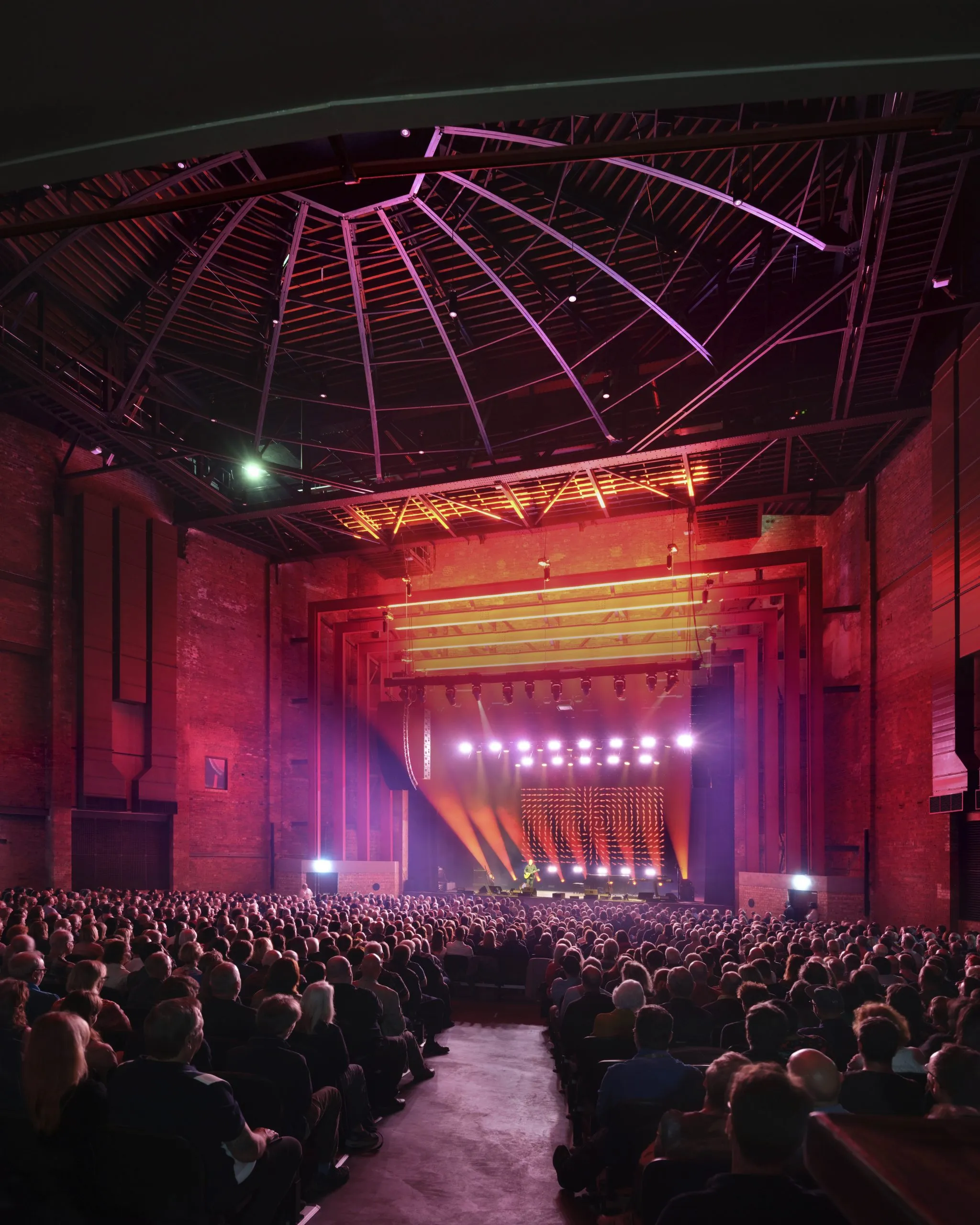
Auditorium
‘We wanted to keep the building’s battle scars,’ says Ronalds, ‘and bring out the drama and qualities of the found structure’, although he admits that appreciation of the look of ‘arrested decay is not entirely shared by all the people of Bradford’.
The one contrastingly new addition to the space is four large red steel frames splaying out from the stage. They form an implied proscenium, echoing the original faceted Art Deco surround, and direct a clear focus to the stage, their riveted joints reflecting those of the 1930s steelwork while providing a structure from which to hang lighting rigs.
The decayed precast flooring planks have meanwhile been replaced with a lightweight concrete floor over steel decking, while the sea of seating that floods the stalls is removable for standing events. Above, the roof has been built-up to meet the latest thermal and acoustic standards.
While most of the new services have had to be carefully threaded through existing structure, service engineer Buro Happold was able to reuse the original ventilation ducts for the new air-handling system, finding space on the roof and in the basement for the four bulky new units.
Gaumont Bar
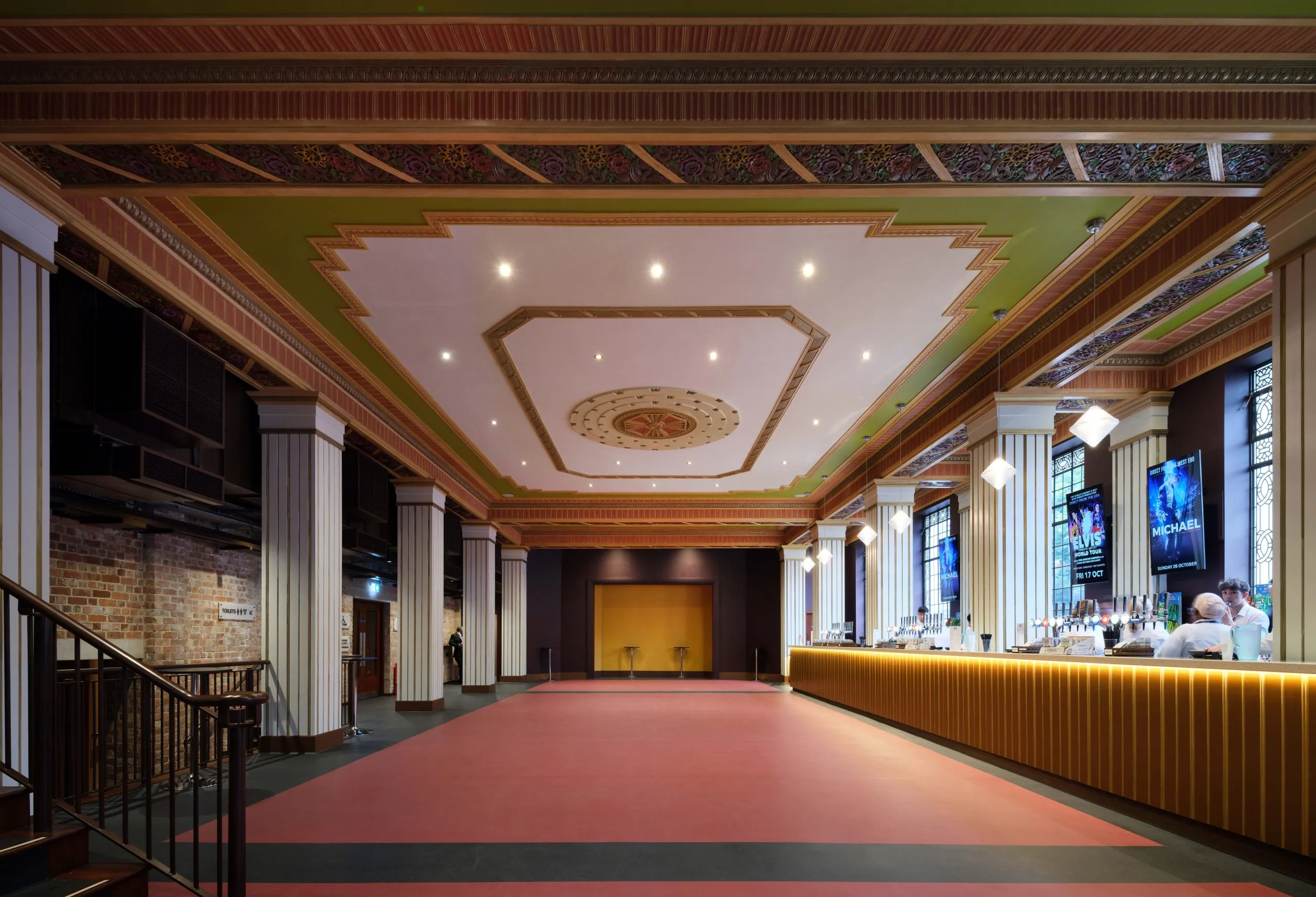
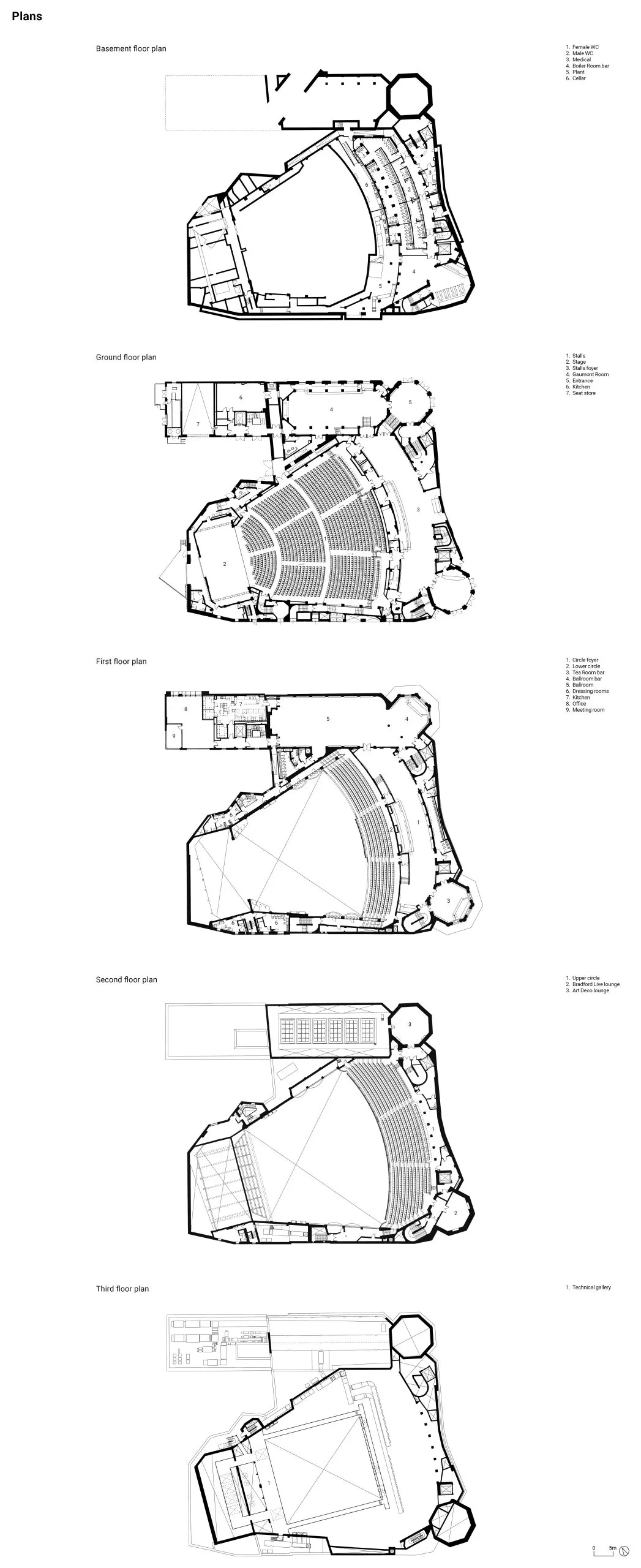
Generous ancillary spaces, meanwhile, wrap around the auditorium in an almost Beaux-Arts-like layout, worthy of Garnier’s Paris Opera House in plan. Two entrance lobbies at the base of the turrets lead into opposite ends of a long curving foyer serving the stalls with a second serving the circle above. In the 60s, these spaces were stripped of any decoration but they are now focused around the drama of long sweeping plywood and studwork bars, lined with mirrors and gleaming ranks of beer taps and glasses.
To the north, both the ballroom and ground-floor restaurant still have much of their original decoration – despite the ballroom having been converted to a third screen in the 1980s. The ballroom is covered in delicately mirrored Deco, while the restaurant, now the Gaumont Room, offering more substantial food and drink, is in a more full-throated high-colour Classicism – à la Moscow Underground – the flutings of its square columns picked out in gold.
Yellow stair
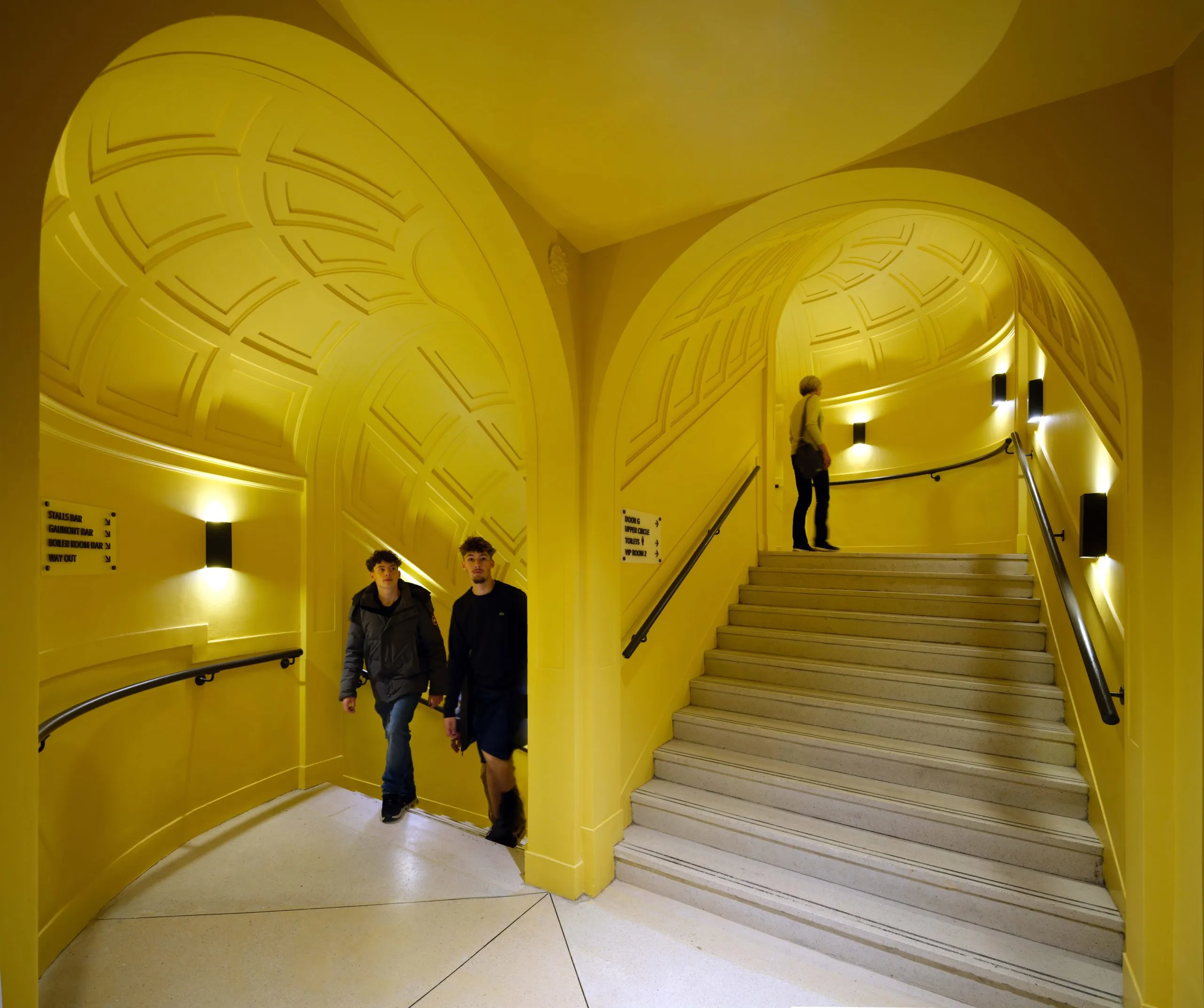
Two enclosed stair spaces are given instant wayfinding identity by being soaked in strong colour too, one bright lime-yellow, one blue, rising past further lofty bars to slightly odd windowless ‘lounges’ at the top of the octagonal turrets. These are also awash with colour and give off a weirdly Twin Peaks vibe. Much of the plaster decoration in these spaces has been restored thanks to money from the National Lottery Heritage Fund that was ring-fenced solely for fibrous plaster mouldings. In the basement, the old boiler room has also been turned into a bar, the boilers left in place but painted gold. The basement also contains capacious toilets with serried curving banks of cubicles so numerous you assume their length is a mirrored reflection.
The cheap-and-cheerful painted pizzazz of these spaces, while not exactly sensitive, is appropriate dressing for them as stages for audiences to see and be seen, providing a high-coloured contrast to the subdued bare-brick and brown of the auditorium. They are also able to function independently as rentals for weddings, conferences or work dos.
Overall, this project strikes a successful balance between thoughtful restoration and pragmatic patch-up, reviving the spirit of the building and setting it up as a place that will be knitted back into Bradford lives again for years to come.
Architect’s view
Bradford Live has taken 14 years. We were introduced to Lee Craven by theatre consultant Peter Angier in 2011, and we worked together to devise a scheme to restore and reopen the derelict giant cine-variety theatre as a music venue.
We were entranced by the atmospheric interiors of the derelict theatre and saw it as an opportunity to do what we had done at Wilton’s Music Hall in east London, but at a large scale.
Lee’s proposal won the Bradford Council competition for the lease of the building. It took until 2018 to develop the scheme, secure an operator and assemble the capital funding. But then because the finance for the project involved public funding, the project team had to be competitively retendered and Aedas won the project.
In 2022, Lee Craven called to ask whether we might consider returning as architects after Aedas went into liquidation. The contract was behind programme and over budget.
Auditorium in the 1930s (credit: Unknown)
We found the Aedas scheme differed little from our 2018 design except for the interior design, and agreed to return providing we could redesign that aspect. One of our directors Adam Goodfellow together with the project architect Kathleen Jenkins then spent half of every week on site in Bradford for the next two years putting the project back on the rails.
The task was very complicated; the surviving parts of the building proved to be in worse condition than anticipated. But we had a good team, Price & Myers, Buro Happold, Carr & Angier and Gillieron Scott. The contractor RN Wooler was good, but the fixed-price contract was under stress.
The key funder, Bradford Council, stuck with the project, but shortly before completion, NEC, the operator contracted to run the venue, pulled out. The operator contract had to be retendered and Trafalgar Theatres stepped in. Bradford Live opened in August to host elements of the City of Culture programme.
Now we watch as the venue builds its programme and its reputation. Lee Craven’s vision was that a vibrant music venue of this scale would contribute to the city’s self-esteem and aid its regeneration. We hope it will.
Tim Ronalds, founding director, Tim Ronalds Architects
Client’s view
Lee Craven formed Bradford Live in 2014 as a single-purpose, not-for-profit company with the aim of finding a viable future use for the former Odeon.
Self-funded and working in the early stages with Tim Ronalds Architects, Bradford Live proposed restoring the building as a multipurpose venue, run by a commercial operator. This was supported by the building’s owner, Bradford Council.
Lee Craven’s long-standing friends, Kirsten Branston and myself, Chris Morrell, joined Bradford Live and together we doggedly spent the next five years exploring commercial strategies, lobbying support, applying for funding and grants and negotiating legal agreements while commissioning surveys and developing the building design.
By the time the initial demolition works commenced in 2019, Bradford Live had secured a variety of grants, a loan facility with Bradford Council had been agreed and, crucially, the NEC Group had signed a 30-year agreement to operate the venue.
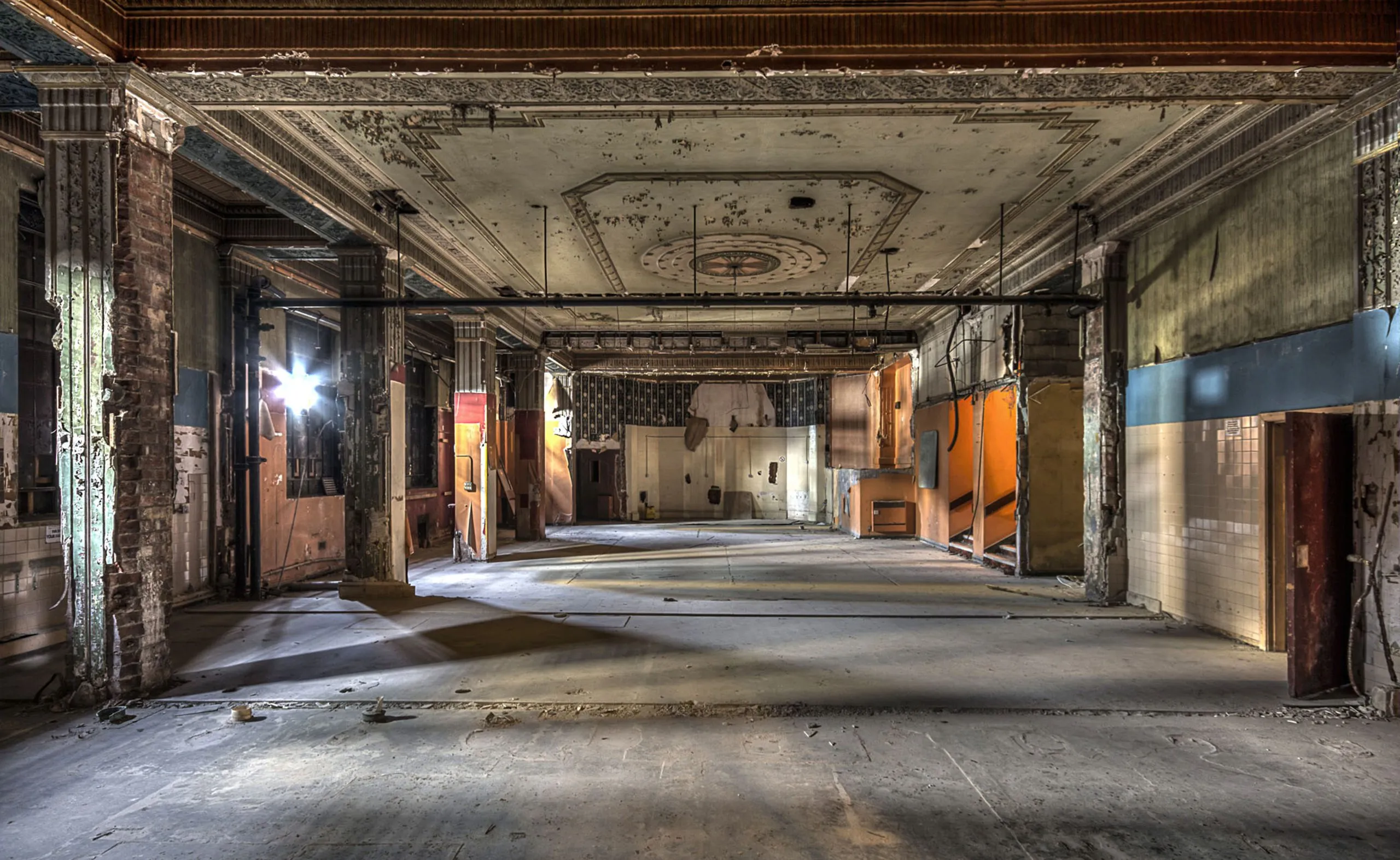
Gaumont Bar before works (credit: David Oxtaby)
Once on site, there were many setbacks and challenges, not least the effects of the pandemic and the war in Ukraine, which hampered the 2020 enabling works. In 2022, to add insult to injury, the project’s architect, Aedas, went into liquidation.
Fortunately, Tim Ronalds Architects agreed to return to the project. Their passion and prior knowledge, alongside the resourceful main contractor, RN Wooler and a team of local subcontractors, overcame the many unforeseen obstacles, ultimately delivering an end result that surpassed everyone’s expectations.
Throughout, Bradford Council maintained its support, both financial and as part of the client team, sharing the belief in the benefits that the new venue would bring to the city.
In a final twist in the tale, NEC Group walked away from the project as it neared completion. A few nervous months passed until Trafalgar Entertainment was announced as the new operator, bringing even greater ambition and investment. Like so much else in the project, it felt like it was meant to be!
Chris Morrell, Bradford Live
Sustainability
A robust environmental strategy focused on operational, embodied and whole-life carbon reduction. Operational carbon is addressed through efficient HVAC systems, including reverse-cycle heat pumps and EC fan-equipped AHUs, which provide heating, cooling and ventilation with zonal control and occupancy-based modulation.
Embodied carbon considerations are evident in the reuse of the historic auditorium structure and the modular design of plant equipment, minimising material waste and facilitating future maintenance.
Whole-life carbon is mitigated through durable systems, such as VRF units and LED lighting with DALI and DMX controls, ensuring long-term energy efficiency and reduced replacement frequency.
Innovative techniques include dynamic thermal modelling to optimise comfort and energy use, and flat-pack AHUs assembled on-site to overcome spatial constraints. The integration of smart building systems, such as BMS-linked boiler controls and MID metering, supports ongoing energy monitoring and management.
This comprehensive approach ensures the building will serve as a sustainable, functional and culturally significant venue.
Lawrence Williamson, associate, Buro Happold
Engineer’s view
The abandoned building was a forbiddingly huge, dark, dripping hulk when we made our first visits. Our attempts to understand the scale of the structural challenge initially relied on a mixed bag of record drawings, black and white photographs of the ‘New Victoria’ in its original grandeur, and on what we could make out from torch beams disappearing into the gloom.
Gradually, over many grubby days on site, and helped by a group of knowledgeable local enthusiasts, a picture emerged of a great structure that was down, but not out.
Massive structural alterations had been carried out in the 1960s, but these were done lazily, cutting out anything that was in the way. We mapped out what existed and what needed to be repaired and reinstated.
A detailed programme of investigations and material testing allowed us to analyse the existing structures. As well as replacing what had been lost, we also had to repair damaged elements, upgrade the cantilever circle and balcony seating to modern standards, and satisfy ourselves that a heavy new insulated acoustic roof finish could be added.
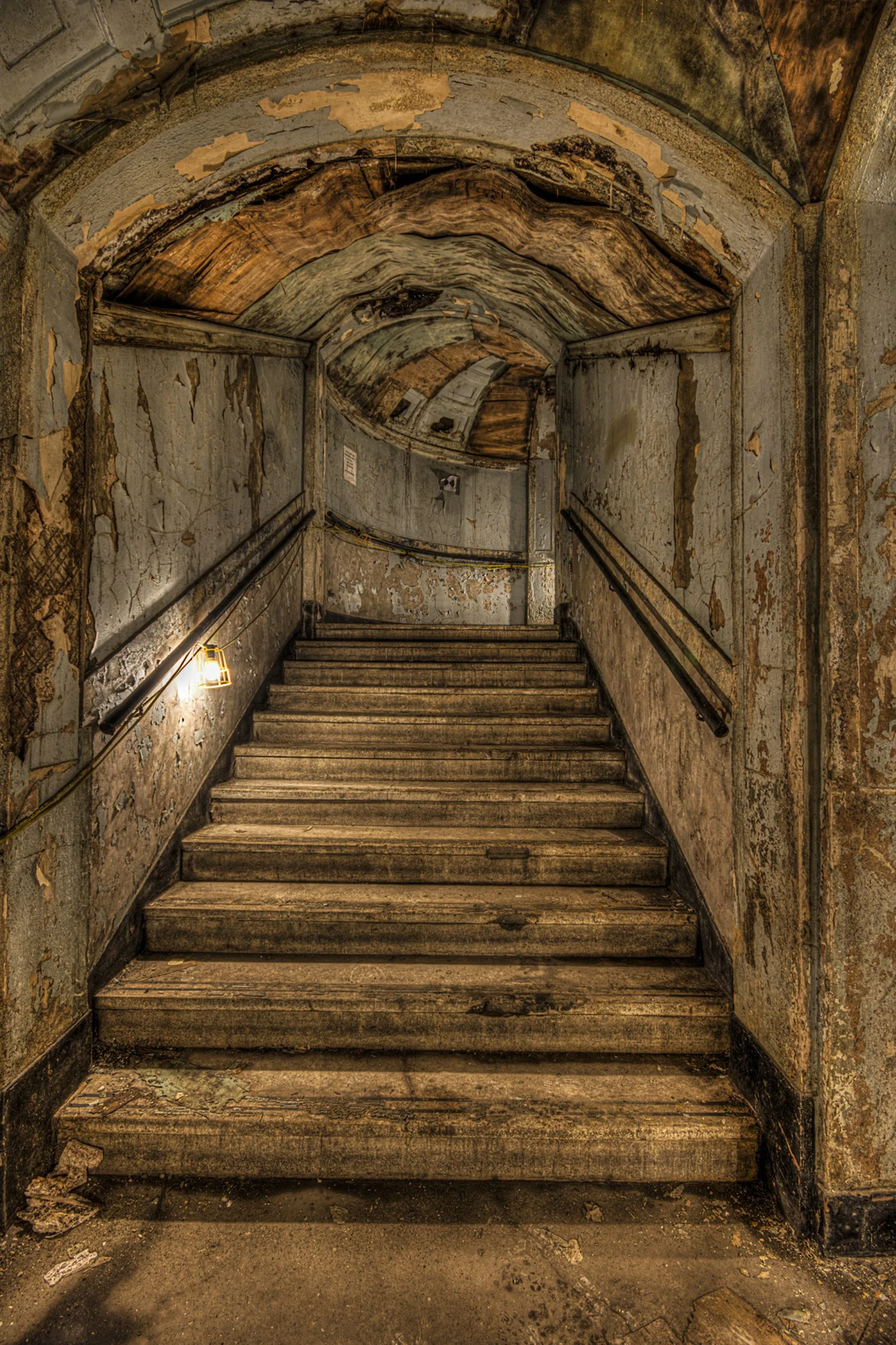
Existing stair (credit: David Oxtaby)
Many areas of the building – including the whole flytower roof – remained unsafe and largely inaccessible until very late in the process, and plenty of unusual features added difficulties on the way, including the semi-derelict culvert of the Bradford Beck, which runs under the building, and the unusual and decaying hollow concrete and timber precast floor units which mostly proved too degraded to keep.
Unfortunately, the original plasterwork was almost entirely lost in the vast auditorium. What did emerge was the beauty and efficiency of the brick walls and the riveted steel and timber roof structure. We were inspired by the ambition and tectonic elegance of the main roof with a radial curved steel ceiling dome more than 20m in diameter.
One of the joys of the final project has been to reveal the engineering of the roof in the finished building.
Andy Toohey, partner, Price & Myers
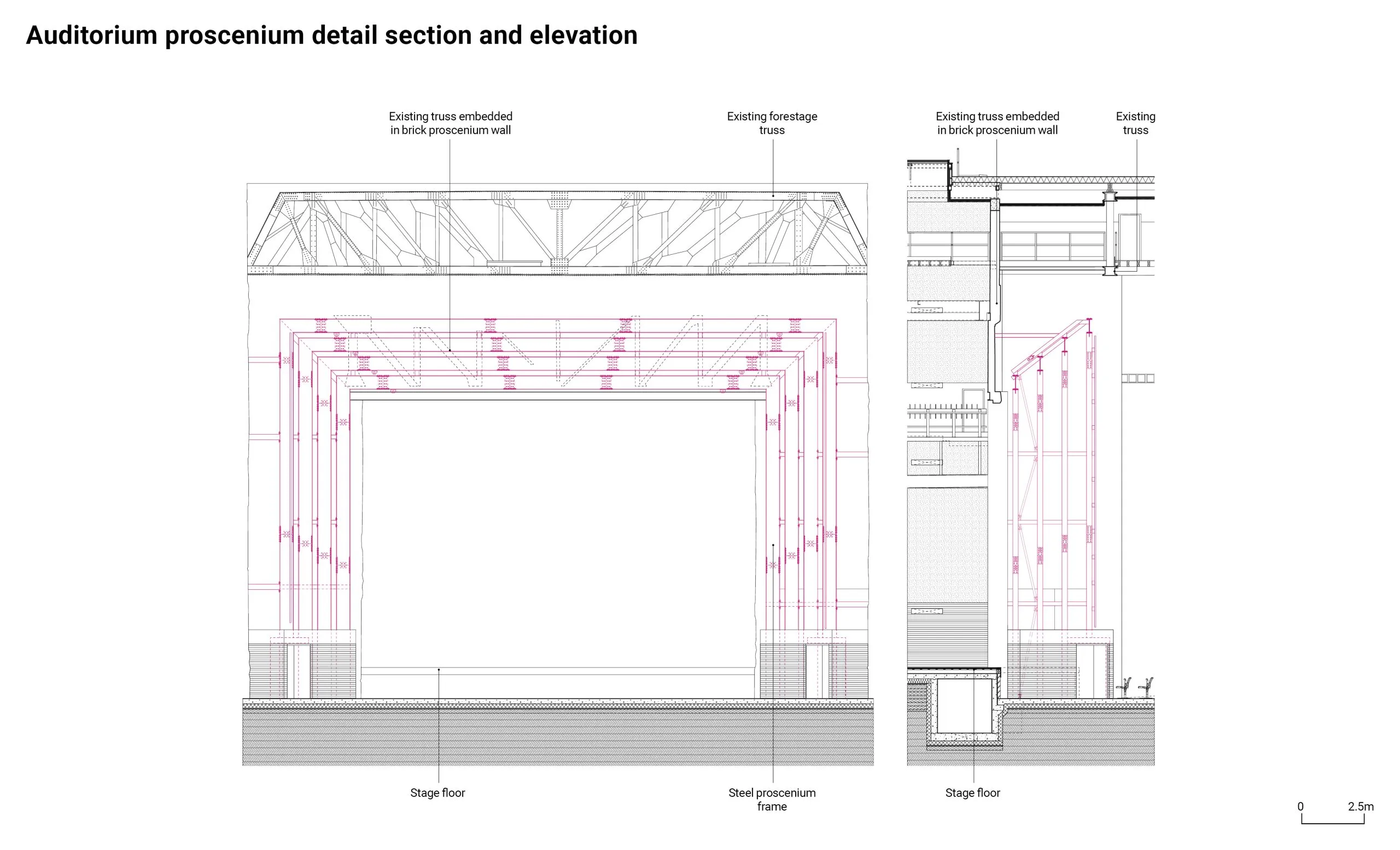
Working detail
Proscenium
The original proscenium was a magnificent ornate plaster frame lit by hundreds of electric bulbs. This was demolished, with the rest of the decorative interior, in the 1960s. The auditorium is now an exposed brick structure with the original steel and timber roof structure above. But a stage needs to be more than a hole in a brick wall. Our solution was a new proscenium made of four giant steel frames, forming a splayed shape which emulates the structure of the original proscenium. It visually relates to the giant lattice steel trusses which support the roof and dome.
The frames serve to support the speaker arrays that touring rock bands bring. The structural design, devised by Price & Myers, uses bracing back to the brick stage wall behind to make the steel beams span further than looks possible.
The splice plates of the steel columns and beams are deliberately expressed but carefully positioned. They are painted in the colour of red lead primer.
North Turret
In the front-of-house spaces, the refined plasterwork had survived though it was very much damaged. The Heritage Lottery Fund and a charitable foundation provided ring-fenced funding for plaster and restoration.
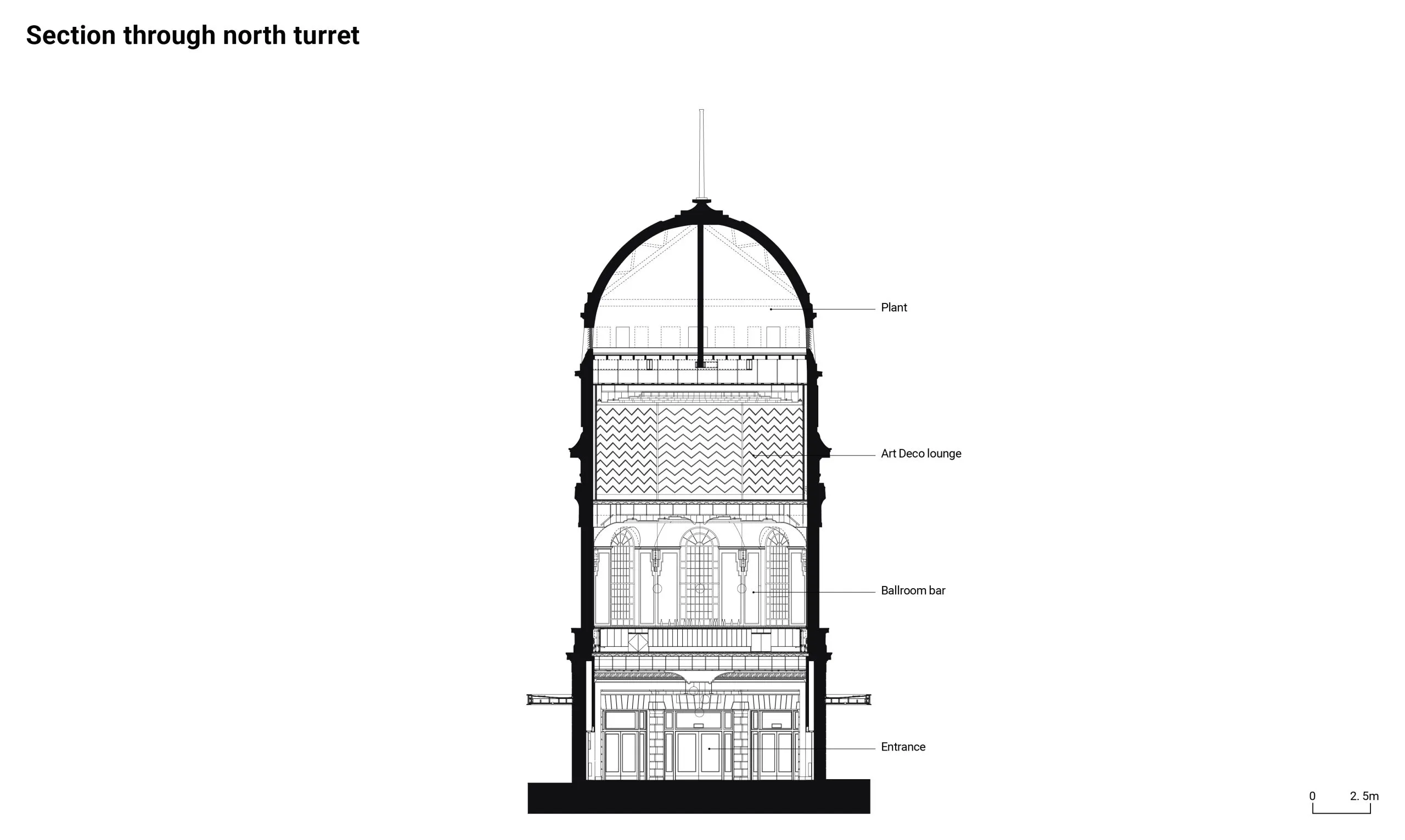
This drawing shows the cross section through one of the octagonal corner towers. On the ground floor, the entrance lobby with a central chandelier; on the first floor the tall ballroom bar with a beautiful coved and moulded ceiling; and on the second floor a function room with zig-zag Art Deco plasterwork. The towers are topped by copper clad domes.
Ornate Interiors made moulds to replicate the original forms and delivered to site pristine white fibrous plaster elements which transformed the crude structure into something refined and palatial.
Tim Ronalds, founding director, Tim Ronalds Architects
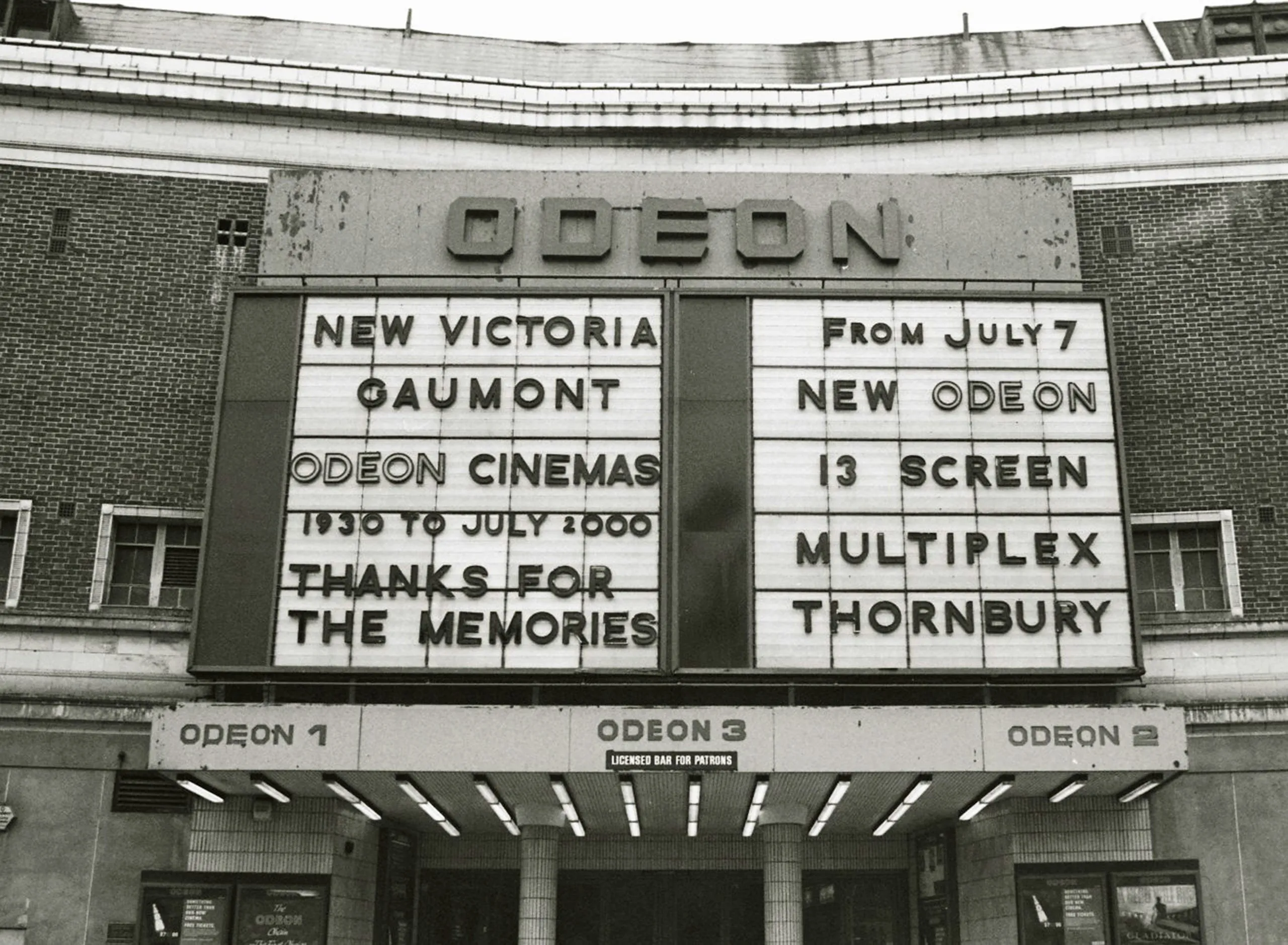
Former Odeon in the 1970s (credit: Unknown)
Project data
Location: Bradford
Start on site: March 2021
Completion: July 2024
Gross internal floor area: 9,328m2
Project cost: £50.5 million
Architect: Tim Ronalds Architects
Client: Bradford Live
Structural engineer: Price & Myers
M&E consultant: Buro Happold
Quantity surveyor: Turner & Townsend
Project manager: Turner & Townsend
Principal designer: PFB
Approved building inspector: City of Bradford Metropolitan District Council
Acoustic consultant: Gillieron Scott
Theatre consultant: Theatre Plan, Carr & Angier
Main contractor: R N Wooler
CAD software used: MicroStation