
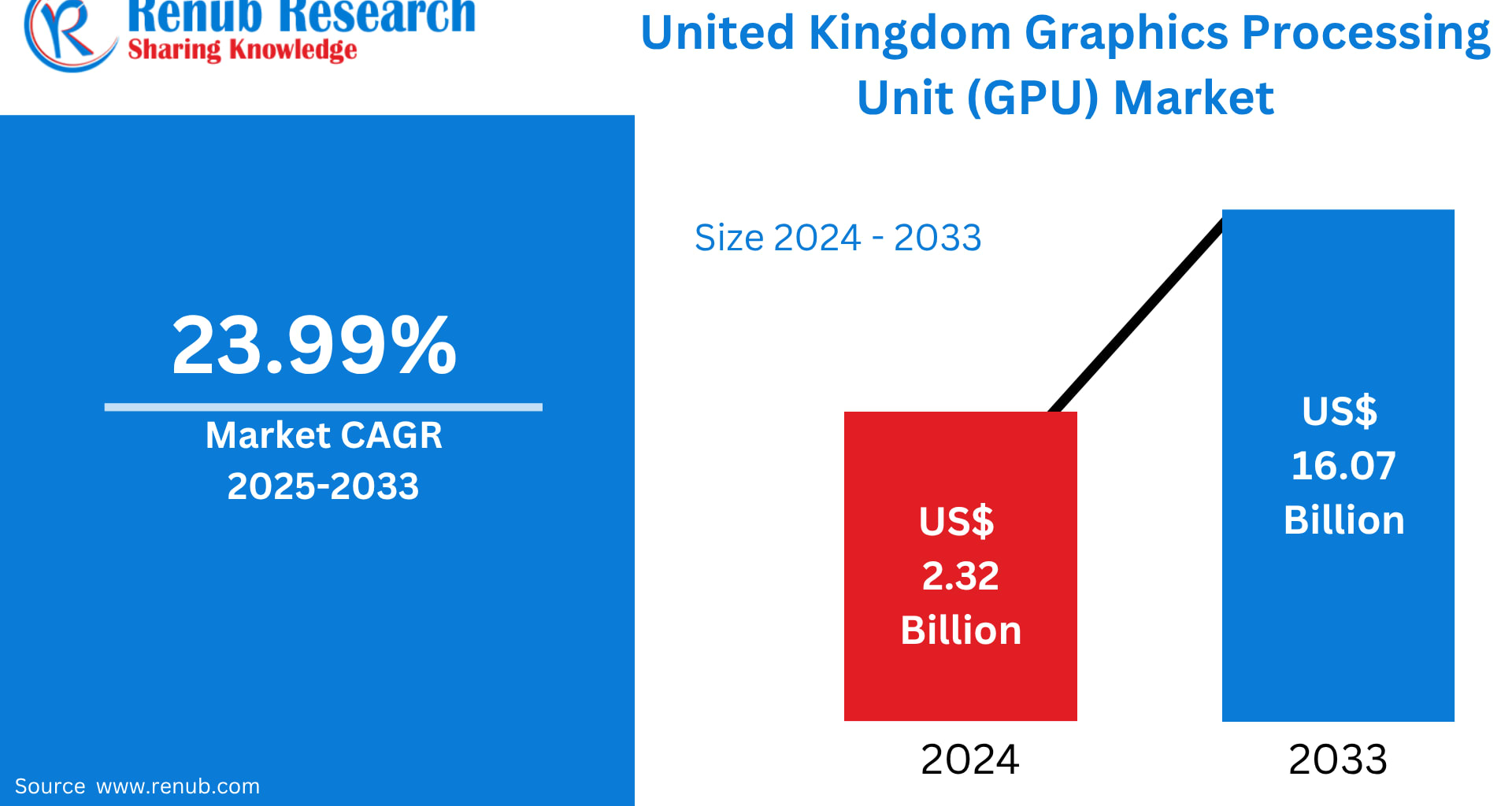
The United Kingdom Graphics Processing Unit (GPU) Market is undergoing a period of rapid acceleration, driven by a powerful combination of technological innovation, enterprise adoption, and government-led digital transformation efforts. According to Renub Research, the United Kingdom GPU Market is expected to reach US$ 16.07 billion by 2033, rising dramatically from US$ 2.32 billion in 2024, with a remarkable CAGR of 23.99% during the forecast period of 2025 to 2033.
This explosive growth is underpinned by a surge in gaming demand, the expansion of AI and machine learning across industries, the rise of data center infrastructure, and the nation’s increasing reliance on high-performance computing. As the UK strengthens its digital ecosystem—from fintech clusters in London to AI innovation hubs in Scotland and the Midlands—GPUs are emerging as the backbone of the country’s computational future.
United Kingdom Graphics Processing Unit (GPU) Industry Overview
A Graphics Processing Unit (GPU) is a specialized electronic circuit designed to accelerate the creation of images and simulations through rapid mathematical processing. Once limited to gaming and multimedia, GPUs are now indispensable in AI model training, deep learning, complex simulations, high-performance computing (HPC), medical imaging, fintech analytics, and immersive media production.
While CPUs handle sequential tasks, GPUs excel in parallel execution, enabling them to process large datasets at exceptional speeds. This capacity makes them vital in sectors that increasingly rely on automation, modeling, or intelligent algorithms. In the UK, this includes healthcare, finance, automotive, entertainment, academia, cloud technology, and advanced research institutions.
The country’s digital-first business environment, bolstered by investment in innovation and supercomputing, further amplifies GPU demand. Whether powering AI-driven analytics in banks, enabling visual effects in cinema, accelerating scientific simulations in universities, or supporting cloud gaming infrastructure, GPUs are reshaping how the UK computes, creates, and competes globally.
Growth Drivers for the United Kingdom GPU Market
1. Gaming and Esports Expansion
The UK is one of the world’s most vibrant gaming hubs, home to millions of players, globally recognized studios, professional esports leagues, and a deep-rooted developer community. As gaming evolves into ultra-realistic, graphics-heavy experiences, demand for advanced GPUs continues to skyrocket.
Key factors include:
High-definition rendering, photorealistic textures, and real-time ray tracing
The rise of VR (Virtual Reality) and AR (Augmented Reality) experiences
Competitive esports requiring high-refresh-rate GPUs for precision gameplay
Growth of cloud gaming, dependent on GPU-powered servers
A thriving content creation environment for streamers and gaming influencers
With esports viewership and gaming revenues increasing year after year, GPUs remain at the heart of the UK’s gaming evolution.
2. Artificial Intelligence and Machine Learning Adoption
AI and machine learning are transforming every corner of the UK’s economic landscape—from banking and medicine to retail and transportation. GPUs are essential to this revolution due to their unparalleled ability to accelerate:
Deep learning model training
Neural network computations
Predictive and real-time analytics
Natural language processing and automation
Financial institutions use GPU-enhanced systems for fraud detection, risk modeling, and algorithmic trading.
Healthcare providers depend on GPUs for scans, diagnostics, genomics, and real-time medical analysis.
The automotive sector leverages GPUs for driverless vehicle testing, intelligent mobility, and engineering simulations.
As the UK government pushes forward with large-scale AI investments—such as the Frontier AI Taskforce and national compute initiatives—the demand for high-performance GPUs is projected to soar across industries.
3. Growth in High-Performance Computing (HPC)
High-performance computing is a core pillar of innovation in the UK. HPC systems powered by GPUs are critical for:
Climate modeling and environmental research
Pharmaceutical development and genetic research
Space technology and advanced engineering
Quantum computing simulations
Large-scale scientific experiments
Universities, government agencies, private labs, and technology firms depend on GPU clusters for computation-heavy workloads. Cloud service providers operating in the UK are also scaling GPU infrastructure to support HPC-as-a-service, making advanced computing more accessible to enterprises and academia.
The UK’s strategic push to develop cutting-edge AI and compute capabilities ensures that HPC will remain a central force driving GPU adoption well into the next decade.
Challenges in the United Kingdom GPU Market
1. High Costs and Supply Limitations
One of the biggest impediments to widespread GPU adoption is cost. High-end GPUs are expensive due to:
Advanced fabrication processes
Global semiconductor shortages
Import duties and fluctuating exchange rates
Increasing demand from AI and gaming markets
Startups, small businesses, educational institutions, and individual consumers often face budget constraints that delay or limit GPU purchases. This cost barrier can slow innovation and restrict access to cutting-edge computing.
2. Cryptocurrency Market Volatility
While cryptocurrency mining is not the dominant factor it once was, volatility still affects GPU demand:
Crypto booms lead to large-scale GPU purchases, creating shortages.
Market crashes leave vendors with surplus inventory.
Supply chain unpredictability affects pricing and production cycles.
Environmental concerns and government scrutiny surrounding crypto mining further complicate market stability.
Although the crypto impact has diminished compared to 2017–2021 levels, it remains a recurring challenge for the UK GPU ecosystem.
Regional Analysis of the United Kingdom GPU Market
London
London remains the UK’s most influential GPU market, supported by its concentration of:
Fintech giants using GPUs for high-speed trading and analytics
Media houses and film studios requiring GPU-accelerated rendering
AI startups developing deep learning and advanced data models
Gaming companies and content creators
However, challenges for London include high energy costs, operational expenses, and limited physical space for large-scale GPU clusters. Despite this, London remains the center of commercial GPU adoption and innovation.
North West United Kingdom
Cities such as Manchester and Liverpool host a thriving landscape of:
Research universities
Gaming companies
Digital startups
Media production studios
The North West’s strong academic presence drives GPU usage in simulations, AI development, and predictive modeling. This region is fast emerging as a secondary tech hub, backed by investments in digital infrastructure and HPC facilities.
Scotland
Scotland’s GPU market is heavily influenced by:
Strong academic institutions
Climate science research
Life sciences and medical computing
AI and innovation-focused government initiatives
Edinburgh and Glasgow have growing clusters of AI startups, gaming companies, and research organizations. While energy costs and geographical constraints pose challenges, Scotland’s commitment to digital innovation positions it as a key contributor to the UK GPU market.
West Midlands
The West Midlands is becoming a significant GPU hub due to its automotive engineering powerhouses. GPUs power:
Autonomous vehicle simulations
Manufacturing optimization
AI-driven engineering workflows
Scientific research and digital twin environments
Universities in the region further drive demand through HPC projects and AI R&D. Investment in 5G, smart mobility, and industrial digitalization ensures strong growth potential for the GPU market here.
Recent Developments in the United Kingdom GPU Market
September 2025: Nvidia announced that the UK will host Europe’s largest GPU cluster, featuring 120,000 Blackwell GPUs by the end of 2026, massively increasing national compute capacity and cementing the UK’s status as a global AI and HPC leader.
Market Segmentation – United Kingdom GPU Market
By Component
Hardware
Software
Services
By Type
Integrated GPU
Discrete GPU
Hybrid GPU
By Deployment
On-Premise
Cloud
By Application
IT & Telecommunication
Healthcare
Media & Entertainment
Others
By Region
London
South East
North West
East of England
South West
Scotland
West Midlands
Yorkshire and the Humber
East Midlands
Others
Key Players Covered
Intel Corporation
Advanced Micro Devices (AMD) Inc.
Nvidia Corporation
Imagination Technologies Group
Samsung Electronics Co. Ltd
Arm Limited
EVGA Corporation
SAPPHIRE Technology Limited
Qualcomm Technologies Inc.
Final Thoughts
The United Kingdom’s Graphics Processing Unit (GPU) Market is accelerating at one of the fastest rates in Europe, powered by the convergence of AI adoption, gaming innovation, cloud computing expansion, and government-backed digital infrastructure investment. With a projected market size of US$ 16.07 billion by 2033, the UK is positioning itself as a global powerhouse in the era of intelligent computing.
As GPUs become the central engine for research breakthroughs, immersive entertainment, automation, and financial innovation, their importance to the UK economy will only grow. The next decade will witness an unprecedented transformation in how the UK computes, analyzes, and creates—and GPUs will remain the driving force behind this digital evolution.