
Your support helps us to tell the story
From reproductive rights to climate change to Big Tech, The Independent is on the ground when the story is developing. Whether it’s investigating the financials of Elon Musk’s pro-Trump PAC or producing our latest documentary, ‘The A Word’, which shines a light on the American women fighting for reproductive rights, we know how important it is to parse out the facts from the messaging.
At such a critical moment in US history, we need reporters on the ground. Your donation allows us to keep sending journalists to speak to both sides of the story.
The Independent is trusted by Americans across the entire political spectrum. And unlike many other quality news outlets, we choose not to lock Americans out of our reporting and analysis with paywalls. We believe quality journalism should be available to everyone, paid for by those who can afford it.
Your support makes all the difference.Read more
Kenya’s wildlife service has rejected claims that a new Ritz-Carlton luxury lodge is blocking a wildebeest migration corridor between the Maasai Mara reserve and Tanzania’s Serengeti National Park.
This follows a lawsuit filed by a Kenyan activist in August, seeking to block the hotel’s opening. Though the establishment, charging from $3,500 per person nightly, was allowed to open, the legal challenge continues.
The case has sparked a vigorous debate in Kenya, a nation reliant on tourism, over access to industry benefits.
In a statement shared on its official X account on Thursday, KWS said that monitoring data indicated that the Ritz-Carlton property did “not fall within, obstruct, or interfere with any wildebeest migration corridors”.
“Migrating wildebeest are using the entire breadth of the Kenya-Tanzania border within the Reserve (approximately 68 km wide), without a specific preferred route or corridor,” it said.
Marriott International, which owns Ritz-Carlton, has said the project’s local developer Lazizi Mara Limited obtained all necessary approvals for the hotel. Lazizi said an environmental impact assessment had established that the site was not a wildlife crossing point.
open image in gallery
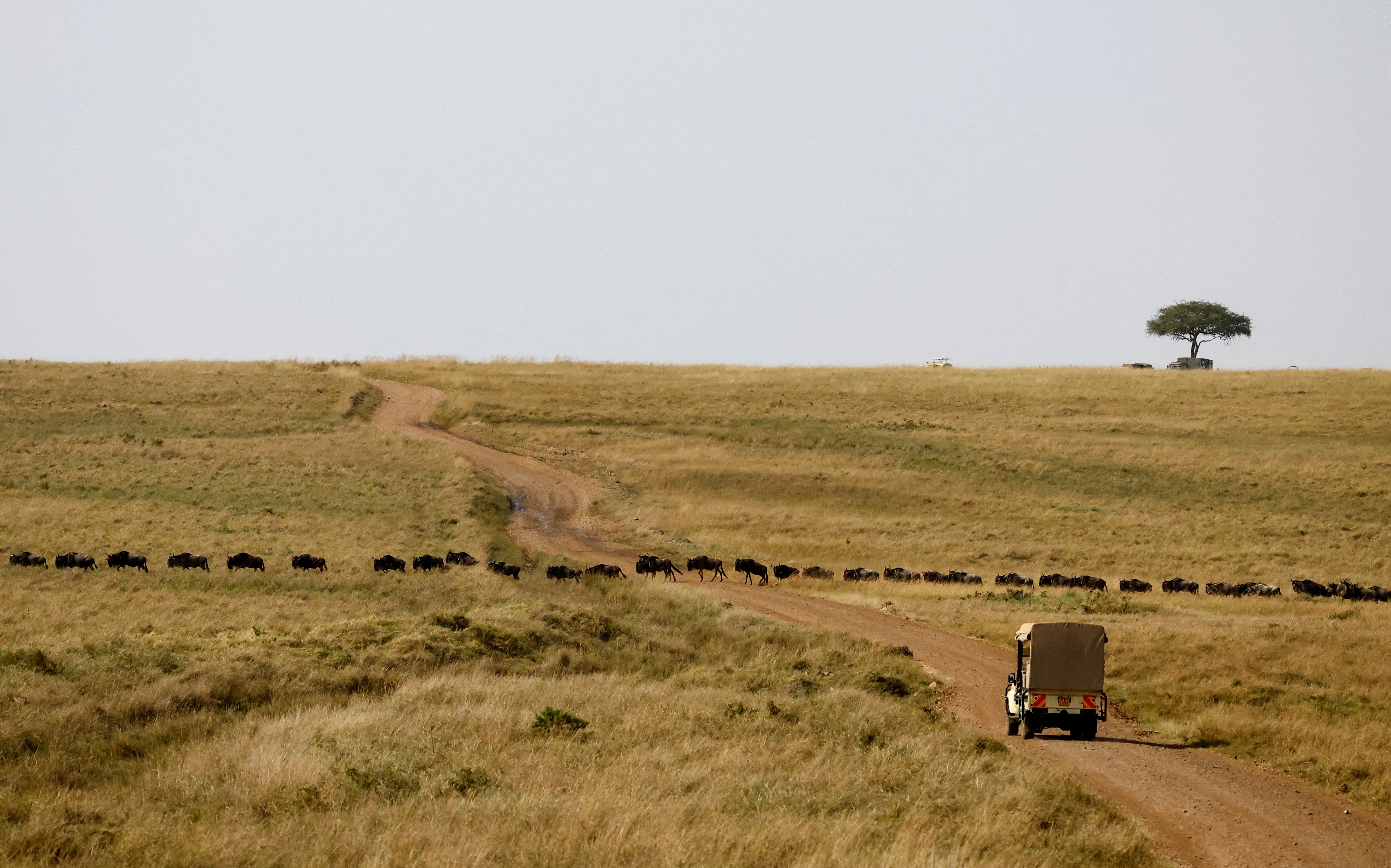
A tour vehicle stops as wildebeests (Connochaetes taurinus) cross a road during their migration to the greener pastures, between the Maasai Mara game reserve and the open plains of the Serengeti, southwest of Nairobi, in the Maasai Mara game reserve, in Narok county, Kenya August 7, 2025 (Reuters)
The hotel is just the latest flashpoint in a broader rift over East Africa’s wildlife tourism industry.
In Kenya, locals have complained about what they say are land grabs by wealthy investors. In Tanzania, protests against the eviction of tens of thousands of Maasai to make way for hunting lodges have led to deadly clashes with police.
According to research by the University of Manchester published in August, some African nations’ efforts to attract luxury tourism have yielded limited benefits for local communities and even deepened inequality.
All-inclusive resorts are often cut off from local life, hire few local workers, and keep tourists from spending in nearby communities by providing everything on-site, the research published in African Studies Review said.