

The study challenges long-standing assumptions about when life first began to thrive on our planet. Previously, evidence of ancient life older than 2.5 billion years was scarce. By combining modern technology with ancient rocks, researchers have extended the timeline of life on Earth, showing that photosynthesis, the process that sustains nearly all life on Earth, appears to have emerged much earlier than anyone expected.
Machine Learning Finds Ancient Life’s Chemical Echoes
In a breakthrough method, scientists turned to artificial intelligence to help analyze ancient rocks for signs of life. The team, led by researchers from Carnegie Science, trained an AI system to recognize faint chemical traces of life embedded in rocks. Using high-resolution chemical analysis, the team analyzed 406 diverse samples, including meteorites, fossils, and modern biological material, and trained the AI to distinguish between biological and non-biological substances. According to the study, this approach achieved more than 90% accuracy in identifying molecular fingerprints of life, even in highly degraded ancient samples.
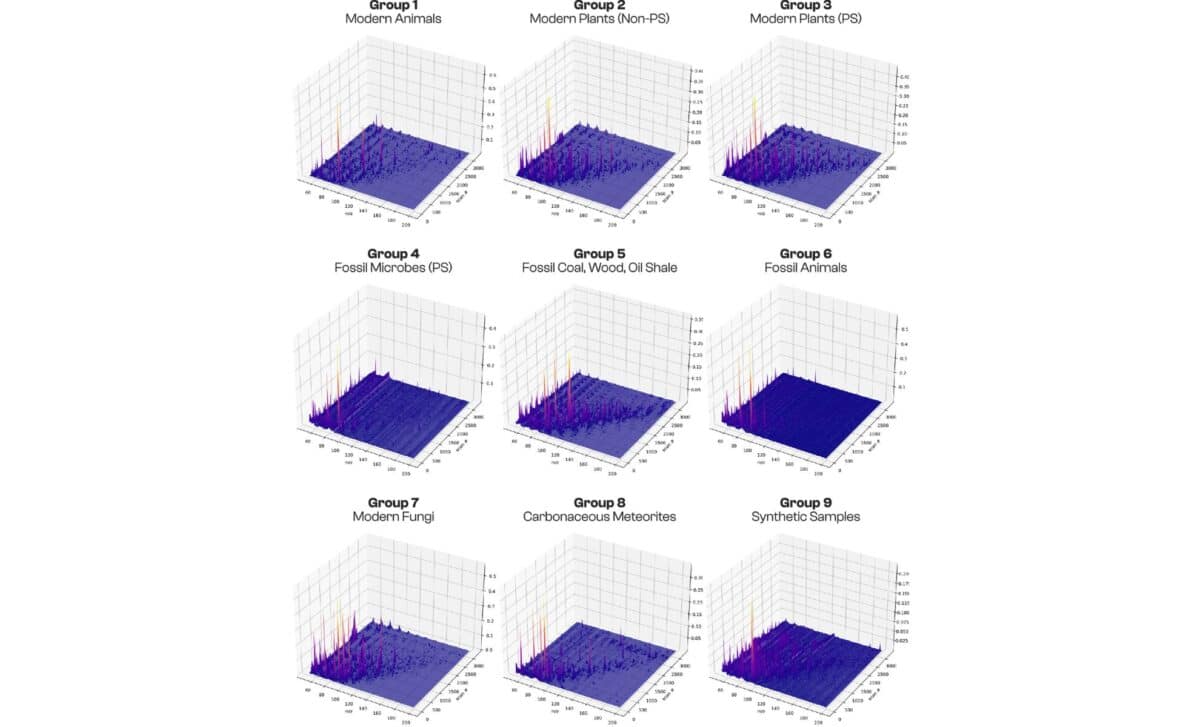 The aggregated three-dimensional py–GC–MS data for each of the nine categories ©PNAS
The AI was especially adept at identifying the remnants of photosynthesis, a vital process that produces oxygen and organic compounds. These new findings show that signs of photosynthesis have been detected in rocks as old as 2.5 billion years, a full billion years earlier than scientists had thought. This is significant because it shows that Earth’s biosphere began producing oxygen long before the Great Oxygenation Event, which occurred around 2.4 billion years ago.
Implications for Earth’s Early Biosphere
The research provides a new glimpse into the Earth’s earliest biosphere, shedding light on life forms that existed when our planet was much younger. According to Robert Hazen, a senior scientist at Carnegie Science, “Ancient life leaves more than fossils; it leaves chemical echoes.” These chemical “whispers” are the molecular traces that remain in ancient rocks, even after the original biomolecules have long since degraded. The ability to interpret these chemical echoes using AI could open a new frontier in the study of ancient life on Earth and beyond.
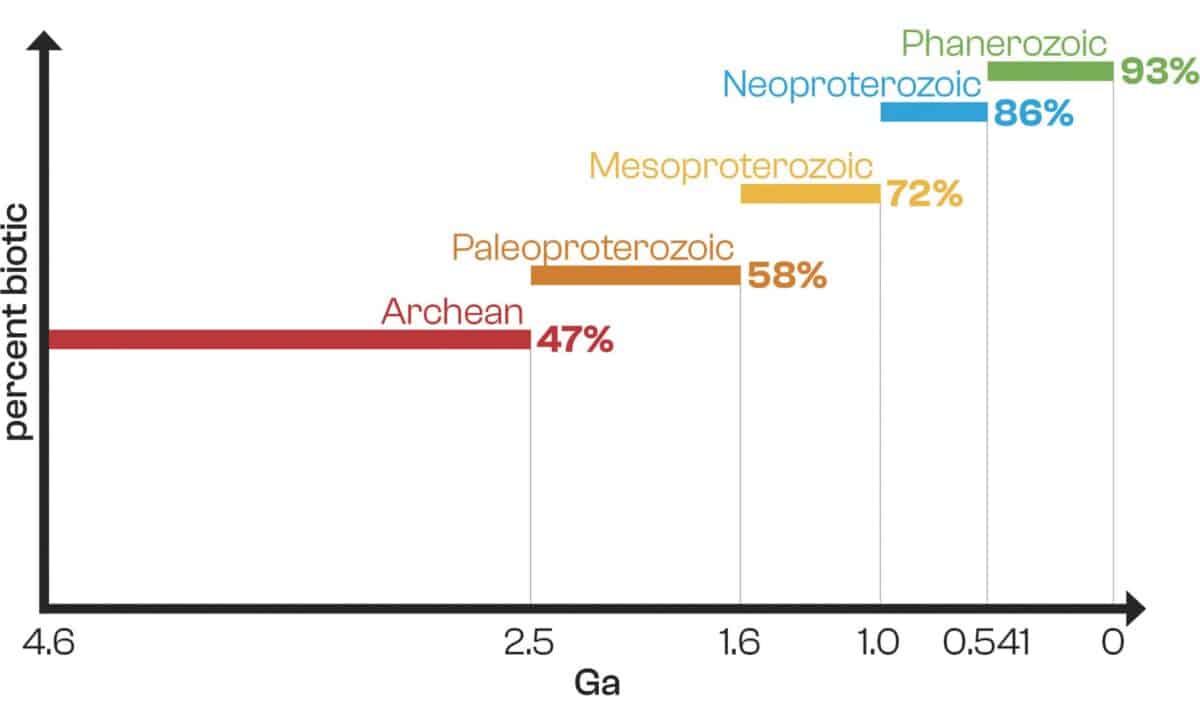 The percentage of biogenic (vs. abiogenic) samples classified by random forest Model ©PNAS
Katie Maloney, an assistant professor at Michigan State University who contributed to the study, emphasized that this method of combining chemistry with machine learning “has revealed biological clues about ancient life that were previously invisible.” This breakthrough is especially important because most ancient life forms left few tangible traces, and any surviving cells or microbial mats were often obliterated by geological processes over time. This new technique allows scientists to retrieve molecular clues that would otherwise remain hidden.
A Step Toward Finding Life on Mars and Beyond
While this research focused on Earth’s ancient history, its implications extend far beyond our planet. The methods developed in this study could help scientists detect signs of life on other planets, including Mars.
As Katie Maloney points out, “This innovative technique helps us to read the deep time fossil record in a new way. This could help guide the search for life on other planets.” The technology used to detect molecular traces of photosynthesis on Earth can be applied to analyze extraterrestrial samples, potentially opening up new possibilities for astrobiology.
For instance, future missions to Mars could use similar techniques to analyze Martian rocks for signs of ancient life. While the search for life beyond Earth remains in its early stages, the ability to identify faint chemical signatures could significantly enhance our chances of finding extraterrestrial organisms.