
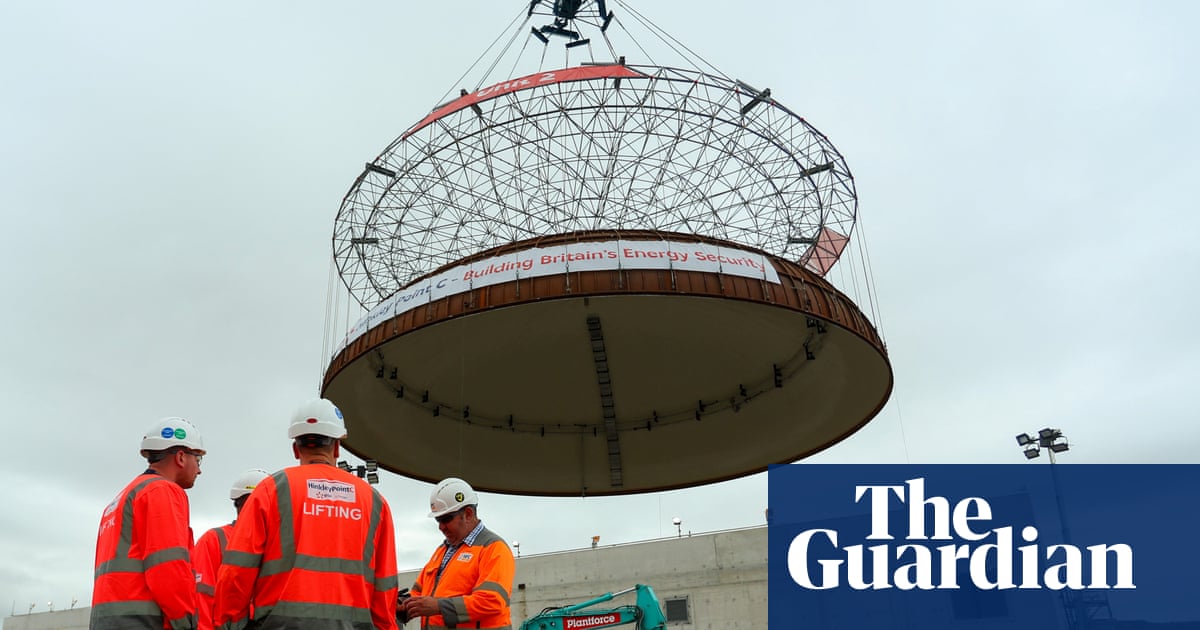
UK energy bill payers will hand over £2bn a year in subsidies to EDF, the French company building two nuclear power stations, according to government figures.
EDF, owned by the French government, will be entitled to £1bn in annual payments as soon as Hinkley Point C, in Somerset, comes on to the grid in 2030. The sum is due under the contracts-for-difference system that guarantees low-carbon energy companies a fixed price for the electricity they generate.
Separately, £1bn will be added to bills through a separate nuclear levy scheme to fund Sizewell C, in Suffolk, a 3.2 gigawatt (GW) project also led by EDF.
The result is an increase of about £2bn in bills, funding the cost of two plants that together will generate about a sixth of the electricity that Britain was using during peak demand so far this year, equivalent to 6m homes.
A government spokesperson said: “We are reversing a legacy of no new nuclear power being delivered to unlock a golden age of nuclear, securing thousands of good, skilled jobs and billions in investment.”
The government hopes the extra cost of new nuclear reactors could be offset in the future by the stable “baseload” output they offer, which can rein in the rising cost of balancing volatile output from energy sources such as solar and wind.
That balancing cost is expected to hit about £2bn this year, according to the Nuclear Industry Association. The government said Sizewell alone could save £2bn a year in future, adding that the impact on bills over the construction period was likely to be about £1 a household each month.
The chancellor, Rachel Reeves, has promised to cut energy bills by an average £150 for each household from April by slashing green levies.
Assessments of the nuclear subsidy were revealed in documents released by the Office for Budget Responsibility (OBR), which assesses the impact of economic policy. The OBR said EDF would receive £1bn in the first year of operation at Hinkley, due to come on stream in 2030 after 12 years of construction.
“In 2030-31, contracts for difference (CfDs) are expected to generate £4.6bn in government receipts, including £1bn to fund subsidy payments to the Hinkley Point C nuclear power plant for its first year of expected generation,” the OBR said.
The subsidy is the result of an agreement struck between EDF and the Conservative-Liberal Democrat coalition government in 2013.
The then energy secretary, Ed Davey, now the leader of the Liberal Democrats, agreed a “strike price” guaranteeing that the French state-owned company would receive £92.50 for each megawatt hour (MWh) for electricity generated at the 3.2 GW plant.
skip past newsletter promotion
Sign up to Business Today
Get set for the working day – we’ll point you to all the business news and analysis you need every morning
Privacy Notice: Newsletters may contain information about charities, online ads, and content funded by outside parties. If you do not have an account, we will create a guest account for you on theguardian.com to send you this newsletter. You can complete full registration at any time. For more information about how we use your data see our Privacy Policy. We use Google reCaptcha to protect our website and the Google Privacy Policy and Terms of Service apply.
after newsletter promotion
The strike price has risen with inflation to about £133 and is projected to reach £150 in 2030, according to the Daily Telegraph, which first reported the Hinkley subsidy.
The wholesale cost of electricity is much lower, now about £80 a MWh, meaning EDF will be able to claim the shortfall from consumers and businesses that use its electricity, thanks to the CfD agreement.
However, government sources said if Hinkley Point C had been generating power during the energy price spike that followed Russia’s invasion of Ukraine, it would have saved energy users more than £4bn.
The construction of Sizewell C, which has yet to begin and is scheduled for completion in the 2030s, will also drive up bills.
From January, energy bills will be inflated by a levy supporting the plant’s construction, adding £10 a year. The levy is expected to raise £700m but will double to 2030 to fund Sizewell, whose price tag is projected to hit £100bn.
In practice, the cost of the power station could increase. Hinkley Point C was originally projected to cost £18bn but has been subject to several time and cost overruns; EDF predicted last year the final bill could hit £46bn.