
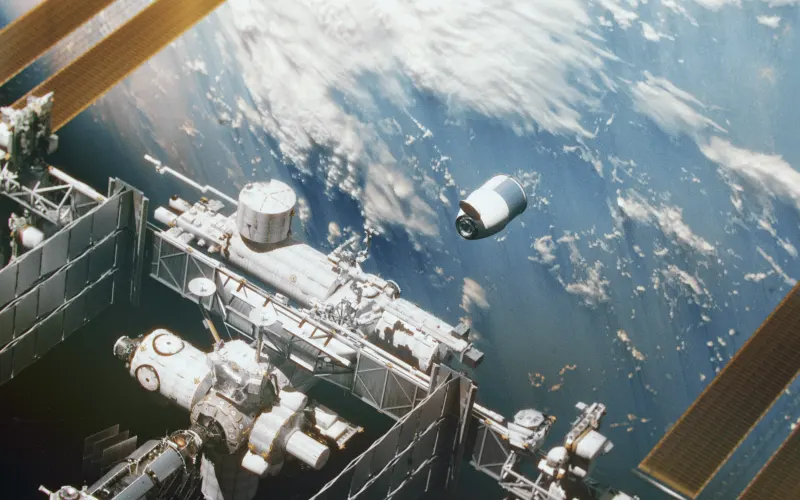
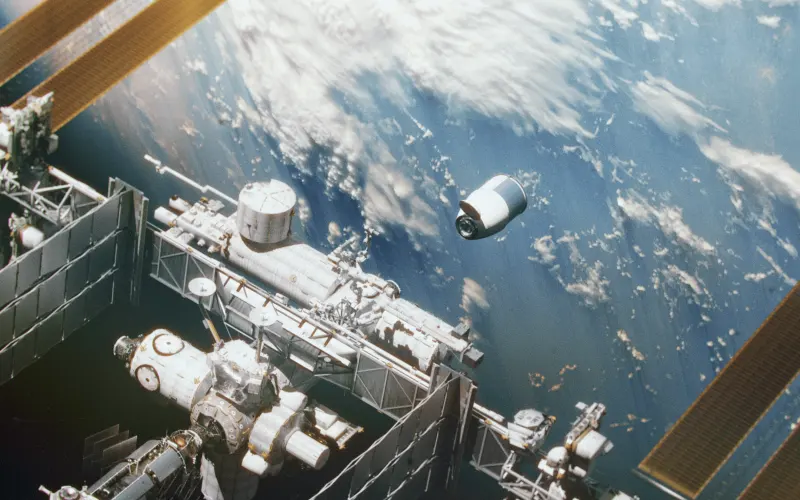
 Credit: The Exploration Company
During the European Space Agency (ESA) Ministerial Council meeting in Bremen (CM25), Member States agreed to fund two cargo delivery demonstration missions to the International Space Station (ISS). The agency also committed to serving as an anchor customer for the resulting commercial service once the systems have been successfully proven.
With the LEO Cargo Return Services initiative, ESA aims to foster the development of a European commercial cargo space transportation service. In May 2024, the agency awarded Phase 1 contracts to Thales Alenia Space and The Exploration Company, with each receiving €25 million to mature the design of their respective vehicles. This phase of the initiative is expected to be concluded in 2026.
Phase 2 will be open to all providers and will not be limited to Phase 1 awardees, and will encompass the vehicle’s full development up to and including an initial test flight to the International Space Station (ISS). This test flight had initially been expected to be completed by the end of 2028, but that deadline has since been extended to mid-2029. This leaves little room for delay, as the ISS is slated to be retired and deorbited in 2030.
Speaking to European Spaceflight, the Director of Human and Robotic Exploration Daniel Neuenschwander explained that following discussions during CM25, Member States have decided to fund two demonstration missions to the ISS. He explained that the call to tender is expected to be published in early 2026, with bid evaluations being completed by mid-2026.
Moving beyond the demonstration missions, Member States also decided to support the incumbent providers with guaranteed flights, with the agency acting as an anchor customer.
“Part of the decision which has been taken was that ESA is committing to be a customer after the demo missions of four LEO Cargo Return Service vehicles,” explained Neuenschwander.
The agency is currently exploring conducting these additional missions between 2030 and 2032. This period would represent a post-ISS era, one that will rely on commercial actors to build and maintain human outposts in low Earth orbit. While vehicles like The Exploration Company’s Nyx spacecraft could be used for ESA-managed free-flight missions, the flights the agency has committed to purchase could also be used to barter for crew opportunities for European astronauts aboard commercial space stations.
During CM25, the agency also discussed possible European activities in a post-ISS era. While likely not intended for public release, a now-deleted presentation that ESA shared with the Belgian delegation ahead of CM25 outlined a second of three possible scenarios.
The first scenario outlined was committing no European investment in infrastructure. The second, labelled the baseline scenario, called for limited European investment. Scenario 3 called for a European initiative to develop a LEO outpost, with contributions from various partners. While the second scenario was considered the baseline, the agency noted that “in an ever-changing environment,” there was increased importance in considering the third, more ambitious scenario.
Keep European Spaceflight Independent
Your donation will help European Spaceflight to continue digging into the stories others miss. Every euro keeps our reporting alive.