
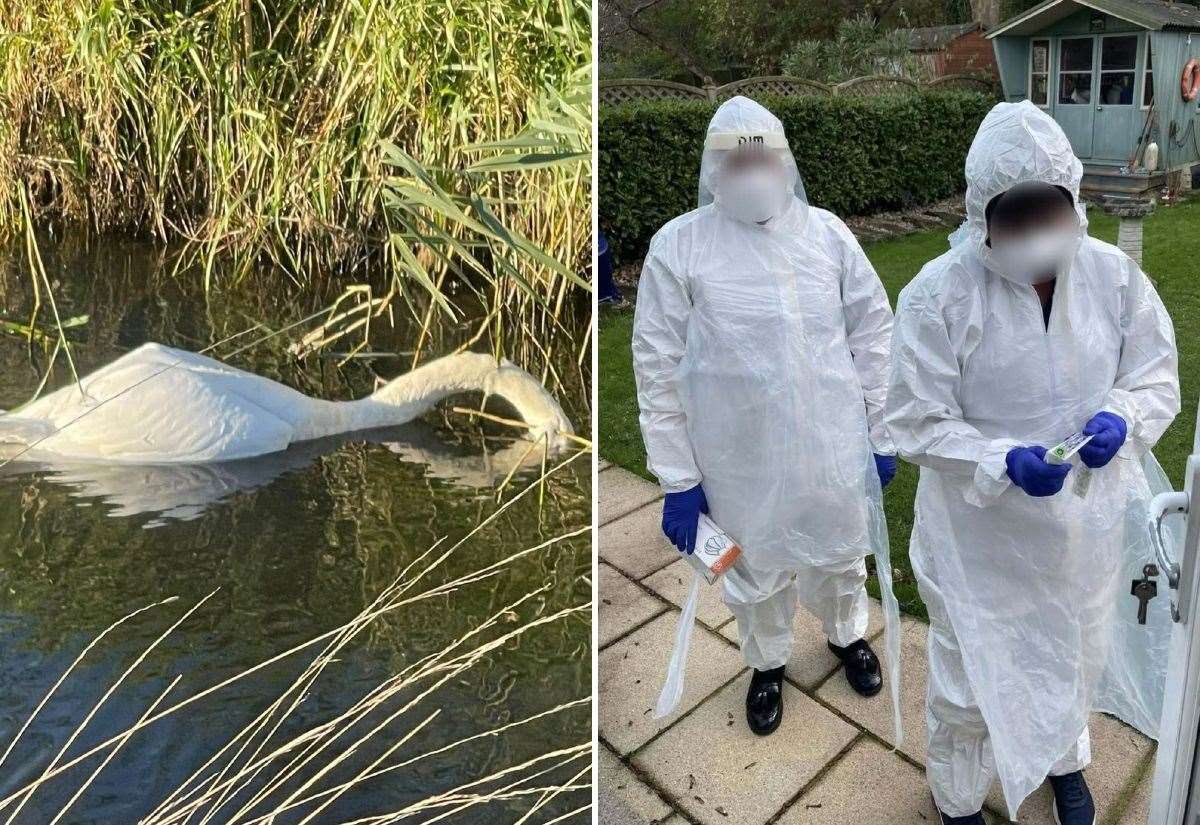
Wildlife rescuers fear the swan population could be “decimated” after dozens were found dead amid suspected outbreaks of bird flu.
Experts have been left horrified after discovering “at least 50” of the birds had died in the Canterbury and Thanet areas.
 One of the dead swans found in the Sarre Penn, between Canterbury and Thanet. Picture: Johnny Allen
KentOnline reported earlier this week how avian influenza has been confirmed at a farm in Lydd on Romney Marsh – where all the poultry will be culled.
Meanwhile, several birds and other animals have died in the Chistlet Marshes, near Canterbury, following an outbreak of the virus, with at least one swan testing positive.
With hundreds of swans expected to arrive to winter in the area, Kent Wildlife Rescue volunteer Johnny Allen is expecting “carnage”.
He explained: “This is potentially the beginning of the end. Once the flock arrives, it will be carnage.
“What else can I say but ‘pray’?”
Johnny Allen is a volunteer for Kent Wildlife Rescue ServicePicture: Johnny Allen
He fears the swan population could be wiped out in the area encompassing Minster Marshes, near Ramsgate, St Nicolas at Wade and up to Reculver Towers, near Herne Bay.
Mr Allen had been collecting and reporting the dead birds before feeling unwell himself. Due to his recent activity with potentially infected swans, he was visited by the UK Health Security Agency (UKHSA).
Two representatives in masks, face shields and full-body suits came to his home to test him for avian flu.
Staff from the APHA visited Johnny Allen to test him for avian fluPictures: Johnny Allen
Thankfully, he was cleared of the virus and it has since been confirmed that he has Covid.
Mr Allen says the Environment Agency (EA) and the Department for Environment, Food and Rural Affairs (Defra) have not been collecting carcasses as they should be, to help prevent “secondary contamination”.
“Defra is reluctant to collect primarily due to the remote locations,” he explained.
“I myself have stopped recovering deceased swans after discussions with government agencies – also, because of both financial and time constraints.
“Local wildlife is actively feeding on the carcasses; therefore, there is a potential for secondary contamination.
“This has already been found to be the case of some deceased seals that, when tested, proved a positive result for avian influenza.
“I don’t know how many carcasses are currently just lying out there – increasing the probability of the total decimation of the flock.”
Swans dying in the marshes and streams are now making their way into the food chain
The Animal and Plant Health Agency (APHA), an arm of Defra, says it is the landowner’s responsibility to remove dead animals if warranted.
As well as the bird flu outbreak, earlier this month, a pollution incident in the Sarre Penn and Wanstum River area, between Canterbury and Thanet, killed “several thousand” fish.
Three dead swans were also discovered but the EA says it has no evidence that the pollution was the cause.
Mr Allen says that, despite this, he does not feel avian flu alone is causing the spiralling numbers of deaths in mute swans.
This is because he has not seen the bodies of other types of birds in the area.
The Environment Agency is investigating a pollution incident in the Sarre Penn and River Wantsum between Canterbury and Thanet. Picture: Johnny Allen
He explained: “I think the swans on the Sarre Penn have been victims of a contaminant or toxin that has entered the water course, hence why both swans and bottom-feeding fish have died. The cause or point of the original contamination has yet to be determined.”
Swans feed by ducking their heads under water and feeding on shoots and plant matter on the river bed.
The EA says its investigation into the incident is “moving at speed”.
It says specialist fisheries officers have relocated about 20,000 fish away from the area where the pollution occurred.
A spokesman added: “They continue to monitor conditions and are undertaking further analysis of water samples taken from the stream.
At least 50 dead swans have been found. Picture: Johnny Allen
“The affected stretches of the Sarre Penn stream and the River Wantsum are returning to normal.
“The pollutant is continually being diluted, and there is no existing threat to the watercourses or water life.
“The Environment Agency has no evidence that any swans died as a result of the pollution.”
Anyone with information on the pollution can contact the EA’s 24-hour incident hotline on 0800 807060.
An APHA spokesperson said: “We are aware of a number of wild birds’ deaths in the Sarre Penn, River Wantsum and Chislet Marshes areas between Canterbury and Thanet, and a mute swan collected from the Chislet area has been found positive for highly pathogenic avian influenza
“Members of the public are advised not to touch or pick up any dead or visibly sick birds.”
It is understood that although the Chislet swan tested positive, this cannot be officially confirmed as the cause of death.
Following the outbreak at Chislet Marshes, Canterbury City Council put out a warning to locals, especially dog walkers.
A spokesperson said: “Sadly, we have to announce that a number of birds have been found dead in the Chislet Marshes area of the district with suspected avian influenza.
“Avian influenza, commonly referred to as bird flu, is circulating in seabirds and other wildlife in the area
Reports of dead swans (in blue) made between October 29 and November 29. There were none in the shown area in the same period last year. Picture: APHA
“If you see a dead bird or other wildlife where the cause of death is unclear, please do not touch or remove it. Keep away and do not let your pets (and particularly dogs) go near it.”
Thanet District Council has now also warned walkers, and is erecting signage on footpaths.
A spokesperson said: “As a precaution, and in line with government guidance, work has started to put signs out at rural paths through Plucks Gutter to St Nicholas and Sarre, to warn the public.
“Signs include important messages warning people not to handle dead birds or any other wildlife. They also advise against feeding birds and have information on how to report dead birds or other wildlife.
“Trained officers from the council are responsible for their collection and disposal.”
Meanwhile, at the Happy Pants Ranch animal sanctuary in Newington, Sittingbourne, more than 60 birds had to be culled after a positive test for avian influenza.
The UKHSA advises that bird flu is primarily a disease of birds and the risk to the general public’s health is very low.
There have been 45 cases of bird flu confirmed in England since the start of October.