
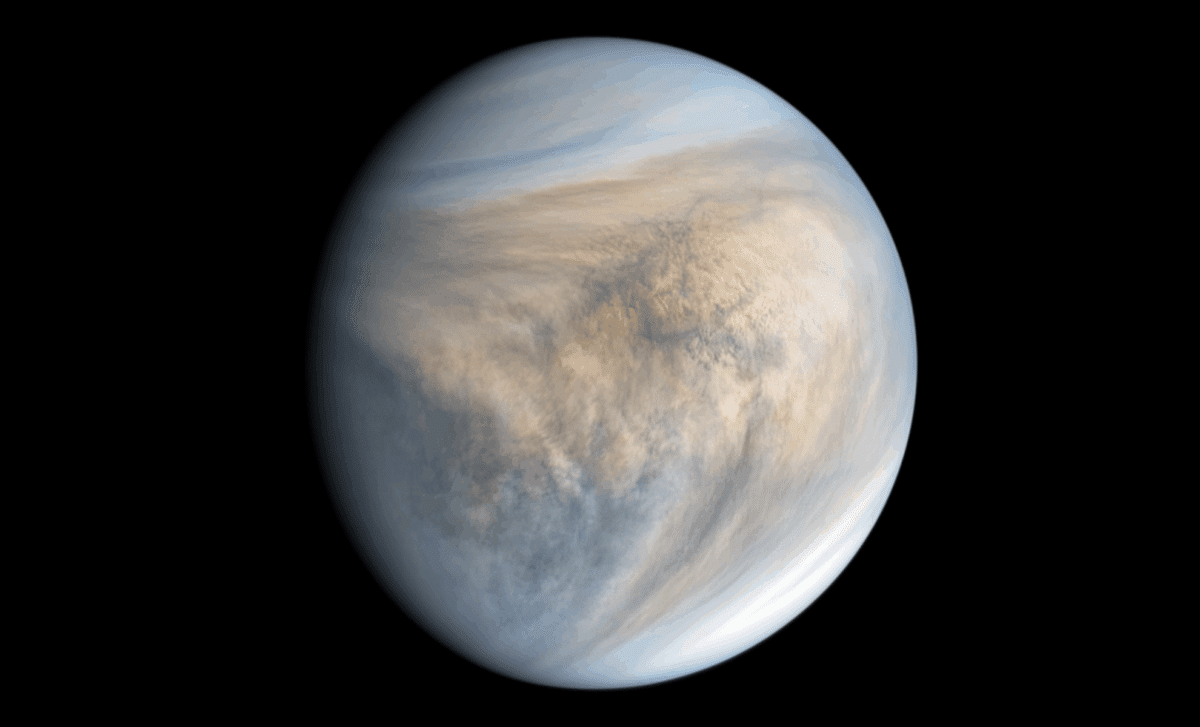
Venus, with its fiery surface and rapid atmospheric rotation, has always been a subject of fascination for scientists. Recent discoveries reveal that its extreme winds might be even more dramatic and complex than we once thought. The findings published in Eos, sheds light on the role of atmospheric thermal tides in shaping these high-speed winds. Understanding the dynamics behind Venus’s superrotation could unlock new insights into planetary weather systems across the solar system.
The Mystery of Venus’s Extreme Winds
Venus is known for its extreme weather, with winds that can reach speeds of over 100 meters per second. These hurricane-like gusts whip across the planet’s atmosphere, contributing to a phenomenon known as superrotation, where the atmosphere circulates much faster than the planet itself. While earlier research pointed to various atmospheric processes contributing to these wild winds, scientists had long debated which ones were the key drivers.
The findings from Lai et al, published in AGU Advances and further detailed by Eos, provide an intriguing clue. A key factor in this atmospheric behavior is thermal tides—patterns of air movement generated by the Sun heating Venus’s surface. The study reveals that these thermal tides are a major factor in Venus’s rapid atmospheric rotation, particularly the diurnal thermal tides that cycle once per Venusian day. This discovery shifts our understanding of the planet’s atmospheric dynamics, highlighting a component that was previously underappreciated.
What Are Thermal Tides and How Do They Work?
Thermal tides are waves of atmospheric motion driven by the Sun’s heating effect on a planet’s surface. On Venus, these tidal movements play a pivotal role in redistributing heat and momentum across the atmosphere. When sunlight strikes the dayside of the planet, it heats the surface and causes the air to expand and move. This movement sets off a cycle of atmospheric waves, which can transport momentum, affecting the planet’s overall rotation speed.
On Venus, thermal tides exist in two major forms: diurnal and semidiurnal tides. Diurnal tides follow a once-per-day cycle, while semidiurnal tides complete two cycles daily. While semidiurnal tides had long been thought to be the dominant force driving the superrotation, the new study suggests that diurnal tides may play a more significant role in the planet’s extreme winds than previously understood.
This shift in focus toward diurnal tides is a breakthrough, offering a new perspective on the forces at work in Venus’s upper atmosphere. As these tides carry momentum toward the cloud tops, they contribute directly to the acceleration of Venus’s winds, which are among the fastest in the solar system.
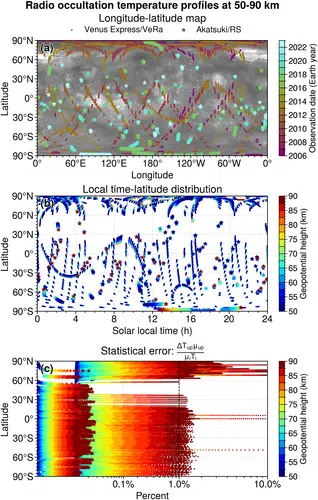 Distribution and uncertainty of temperature profiles from radio science experiments of Venus Express and Akatsuki. Panels (a) and (b) show the sampling locations (50–90 km) on topography and local time–latitude maps. Panel (c) shows retrieval uncertainties versus latitude; points with uncertainties below 1.0% (black dashed line) are used. (Lai et al.)
The Role of Momentum Transport in Superrotation
At the heart of Venus’s atmospheric phenomena is the concept of momentum transport. As the planet rotates slowly, with one complete spin taking 243 Earth days, the atmosphere spins much faster—about 60 times quicker than the surface. This disparity creates the phenomenon of superrotation, where the atmosphere outpaces the planet’s rotation in an almost continuous cycle.
The recent study highlights how thermal tides, particularly the diurnal tides, facilitate this momentum transport. By moving heated air toward the cloud tops, these tides inject energy into the upper atmosphere, helping to accelerate the winds. This constant momentum transfer sustains the superrotation, allowing it to maintain the planet’s extreme wind speeds.
The study’s use of data from the European Space Agency’s Venus Express satellite and Japan’s Akatsuki spacecraft was crucial in identifying the patterns of thermal tides. These spacecraft provided valuable insights by measuring the bending of radio waves as they passed through Venus’s dense atmosphere. Combining this data with sophisticated atmospheric models, the research team has been able to map out how thermal tides influence Venus’s meteorological behavior, offering a clearer picture of the planet’s complex weather systems.
Implications for Understanding Other Slowly Rotating Planets
The implications of this research extend beyond Venus. While Venus is unique in its extreme winds and harsh conditions, many other planets in our solar system share characteristics that could make them susceptible to similar atmospheric phenomena. For example, Mars, which has a much thinner atmosphere, and even some of the gas giants, such as Jupiter, experience complex weather patterns that might be influenced by similar tidal effects.
Understanding how Venus’s thermal tides drive its superrotation could provide valuable insights into the atmospheric dynamics of other planets. The study also highlights the importance of planetary waves, meridional circulation, and other atmospheric forces, which together create an intricate and often unpredictable system of weather. By studying Venus, scientists can refine models of planetary atmospheres, leading to a better understanding of weather patterns on distant worlds.