
Every bit as dispiriting as expected. Worse, was it pointless? Well, it certainly had more points to it than Wales would have liked. But, worse again, was it actively alienating? A record defeat, 11 tries conceded, the first time since 1967 Wales have failed to score a point in Cardiff. The opposition on that day 58 years ago, Ireland, scored 70 fewer than the Springboks here.
“It’s quite a raw, emotional dressing room,” said Dewi Lake, Wales’s captain. “The boys are proud Welshmen, so coming off the field with the scoreboard looking like that is tough to take. But I don’t think it’s going to ruin the confidence of the younger boys. If anything, it drives you even more. You recognise the gap and what you’ve got to do.”
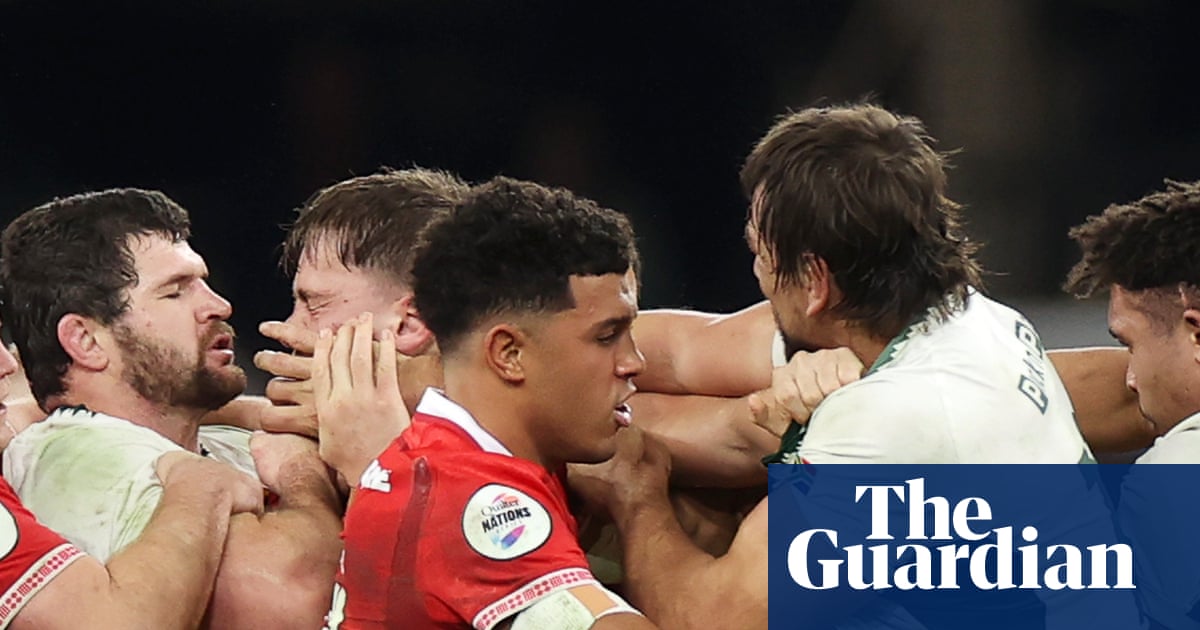
South Africa continue to demonstrate their superiority over every other nation. People are starting to compare them to the best sides we have ever seen. And they remain as brutal as ever, mostly legitimately, sometimes less so. They received their third red card of the autumn, their third to a second-row, but there was no arguing with this one. Eben Etzebeth, a full head taller than any of his opponents in the middle of a fracas two minutes from time, jabbed his thumb into the eye of Alex Mann. The least contentious red card of the autumn.
“It didn’t look good,” said Rassie Erasmus. “I think it was a justified red card. How it happened and why it happened I don’t know. That’s definitely not the way we would have liked to end the game.”
Sacha Feinberg-Mngomezulu scores a try for the rampant Springboks. Photograph: Andrew Boyers/Action Images/Reuters
The buildup to this Test was dominated by its characterisation as the game no one wanted, each side surrendering upwards of a dozen players to their respective clubs in England and France, the international window now shut. The Welsh regions were stretched as well, shipping in players on loan to fulfil their fixtures in the United Rugby Championship.
But the harsh truth is, the Welsh Rugby Union is also down to its bare bones. People like to tut and roll their eyeballs when the making of money is seen as prioritised over player welfare, but there is a difference between “making money” and not haemorrhaging it. The extra revenue from this fixture, no matter the stadium was two-thirds full, is precious indeed as the WRU faces up to the realities of the professional era, approaching the end of its third decade.
Quick GuideWales 0-73 South Africa teams and scorersShow
Wales Murray (B Thomas 66); Mee, Roberts, Hawkins, Dyer; Edwards (Sheedy 50), Hardy (Morgan-Williams 50); G Thomas (Southworth 50), Lake (capt; Coghlan 78), Assiratti (Coleman 44; Assiratti 62), Carter, Davies (Ratti 61), Plumtree, Mann, Wainwright (Morse 43)
Yellow cards Plumtree 43, Wainwright 54
South Africa Willemse; Hooker, De Allende, Esterhuizen, Moodie; Feinberg-Mngomezulu, Van Den Berg (Reinach 51); Steenkamp (Porthen 51), Grobbelaar (Mbonambi 51), Louw (Ntlabakanye 51), Kleyn (Etzebeth 51), Nortjé, Kolisi (capt; Smith 51), Mostert (Van Standen 51), Wiese (Dixon 51)
Red card Etzebeth 79
Tries Steenkamp, Hooker, Wiese, Van den Berg, Louw, Feinberg-Mngomezulu 2, Moodie, Esterhuizen, Nortjé, Etzebeth Cons Feinberg-Mngomezulu 9
Referee Luc Ramos (France) Att 50,112
Thank you for your feedback.
The bookies gave Wales a 40-point head start. South Africa had covered that only five minutes into the second half, when Sacha Feinberg-Mngomezulu, continuing to play on another plane from most people in rugby, certainly anyone in Wales, scored the first of his two tries. He converted that, just as he had the previous six tries. The Springbok fly-half ended up with a haul of 28 points.
skip past newsletter promotion
The latest rugby union news and analysis, plus all the week’s action reviewed
Privacy Notice: Newsletters may contain information about charities, online ads, and content funded by outside parties. If you do not have an account, we will create a guest account for you on theguardian.com to send you this newsletter. You can complete full registration at any time. For more information about how we use your data see our Privacy Policy. We use Google reCaptcha to protect our website and the Google Privacy Policy and Terms of Service apply.
after newsletter promotion
Ethan Hooker receives the acclaim of his Springbok teammates as Wales players look on disconsolately. Photograph: Andrew Matthews/PA
None of South Africa’s 11 tries were dazzling. Imagine if they had actually played at their best. They had four in the first half, all based around an utterly dominant scrum. Ethan Hooker’s try, South Africa’s second, straight from that set piece was nicely worked. The others were a story of brutal physicality.
Wales had one lineout in the Springbok 22 in the first half. They overthrew it. They had another – and their first piece of possession in the opposition “red zone” as people like to call it these days – in the 58th minute. They worked a few phases, then Kwagga Smith was over the ball to win the penalty. End of that little interlude.
Smith was on because South Africa brought on all eight replacements 10 minutes into the second half, which meant seven forwards, the whole pack replaced bar Ruan Nortjé, who weighed in with a try himself 10 minutes from time. Etzebeth led the phalanx of replacements. For a side to be 49-0 down and face the introduction of players of that calibre is almost too much, whether an international window is shut or not.
Etzebeth battered his way over from close range for a try with five minutes to go, the 11th and final of the rout. And then, that grin never far from his face, he took his menace too far. Rarely can an act of barbarity have seemed so pointless. Never has a match here in this famous stadium been so full of points for the opposition.