
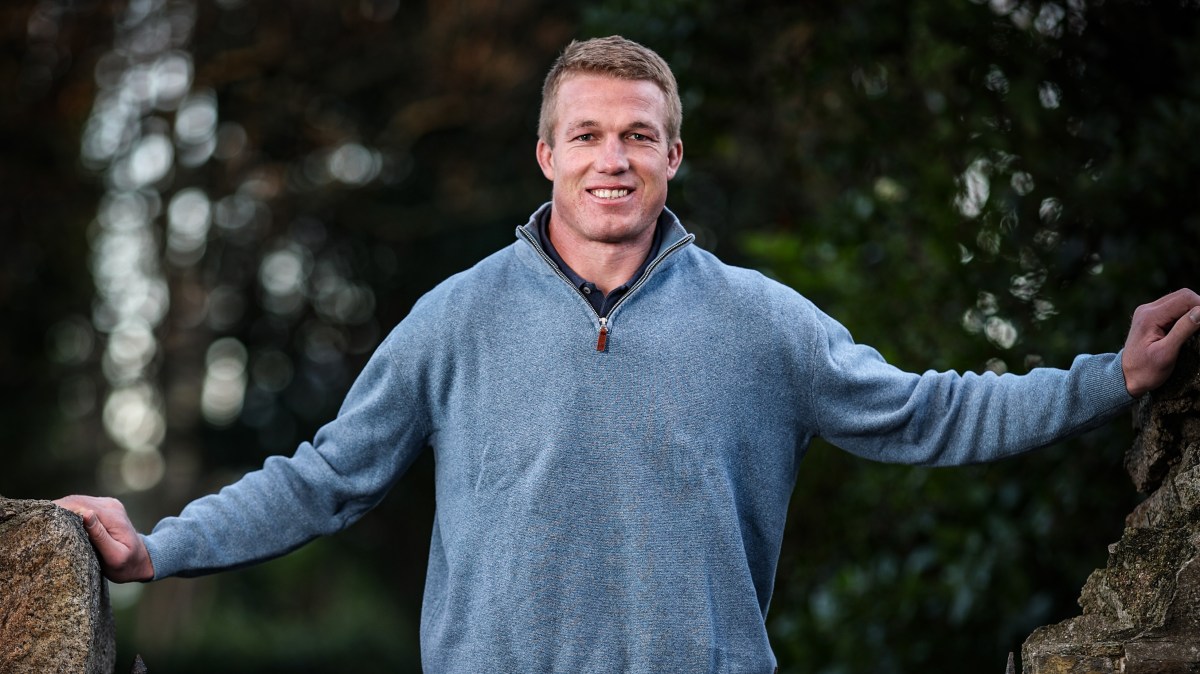
Saturday, March 13, 2015, dawned under a clear blue sky in the Western Cape. It would get hot in the afternoon. For Pieter-Stephanus du Toit, a wine-producing farmer from just outside Riebeek-Kasteel, it was another rugby day. Not that he was complaining. He liked to watch his boys play. Three were in action that Saturday.
The younger ones, Anton and Daniel, had trials for South Africa schools’ most prestigious tournament, Craven Week. Already a professional, the eldest son Pieter-Steph would be in Bloemfontein for the Sharks against the Cheetahs in the Super Rugby Championship. That was too far for Pieter-Stephanus, who only had to jump in the bakkie to see the younger ones in their trials at nearby Hopefield.
All four of the Du Toit boys were good at rugby but Pieter-Stephanus and his wife Annaleane thought Anton the one with the most talent. He could play fly half, centre, wing or full back. That day at Hopefield, Anton’s foot got caught in an unseen mole-made hole and he smashed his ankle, breaking the bone and causing serious ligament damage.

Du Toit celebrates World Cup success with his family in Paris in October 2023
DAN MULLAN/GETTY IMAGES
Pieter-Stephanus took Anton to the emergency unit at Durbanville Medical Centre, a private hospital near Cape Town. There, in the waiting room, he and Daniel watched the Sharks v Cheetahs on TV. X-rays showed Anton’s injuries were as bad as they’d feared. When Annaleane turned up, her husband and Daniel headed back to the farm, hoping to catch the second half of the Sharks game.
Along the way they listened to the radio commentary. Three minutes before half-time, a Sharks player went down. They prayed it wasn’t Pieter-Steph. It was. The commentator said it looked bad. Pieter-Steph was replaced. After getting home, Pieter-Stephanus called his son’s number. No answer. Called it again. Again, nothing.
Two years before, Pieter-Steph had made the Springbok team. Now his dad’s concern was chaperoned by the fear that injury would keep him out of the 2015 World Cup, just six months away in England. Eventually Jimmy Wright, a fitness coach at the Sharks, called.
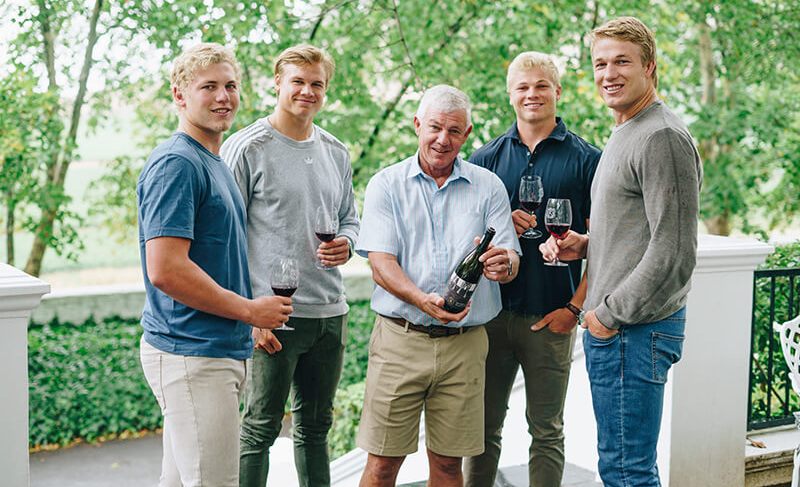
Pieter-Steph, right, with his dad, centre, and three brothers
NOT KNOWN, CLEAR WITH PICTURE DESK
“Pieter-Stephanus, the news is not good. I’m going to hand over to Pieter-Steph.”
“Dad,” said Pieter-Steph, “we think I’ve done the ACL again.”
Though he was then just 22, Pieter-Steph had already had an ACL reconstruction. That took nine months. Fearing the consequences of this latest injury, Pieter-Steph cried while speaking to his dad and brother. Pieter-Stephanus and Daniel also cried. When the emotion subsided, Pieter-Stephanus spoke earnestly to his son. “Don’t worry,” he said, “we’ll make a plan.”
Had you asked about the nature of the plan, Pieter-Stephanus would have said he didn’t know but he had to get his boy to believe they would get through this.
Two days later the two Pieter-Stephs went to Cape Town to see the renowned surgeon Dr Willem van der Merwe, who explained that as they had taken tendon from young Pieter-Steph’s hamstring for his first ACL, it wouldn’t be good to take more tendon from him.
“We will need to order some and that comes from Germany. It will take six weeks.”
“Could you not take tendon from my leg,” said Pieter-Stephanus.
“I don’t know,” said Dr Van der Merwe. “ I’ve never done that. I will inquire from some US colleagues to see if it’s possible. We would need to do blood tests to make sure you’re in good health.”
“I have just had a full health check. I can email the blood results.”
Dr Van der Merwe’s colleagues said it should be possible to use tendon from Mr Du Toit to help stabilise his son’s knee. Two days later the two Pieter-Stephs went under the surgeon’s knife at the Vincent Pallotti Hospital in Cape Town. First, an examination of the damage to young Pieter’s knee and an assessment of how much tendon they’d need. Once that was done, Dr Van der Merwe went to work on Pieter-Stephanus, slicing three inches of tendon from his hamstring. That was then used to repair Pieter-Steph’s torn ACL.

Du Toit scores against England at Twickenham during the 2024 autumn internationals
WARREN LITTLE/GETTY IMAGES
They left the hospital, side by side, in wheelchairs. Two days later Pieter-Stephanus was back at work on the farm. His son’s recovery took a lot more time. Appreciating what his father had done, Pieter-Steph worked harder than he’d ever done. Four months after ACL surgery he played for the Sharks, and six weeks after that he played for South Africa at the World Cup.
Anton, too, recovered from serious ankle surgery and was so impressed by the skill of his surgeon, Dr Matthys Boeyens, that he changed his career plan and went to medical school. Anton is now a doctor.
As for Pieter-Stephanus, he likes to joke that he once dreamt of playing for the Springboks. His father had. His son does. And now, since 2015, a small part of him plays for the Springboks.
‘Don’t worry, we’ll make a plan’
He walks into the Dublin hotel where we had agreed to meet. Slim and towering, he looks taller than his 6ft 6in. Through the latest rise of the Springboks, beginning with victory at the 2019 World Cup, Pieter-Steph du Toit has been a colossus. The one who is selected first and replaced last. No one in the squad embodies better the team’s character than the athletic and relentless flanker.
A two-time world player of the year, he delivered one of the all-time great performances in the 2023 World Cup final against New Zealand, a match the Springboks won 12-11. That night at the Stade de France, he made 28 tackles, eight more than the player with the second highest tackle count, his team-mate Deon Fourie. “Pieter-Steph wasn’t just making tackles,” said team-mate RG Snyman, “he was obliterating people.”
Does he consider it the best of his career?
“I would agree, yeah, and the chances of it happening again, one in a million,” he says. “First of all, it was a blessing, how we were able to play that game, and how it came at just the right time and the right place for me. The timing was perfect. With the tackling, that just came naturally. It was meant to be. Afterwards I didn’t really remember anything I did in the game.
“I couldn’t recall tackles I’d made, or ball carries. The one thing I remember is being focused on the next thing. In a game you must forget about what you’ve just done, because what happened has happened, it’s over and it’s not going to make a difference anymore. So, focus on the next thing, the next step. But as I’ve said, the chance of this happening again, one in a million.

A dejected South Africa looked to be heading to defeat against England at the 2023 World Cup before Du Toit’s half-time team talk rallied them
DAVID RAMOS/GETTY IMAGES
“I would love to be in a set-up, in an environment like that again; the way we struggled in the semi-final and got to the final, and then how things played out.”
Ah, that semi-final against England that South Africa came so close to losing. Within the camp, Du Toit’s contribution to that win is fondly spoken about. Picture the scene inside the changing room at half-time. Outplayed in the first half, South Africa are 12-6 down and in trouble. As soon as the players sit in their places, Rassie Erasmus, the head coach, let’s them have it, reminding them he’s got replacements who are ready to play.
The players are positioned according to their number. From the left, there’s Steven Kitshoff, Bongi Mbonambi, Frans Malherbe, Eben Etzebeth, Franco Mostert, Siya Kolisi and then Du Toit. After Erasmus has spoken, there is an embarrassed and almost sullen silence. Some sit with heads bowed, others stare vacantly in front of them. Bottles of water and Lucozade stand untouched by their feet. Du Toit stretches out his legs, draws them back in and he then speaks. This is an event in itself. “I had never seen Pieter-Steph like this before,” Mbonambi would say later.
“Let’s get up,” he said. “We can’t just sit around. F*** it, man, come together. For f***’s sakes. You must decide for yourself. Are you going to f***ing stay or go? Play and get some excitement and talk to each other. Everyone’s f***ing scared. If you’re afraid, say so. We’ll make a f***ing plan.”
We’ll make a plan, exactly what his father had said to him at a tough moment in 2015.
Erasmus could hardly believe what he’d heard. “Pieter-Steph’s never done that. When he does that all of a sudden, my talk, what I said there, is irrelevant. Pieter-Steph du Toit just said, ‘Get up.’ Sorted, Rassie, move out, go and sit in the coaches’ box. Pieter-Steph had spoken.” No 8 Duane Vermeulen was just as taken aback. “For a guy that doesn’t say much, you see how special the jersey is to him.”
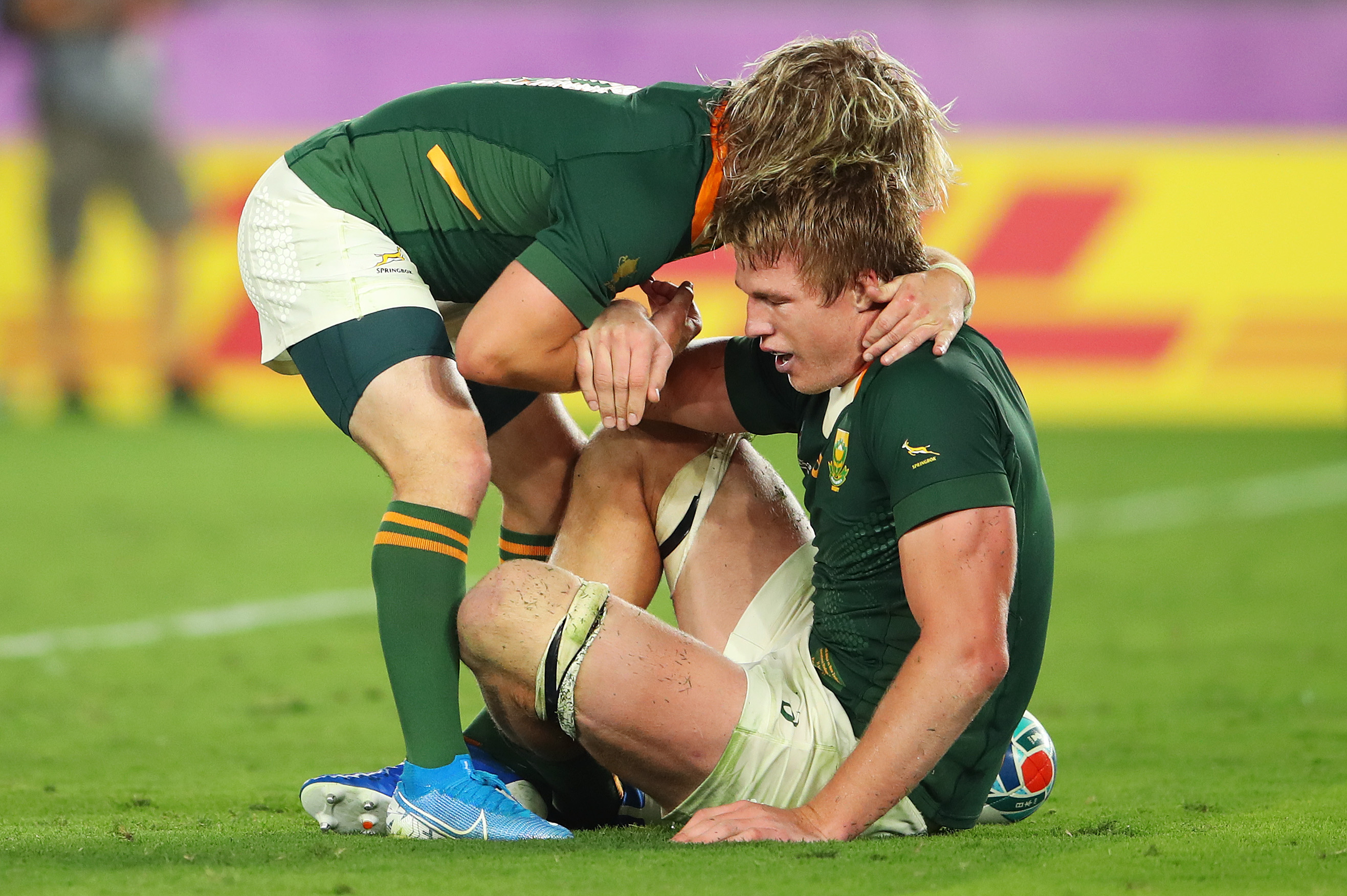
Du Toit is helped up by Faf de Klerk after scoring for South Africa during the 2019 World Cup
WARREN LITTLE/GETTY IMAGES
This was one of the pivotal scenes in Chasing the Sun 2, the TV documentary about the 2023 World Cup victory. After the team had somewhat fortunately squeezed through against England, Du Toit thought about what he’d said at half-time, including the swear words, and how it had been filmed. “When I got to the hotel, I told my wife, and she said, ‘It’s OK’. I just said if they put it in the documentary, they have to give context, because you can pull something out of context and it doesn’t make sense. Luckily, they gave the context and it’s something that happened. It’s part of our team. It brought us together on the field and helped us through that game.”
What was the context?
“We normally have a system,” he says. “When we come in at half-time, the players have a minute or two to ourselves. We relax and then we split into forwards and backs’ meetings. After that, the different coaches will make some points. This time, we didn’t have a minute for ourselves. Rassie just spoke to us. Why were we not delivering what we promised. Then he just called the reserves next door. I remember there was a table in the middle, Jacques [Nienaber, coach] was standing by the table, and the medical staff, and everyone was just standing there.
“We were not making a plan. We were not speaking. We were not creating solutions. I was looking around, and something came over me, and I just spoke up. I didn’t know what to say. I just wanted us to be more together, and that’s probably the first thing that came to mind. It’s not always about the words that come out, it’s more the intention to find solutions. For everyone to be awake, to get excited because we had this big opportunity to win a semi-final, get to a final. That was the big cause.”
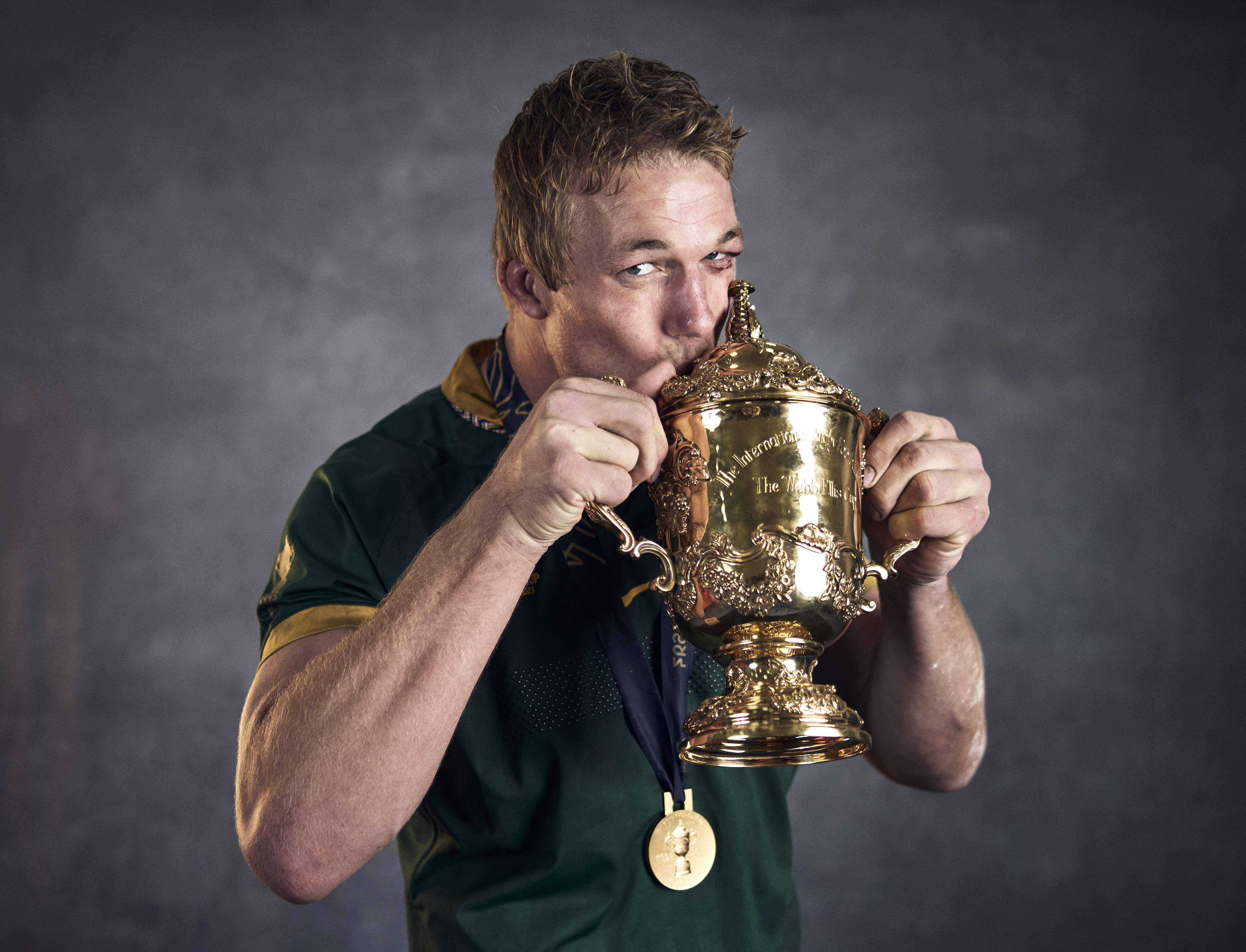
Du Toit has ensured his name is etched in World Cup folklore with his exploits across two tournaments
ADAM PRETTY/GETTY IMAGES
The childhood that he remembers is idyllic. He was the eldest of four boys and the tallest. The one that was called Pieter-Stephanus, the eighth in the family. His own first-born is now the ninth Pieter-Stephanus. It sounds like a tradition that comes with responsibility. “I wouldn’t say it’s responsibility,” he says. “I would just say this is how life happens and my personality went with that. I was the oldest, I took the lead in certain stuff but there have been points in our lives where I have followed my brothers.
“I give credit to my parents. The best thing they did for me is that they didn’t say, this is the tradition and you’ve got to follow it. I see the register in my father’s office, all the Pieter Stephanus du Toits. It’s nice, but it was never said, ‘You’ve got to call your son Pieter-Stephanus. You’ve got this responsibility.’ This was never the way. You just want to feel part of something, and that’s what makes this special.”
In one of his favourite memories, he is 10 or 12. It is a Saturday afternoon at the farm and he is watching the Springboks on TV. At half-time, they rush to the small, improvised pitch in the garden. He and Johan against their younger brothers, Anton and Daniel. The rule is that the younger ones only need to touch the bigger boys while Pieter and Johan must tackle.
In the late afternoon, Pieter-Stephanus got the braai going and the boys played until it was time to eat. “I would lie on the grass, looking up at the stars, praying and wishing that I would become one of the best Springbok players in the world,” he says. “It was just a wish and, of course, you don’t know you’re going to get there but that’s what keeps you excited, this dream, this small flame burning inside.”

Du Toit is the eldest of four boys
INPHO/
They fished for carp nearby, left the fishing rod lying on the bank, then ran as fast as they could when the carp dragged the rod into the water. Their granddad made an outboard engine and fixed it to a boat. With that boat, they dragged each other on tubes, getting stuck in the reeds. And Pieter-Steph’s dream of playing for the Springboks wouldn’t go away. With his size, coaches said he should play in the second row but, in his mind, he was a flanker.
He’s had so many good experiences with the Springboks. “My dad’s father, Pieter-Stephanus, known as Piet-Spiere, played 14 times for South Africa, so I always believed it was possible,” he continues. “My first cap was against Wales in Cardiff and that was special because my grandmother was alive at the time and she told me that my grandfather had played against Wales in Cardiff. The best thing about playing for the Springboks is when your family are there and you see the excitement they get out of it.
“My brothers are always there for me and that binds us. Winning the World Cup in 2019 was unbelievable and then in 2023, the pressure we were under against France in the quarter-final, England in the semi-final and New Zealand in the final. Winning that left you with a very satisfying feeling afterwards. Now I see my kids and the excitement they get from seeing me in the Springbok jersey, what it means to them, and I don’t know why they’re so mad about this, but I was the same when I was their age.”
Then he remembers the other days, the tougher, less satisfying times. The losses to New Zealand (57-0) and Ireland (38-3) in 2017, the two dummies he bought from Ben Youngs in 2016, the loss to Japan in Brighton, 2015. Days and moments that can’t be forgotten. And he’s had 18 rugby-related surgeries. Ankles, knees, shoulders, sternum, one terrible experience with acute compartment syndrome that could have ended his career. These times, he says, are as important to him as the good days. Without them, the good times wouldn’t have meant so much.
There have been head impacts and concussions. Does the toll worry him? “Concussion is part of the game,” he says. “I’ve had a few but as a rugby player you just want to play. Sometimes you don’t say stuff because you want to put on that jersey. It’s not always right because you may be putting yourself at risk. That’s a decision you take. It’s on your own terms and you’ve got to take ownership of it.”
Time has passed and now there’s a team meeting he needs to get to. I turn off the tape recorder and, off-handedly, ask if he thinks Ireland will recall Josh van der Flier for the match at the Aviva Stadium in three days. It’s an innocent question that brings to attention his inner Springbok.
“We will be ready for whoever Ireland select on Saturday,” he says.
“Pieter-Steph,” I say, “that doesn’t tell me much.”
“Exactly,” he smiles.