
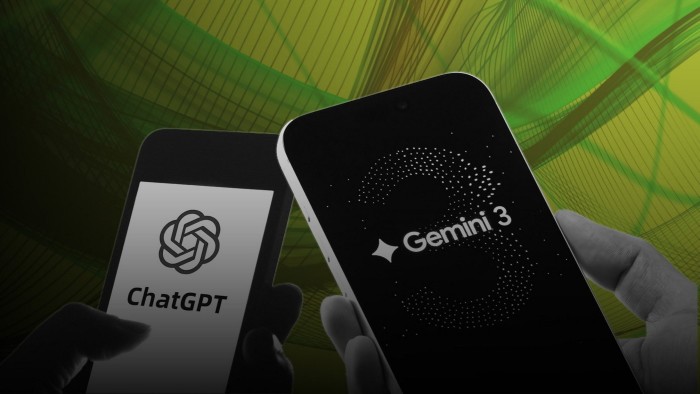
OpenAI’s huge early lead in the race to dominate artificial intelligence is under the greatest pressure since ChatGPT’s launch, as rivals Google and Anthropic gain ground in the cutting-edge technology.
Three years on from the debut of its popular chatbot, the $500bn start-up is grappling with the reality of soaring data centre costs, the technical challenges of remaining at the frontier of AI and the constant battle to retain key talent.
It is also facing a resurgent Google, with the release last week of Gemini 3, Google’s latest large language model, which is considered to have leapfrogged OpenAI’s GPT-5 and achieved gains from the model training process that have eluded OpenAI in recent months.
“It’s quite a strong difference with the world we had two years ago where OpenAI was leading ahead of everyone else,” said Thomas Wolf, co-founder and chief science officer of open-source start-up Hugging Face. “It’s a new world.”
Even before the launch of Gemini 3, OpenAI’s chief Sam Altman told staff in a memo last month that the company would “need to stay focused through short-term competitive pressure . . . expect the vibes out there to be rough for a bit”. The memo was first reported by The Information.
A year ago many had written off Google’s flailing efforts to narrow OpenAI’s colossal lead. Fears that its cash-cow search engine would be cannibalised by ChatGPT and other new AI powered search apps such as Perplexity left parent company Alphabet’s stock price lagging far behind its Big Tech rivals in the AI-driven rally through 2023 and 2024.
But Google’s turnaround began earlier this year, after a confident slate of updates at its IO developer conference in May and the viral popularity of its Nano Banana AI photo-editing tool this summer. This helped boost monthly users of the Gemini mobile app to 650mn, up from about 400mn in May.

The developments have seen Alphabet’s shares surge in recent months, with its market capitalisation now approaching $4tn for the first time, amid confidence on Wall Street that Google can combine its dominant positions in search, cloud infrastructure and smartphones to serve new AI capabilities to billions of existing users.
Koray Kavukcuoglu, Google’s AI architect and DeepMind’s chief technology officer, told the Financial Times that the Big Tech group had “pushed our performance quite significantly” by training its AI models using Google’s own bespoke chips.
“Being able to connect with consumers, customers, companies, at that scale is really something that we can do because of that full stack integrated approach that we have,” he added.
 Koray Kavukcuoglu said Google had a ‘unique approach’ © Google
That “full stack” includes its custom tensor processing unit chips, which allowed Google to train Gemini 3 without needing to rely on the costly Nvidia chips that most of the AI industry uses. “I think we have a unique approach there,” said Kavukcuoglu.
Google “always had these muscles to flex”, said Michael Nathanson, co-founder and analyst at MoffettNathanson, an equity research firm, adding that the IO event showed that “they really managed to find their product footing”.
“The pressure has definitely flipped to Sam Altman and his ability to monetise and keep all the plates spinning,” said Nathanson.
AI researchers and users have been quick to praise Google’s advancements. The model outperformed GPT-5 on several key benchmarks.
Marc Benioff, Salesforce chief executive, said in a post on X: “Holy shit. I’ve used ChatGPT every day for 3 years. Just spent 2 hours on Gemini 3. I’m not going back. The leap is insane . . . It feels like the world just changed, again.”

Publicly, OpenAI has welcomed the competition. “We’re always excited to see progress in the field — competition pushes the whole ecosystem forward,” said Mark Chen, OpenAI’s chief research officer.
“Our models continue to set the standard in performance, reliability, and real-world usefulness, and we will continue to release even more capable models,” he added.
But internally employees are feeling pressure to compete on multiple fronts with deep-pocketed rivals with tens of billions of dollars to throw at building AI. “The arc of any fast-growing start-up is not just going to be up and the right,” said one person close to the company.
Some experts say OpenAI has overextended itself in its pursuit of scale at all costs. The group has spent the past year pushing out new products at a breakneck pace, from automated computer programming tools to its viral video app Sora.
“OpenAI is getting spread too thin. It’s impossible for them to do it all well,” said a partner at a Silicon Valley venture capital firm that has backed several AI model developers but not OpenAI.
The San Francisco-based company has pledged to spend $1.4tn over the next eight years on computing power, striking huge deals with Nvidia, Oracle, AMD and Broadcom. That is orders of magnitude more than OpenAI’s current sales, requiring its partners to use debt to finance the build-out.
“That’s a really, really tremendously risky bet for any company to make,” said Sarah Myers West, co-executive director of the AI Now Institute, a non-profit.
OpenAI’s biggest challenge is finding a big enough revenue stream to sustain that extraordinary investment.
Recommended

The company believes it can attract hundreds of millions of paying subscribers to ChatGPT in the coming years. But its near-term plan to spin up more revenue from advertising, something Altman has hinted it will explore with Sora, will take it into a market already saturated by big players such as Meta and Alphabet.
ChatGPT has yet to dent Google’s strong lead in the ad market, and the start-up is only just starting to integrate ads and shopping features into its chatbot.
Meanwhile Anthropic, which was founded in 2021 by former OpenAI staffers and is currently raising a new round that is expected to value the company at more than $300bn, has built a large and fast-growing enterprise business.
Anthropic’s Claude chatbot has been overshadowed by the massive consumer hit of ChatGPT. But its long-standing focus on AI safety has helped Anthropic create a more reliable tool for corporate customers, its backers argue, and its coding tools are widely seen as best-in-class.

With more than 800mn weekly users, OpenAI still has a hugely dominant market share in overall chatbot usage but people are now spending more time chatting with Gemini than ChatGPT, according to data from web analytics company Similarweb.
The launch of Gemini 3 pushed Google’s AI app higher in the US and UK iPhone app store rankings. Still, ChatGPT has held on as the top AI app, according to Sensor Tower, which tracks mobile usage.
Erik Brynjolfsson, author and professor at the Stanford Institute for Human-Centered AI, said that it was too soon to count OpenAI out, with its vast array of new applications a good way to find new revenue sources that will fund its core research capabilities.
“All these companies have a surplus of very profitable opportunities all around them,” he said. “There’s room for multiple companies to do extremely well because the opportunity is so large.”
Data visualisation by Clara Murray