
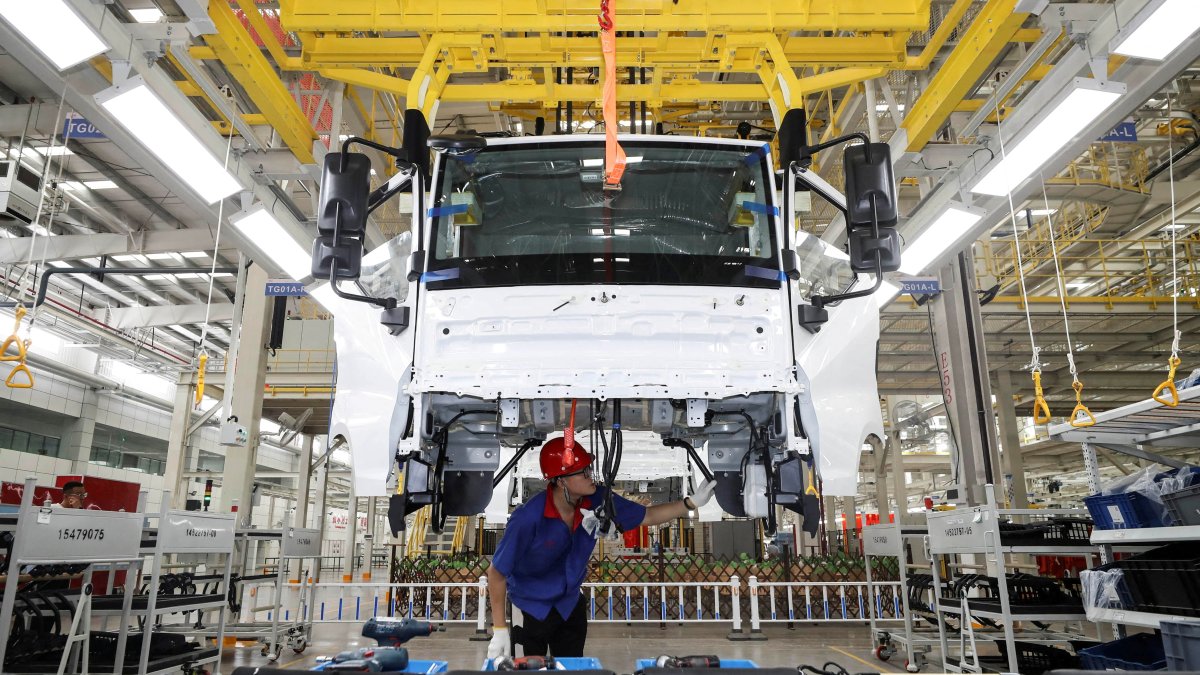
China’s factory activity contracted for the eighth consecutive month in November, official data showed Sunday, suggesting the world’s second-largest economy remains subdued despite a trade truce with the U.S.
The manufacturing Purchasing Managers’ Index (PMI), a key measure of industrial health, stood at 49.2 in November, according to the National Bureau of Statistics (NBS).
That marked an improvement from 49.0 recorded in October but remained below the 50 mark that separates expansion from contraction. The reading missed a median forecast of 49.4 from a Bloomberg survey of economists.
The figure comes after Chinese leader Xi Jinping and U.S. President Donald Trump met in South Korea in October and agreed on a temporary truce in their bruising trade war.
Still, the data reflects manufacturers’ difficulty in sustaining a recovery after COVID-19, compounded by a trade war with the U.S. that has ramped up pressure on businesses.
Although manufacturing continued to slow in November, “We maintain our view that government may hold off on major policy support until the first quarter next year, since this year’s growth target appears broadly achievable,” Goldman Sachs economist Yuting Yang said in a research note.
The government’s 2025 growth target is around 5%.
Holiday boost wanes
For decades, China’s policymakers have had two reliable levers to juice growth: revving up the nation’s huge industrial machine to boost exports when household spending softened, or unleashing state-funded infrastructure projects to drive momentum.
But with a global slowdown, a protracted property crisis and local governments straining under debt, officials are finding it hard to jump-start activity, putting renewed focus on the need for economic reforms.
Despite the overall November decline, the PMI for small manufacturing firms rose by two percentage points to a six-month high of 49.1, NBS data showed.
That improvement may have been driven by export resilience and by Trump reducing the high U.S. tariffs he had placed on Chinese goods, said Tianchen Xu, senior economist at the Economist Intelligence Unit.
The non-manufacturing PMI, which includes services and construction, fell to 49.5 from 50.1 in October, shrinking for the first time since December 2022.
Services fell below 50 for the first time since September 2024 to the lowest since December 2023, as a boost from an October holiday waned, according to the NBS.
“The business activity index for real estate and household services sectors both fell below 50, indicating subdued market activity,” said Huo Lihui, an NBS statistician.
Consumption subsidies
But the services business outlook sub-index came in at 55.9, indicating service enterprises maintain an optimistic outlook on future market development, Huo said.
Policymakers acknowledge the need for reforms to correct long-standing supply-demand imbalances, lift household spending and address the heavy local government debt that prevents many provinces, some with economies the size of countries, from standing on their own.
Even so, they recognize that such structural changes will be painful and carry political risks at a time when Trump’s trade war is piling additional pressure on the economy. China unveiled a plan to boost consumption on Wednesday, homing in on upgrades of consumer goods in rural areas and sectors such as “pet, anime and trendy toys.”
“If the government can earmark a third of its consumption subsidies to the services sector in 2026, that would provide a great lift to the industry and its employment,” the EIU’s Xu said.

The Daily Sabah Newsletter
Keep up to date with what’s happening in Turkey,
it’s region and the world.
SIGN ME UP
You can unsubscribe at any time. By signing up you are agreeing to our Terms of Use and Privacy Policy.
This site is protected by reCAPTCHA and the Google Privacy Policy and Terms of Service apply.