
 Wales’s Kieron Assiratti (centre) appears dejected after Wales conceding another try against South Africa. Photo Andrew Matthews/PA Wire.
Simon Thomas
Well, that’s Steve Tandy’s first campaign as Wales head coach done and dusted, so what’s the verdict?
If truth be told, it’s a pretty grim one.
The results certainly don’t make for pleasant reading.
They conceded 52 points to Argentina in a record loss and then shipped the same tally against the All Blacks, while the series culminated in their worst ever home defeat as they were routed 73-0 by the Springboks.
Their one victory was somewhat fortuitous, with Japan having been the better team before being denied at the death.
So a sorry tale overall, but that’s where Wales are at the moment – firmly in the second tier of world rugby and on the precipice of the third.
It’s been an autumn which has confirmed what we all suspected – that Tandy has a huge job on his hands and there’s going to be more pain ahead.
So, what are the big issues, the main problems?
Well, the primary factor is he’s seriously short of genuine world class players and certainly has far fewer at his disposal than some of his predecessors.
In particular, there is a real dearth of individuals with the size and power you need to compete at the top level of international rugby.
To dig a bit deeper, it’s worth looking in detail at the stats from the campaign. They tell a tale.
Defence
Starting with defence – or the absence of it – Wales conceded 200 points, 27 tries and 42 line breaks over the four matches and missed no fewer than 116 tackles at an average of 29 per game.
As someone who has made his name as a defence coach, that will have made uncomfortable viewing for Tandy.
Whether it’s down to individual error or systemic failings, it’s something he has to address and shore up looking ahead to the Six Nations.
Defence and discipline go hand in hand and the latter was another concern, with Wales conceding 49 penalties, with the tally rising game by game – 8, 11, 14, 16 – which is not the direction of travel you want. They also picked up seven cards, six yellows and a red. So the discipline certainly needs improving too.
As for their attack, Wales scored 78 points and 11 tries, while they made 21 line breaks in total.
There were signs of promise, particularly against Argentina and the All Blacks where they looked threatening with ball in hand and created some fine scores.
But there was no such consolation in the drubbing at the hands of the Springboks as they finished pointless in Cardiff for the first time since they lost 3-0 to Ireland way back in 1967.
That was mainly due to them spending most of the match under the cosh and on the back foot, but also because they failed to capitalise on their rare entries into the opposition 22.
 Wales’ Jac Morgan with his arm in a sling after the Quilter Nations Series match at Principality Stadium, against Argentina. Photo David Davies/PA Wire.
The breakdown was a further problem area during the campaign as they found it increasingly difficult to slow down or steal opposition ball in the absence of talismanic skipper Jac Morgan. With him on the field against the Pumas, they won seven turnovers, but in his injured absence they won just six in the next three matches for a total of 13.
That contrasts damagingly with them having conceded 54 turnovers during the campaign.
There were also major deficiencies when it came to the all-important aerial battle. Blair Murray offers a lot from an attacking perspective at full-back, but the fact he is only 5ft 8ins inevitably makes him vulnerable in the air and that is such a crucial part of the game these days. We wait to see whether Tandy and his fellow coaches will continue to stick determinedly with Murray at 15 for the Six Nations.
The breakdown and aerial issues, along with some wobbles at the set piece, resulted in Wales failing to gain parity in possession in any of their games, having to settle for percentages of 47, 47, 33, 41.
So lots of areas of concern and lots of damning stats, but perhaps the most damning of all is post-contact metres.
That’s the ground you make or concede after the initial collision. The figures are gruesome.
Wales made just 861 post-contact metres over the four games, but conceded a whopping 1,589.
That, above all, tells the story of the autumn.
Power
Again, it all comes down to power. They just don’t have enough of it to cross the gainline consistently or enough of it to stop the opposition from doing so.
Rugby is a simple sport in many ways. To achieve anything, you have to be able to go forward and Wales find that very difficult with the raw materials at their disposal.
The contrast in power and go-forward was never more evident than in yesterday’s pummelling.
It was a total demolition job as the Springboks dominated the scrum and the collisions and rampaged upfield.
The Welsh scrum had gone reasonably well in the first three games, but they just couldn’t live with the South African munching machine and they had similarly little answer to the remorselessly brutal carrying from the ‘Boks, with No 8 Jasper Wiese and Player of the Match centre Andre Esterhuizen leading the way on that front.
The visitors utilised that mighty platform to devastating effect as they ran in 11 tries, with 10 different players crossing the whitewash.
That’s the most Wales have ever conceded in Cardiff, while it was a record home defeat, surpassing the recent 68-14 loss to England in March of this year. There was also a record haul for a visiting player, with two-try fly-half Sacha Feinberg-Mngomezulu scoring 28 points.
It was as one-sided a contest as you could wish – or not wish – to see and that will again lead to a chorus of criticism over the scheduling of the fixture.
Taking on the world champions is hard enough at any time, but nigh on impossible when you are missing so many of your front line players.
With the game being outside the official Test window, Wales were without their 13 English and French-based squad members – ten of whom had featured against New Zealand a week earlier.
To make matters even worse in terms of the optics, it was played on the same weekend as the four regions all had URC matches. They were left seriously depleted as a result, something demonstrated by the Dragons and Cardiff both having to draft in a hooker on loan, the Ospreys starting a hooker in the back row and the Scarlets selecting three Academy players among their backs.
Given this background, it was remarkable how well they all performed with the Scarlets and Cardiff claiming victories over Glasgow and Zebre respectively, while an Ospreys team missing 23 players pushed a strong Edinburgh side all the way and the Dragons also gave Leinster a real game.
Looking at it, the regions coped with their depletion far better than Wales did.
The Springboks were also without a number of front-line players with 12 having been released from the tour squad.
But their strength in depth is such they were still able to select a formidable group featuring the likes of Siya Kolisi, Eben Etzebeth, Feinberg-Mngomezulu, Damian de Allende, Wilco Louw, Damian Willemse and Bongi Mbonambi.
They boasted 899 caps in all, while they had more on their bench (374) than the Welsh match-day 23 put together (306). That gulf in class and experience told from the outset as they delivered a masterclass, with the one negative being a late red card to second row Etzebeth for a thumb to the eye of Welsh flanker Alex Mann.
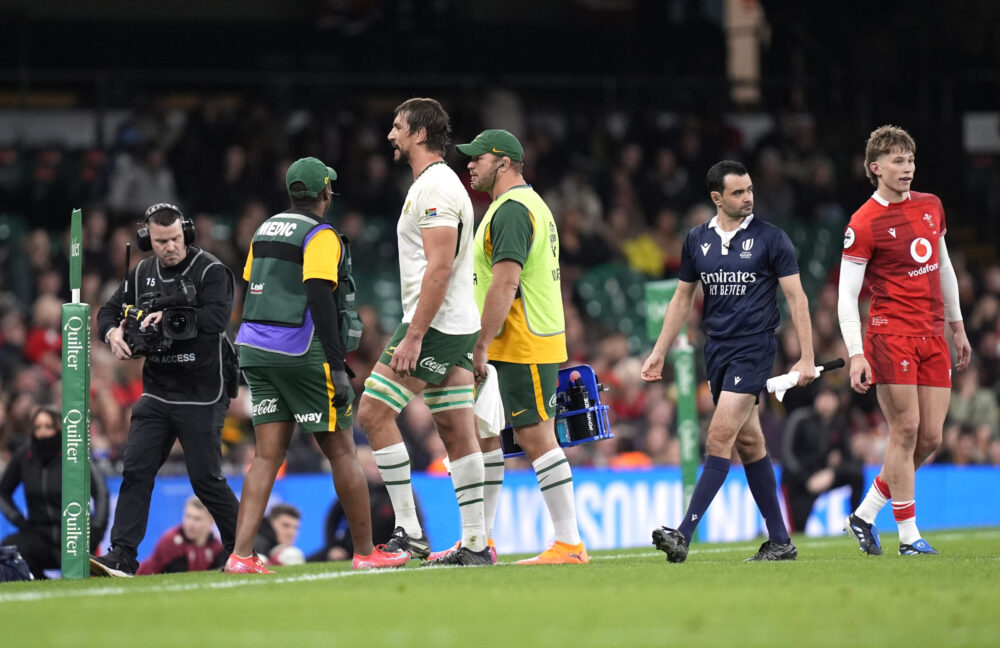 South Africa’s Eben Etzebeth leaves the pitch after being shown a red card for gouging in his side’s crushing win in Cardiff. Photo Andrew Matthews/PA Wire.
So, given the accurately anticipated mismatch, was this a game that should have gone ahead?
Well, on that front, it’s worth looking at the genesis of the fixture.
It was arranged way back in 2018 at a time when Wales were in the habit of beating the ‘Boks. The match was originally set to be played in November 2020, only to be postponed because of Covid and re-scheduled for this autumn, by which time Wales were to be in a very different place.
In terms of the clash with regional games, the date of the Springboks’ visit was long since set in stone and publicly announced in February, months before the URC fixtures were put in place.
What would be interesting to know is just how hard the WRU fought against a full round of league matches being scheduled for this weekend given they knew Wales had a game for which they would be wholly reliant on home-based players.
It would have been much better for the regions had the Round 6 fixtures been on the first weekend of November instead, with Wales not having a game then.
But that weekend – on which Scotland and Ireland had out-of-window Tests – remained free of URC matches.
Saying all that, the regions would probably still have been without their Wales squad members for a round of league matches either way due to the 13-day international training camp.
Out-of-window Tests
The bottom line is the out-of-window Tests have always caused issues for the pro teams.
But they have signed up to them going ahead in their various agreements with the WRU, albeit, no doubt, with some reluctance. That’s largely because their funding payments have been variable and directly dependent on Union income.
Financial necessity has always been the driving force behind these contentious fixtures and it is money that wouldn’t come into the game otherwise.
However, this latest one won’t have brought in the amount the Union would have been hoping for when it was first arranged, with the attendance being 50,112.
That’s significantly down on the numbers for the last three Cardiff clashes with South Africa – 70,353 (2021), 68,511 (2023), 67,236 (2024).
Given the controversy and stink surrounding the out-of-window Tests, it’s something of a relief that we won’t see another one for the foreseeable future.
Wales will still have four November internationals next year as part of the new bi-annual Nations Championship, but the window is being extended to take in the four autumn weekends of that tournament.
That takes care of 2026 and 2028, while there is a World Cup in 2027. So the next time it becomes an issue is 2029 and, by then, Wales are due to be down to three professional teams which may make it impractical.
Given the way what was potentially Wales’ last ever out-of-window Test went, there will be few people shedding any tears over it biting the dust.
Wales Autumn Stats
Points For: 28, 24, 26, 0 – Total 78
Points Against: 52, 23, 52, 73 – Total 200
Tries For: 4, 3, 4, 0 – Total 11
Tries Against: 7, 2, 7, 11 – Total 27
Possession (percentage): 47, 47, 33, 41
Tackles missed: 30, 23, 38, 25 – Total 116
Line breaks: 7, 5, 8, 1 – Total 21
Line breaks conceded: 14, 7, 9, 12 – Total 42
Turnovers won: 7, 3, 0, 3 – Total 13
Turnovers lost: 14, 19, 6, 15 – Total 54
Post contact metres: 263, 288, 188, 122 – Total 861
Post contact metres conceded: 378, 384, 510, 317 – Total 1,589.
Penalties conceded – 8, 11, 14, 16 – Total 49
Yellow cards – 2, 0, 2, 2
Red cards – 0, 1, 0, 0
Support our Nation today
For the price of a cup of coffee a month you can help us create an
independent, not-for-profit, national news service for the people of Wales, by
the people of Wales.