
EDITOR’S NOTE: Call to Earth is a CNN editorial series committed to reporting on the environmental challenges facing our planet, together with the solutions. Rolex’s Perpetual Planet Initiative has partnered with CNN to drive awareness and education around key sustainability issues and to inspire positive action.
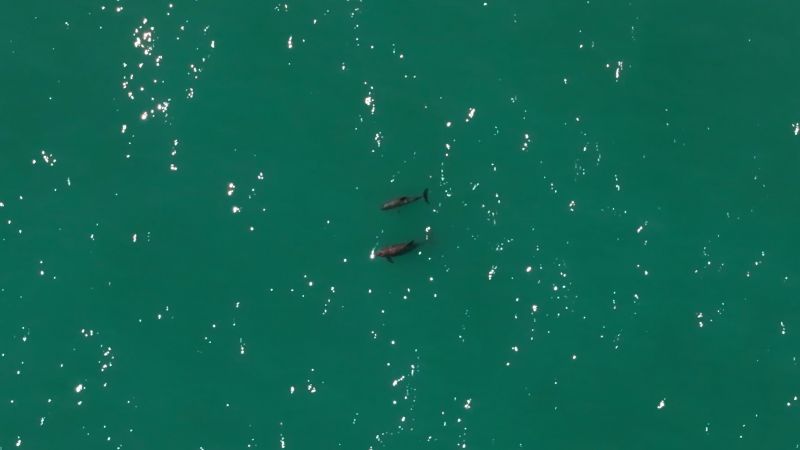
The vaquita, a tiny porpoise found in the northern Gulf of California, is the most endangered marine mammal species in the world. Sometimes referred to as the “pandas of the sea” for the dark rings around their eyes and smiling black lips, populations have declined by 98% in the last 30 years.
According to the latest count in October, fewer than 10 individuals are estimated to remain.
The critical lows have been driven by illegal gillnet fishing (which involves hanging a wall of netting from the surface of the water) primarily for the endangered totoaba fish, whose swim bladder is considered a delicacy in China, and can be sold for as much as $10,000 per bladder. Vaquitas, which grow to about 5 feet (1.5 meters) long and are similar in size to totoabas, are caught in the nets as bycatch.
The fishing of totoaba has been banned in Mexico since 1975 and the nation permanently outlawed gillnet fishing in the Upper Gulf of California in 2017. Both the vaquita and totoaba are listed on Appendix I of the Convention on International Trade in Endangered Species of Wild Fauna and Flora (CITES), which prohibits their trade. Yet, despite these precautions the destructive practice has continued. In March 2025, the Mexican government seized over 9 kilometers (6 miles) of illegal gillnets containing 72 dead totoaba.
Now, as the vaquita teeters on the edge of extinction, conservationists are urgently asking what can be done to save the species. At the CITES conference of parties, held Nov. 24-Dec. 5 in Samarkand, Uzbekistan, Mexico’s efforts to protect the species are under review.
Lorenzo Rojas Bracho, a Mexican scientist who has worked on vaquita conservation for over 30 years, said that the focus needs to be on providing fishers with alternative, vaquita-safe gear.
“It’s a vicious circle. To save the vaquita, you need to eliminate bycatch, and to eliminate bycatch, you have to eliminate the gillnet — and that has not happened,” he told CNN.
In a 2023 analysis for the IUCN Species Survival Commission, Rojas Bracho found that gillnets continued to be used extensively for catching shrimp and fish in the Upper Gulf of California and that little progress had been made toward transitioning communities to alternative fishing gear.
He said that while alternative gear has been developed, there is no incentive for fishers to use it, because it is generally more expensive and less efficient, and the ban on gillnets is poorly policed.
“You have to support the communities, and the communities have to support you to reach an agreement,” he said, adding that there needs to be some kind of compensation for moving to alternative gear.
One measure that has successfully acted as a deterrent is the installation of concrete blocks on the seafloor that have hooks protruding from the top to snag illegal gillnets. But Rojas Bracho said that these have only been installed in a small part of the vaquita range and are not a permanent solution to the problem. The same goes for the “zero tolerance area,” a 225-square-kilometer (87-square-mile) no-fishing zone established in the upper gulf. While the use of gillnets has declined in this area, he said that it cannot solely be relied on for species recovery as the vaquitas use habitat outside of this zone.
However, Rojas Bracho is optimistic that under Mexico’s new administration, which was inaugurated in 2024, efforts to protect the vaquita will accelerate. Within a month of taking office, the government set up meetings about the vaquita which he believes indicates political will.
“We have new authorities in the National Commission for Aquaculture and Fisheries, and new authorities in the Mexican Institute for Sustainable Fisheries and Aquaculture –– that gives us hope,” he said.
But they must act fast, he warned: “This is the best moment in terms of policies and administration, but a very bad moment for the number of vaquita left.”
Limit demand
Efforts to save the vaquita can also happen further afield, by stamping out demand for totoaba.
Paola Mosig Reidl, co-lead of data, research and enforcement support at Traffic, an NGO working globally on trade in wild animals and plants, told CNN that “a demand reduction effort is key,” adding that Traffic had recently started to implement a “behavior change project” in China aimed at reducing the demand for illegal totoaba bladder.

She said that these measures, combined with strengthened enforcement and increased coordination between Mexico, China and the US, would help to combat the organized crime networks fueling the trade.
“The illegal totoaba trade spans source, transit and destination countries, so coordinated action can significantly enhance impact. It enables intelligence-sharing, joint law-enforcement operations, stronger controls along trade routes, and more consistent regulatory approaches, making it harder for criminal networks to operate,” she said.
Another option is to reduce the illegal trade of totoaba by allowing farmed totoaba for export — a concept known as “conservation farming.” A recent study by the University of California, Santa Barbara, and AgroParisTech found that farmed totoaba could help reduce poaching, and it noted that there are already aquaculture operations in Mexico that farm the fish, although international trade of it is illegal.
Mosig Reidl said that while this could be a useful tool, it’s controversial as the legal trade could allow loopholes for illegal wild products to enter the market. Traceability would be crucial in preventing laundering, she added.
International regulations and pressure from global bodies can help to turn things around. In 2023, Mexico was sanctioned by CITES for not doing enough to combat illegal totoaba fishing and protect the vaquita, temporarily suspending commercial trade in any regulated wildlife between the country and other parties to CITES. The same year, the International Whaling Commission released its first-ever extinction alert to warn of the potential danger to the vaquita, in the hope that it would “generate support and encouragement at every level for the actions needed now to save the vaquita.”
Mosig Reidl believes that these frameworks “provide essential support by raising the profile of these issues and creating broader public awareness … enabling compliance measures and reinforcing political commitment.” While they “cannot replace national action, they strengthen accountability, transparency and coordinated responses for endangered species,” she said.
The CITES Secretariat told CNN via email that Mexico had made significant progress since 2023 in limiting illegal fishing in the protected areas, but it noted that “sustained effort and continued vigilance remains essential.” The country’s targets will be discussed again at the next regular meeting of the CITES Standing Committee, in November 2026.
In the last two years, the population of vaquitas has remained relatively steady. While there is a high level of uncertainty in estimates of its numbers, “the population is not declining at the rate it was declining before,” said Rojas Bracho.
He added that is hard to say whether the current population is increasing or has stabilized, but that the identification of juveniles and calves in the most recent survey is a very positive sign.
“If you have juveniles, that means they survived the most difficult years in their lifetime … and that you still see healthy animals producing calves. That’s something to be happy about.”