
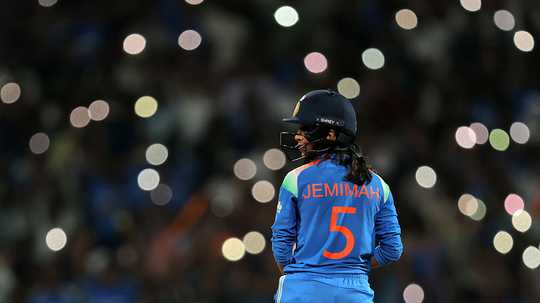
(As told to Purnima Malhotra)
On a night that demanded the highest-ever chase in a Women’s ODI, Jemimah Rodrigues not just rewrote history books, she also rewrote her own script with an epochal 127* under pressure to knock out the defending champions. The crafty innings was a statement, reminding everyone of her match-winning temperament after she had endured a torrid round robin stage.
In Part 2 of her detailed recollections of the successful tournament with Cricbuzz, Rodrigues reveals how she broke down the epic chase with her co-conspirators, overcoming a sense of ‘deja vu’ when it looked like history would repeat itself, and more.
She begins by recounting the conversations in the dressing room as India considered the prospect of facing Australia in a semi-final without the injured Pratika Rawal.
On the night of the unfortunate incident that happened with Pratika, we spoke about how we are going to play for her but we are not going to talk about any negatives like, ‘Oh, why did it happen?’ We spoke that we are going to try and be positive. We spoke about it [that] we know it’s hard, but we’re going to do it for Pratika.
As for Australia, I remember, for some reason, a few of us girls had the discussion like, ‘You know, Australia is more vulnerable in a semi-final than a final.’ And that was the mindset we had. So, we were like, maybe what [semi-final draw] has happened is good because of the past history. Even last year in the T20 World Cup, South Africa had defeated Australia in the semifinal. The 2017 World Cup, where Harry di [Harmanpreet Kaur] played that knock [and] Australia lost in that semi-final… So, we were like, maybe what has happened has happened for good.
On a personal level, Rodrigues held one key focus during her preparations.
I do reflect on games after every match. I always write, ‘Okay, this is what I did well; this is what I could do better.’ So I don’t think I did anything different. I just learned from my mistake in that Australia [round-robin] game. I just went out and made sure I finished the game.
I knew that with Australia we would have to chase big targets. But my preparation for this has been over the last one and a half years, two years, whenever I’m in the nets. I always put myself in challenging scenarios. Like some days, when I walk in, I’ll tell Kranti Anna or Sachin Bhaiya [throwdown specialists] that in six balls, I need to get 16 runs. Because batting at No. 5, I have to be prepared for every situation, even as a finisher. And there are some days, I’ll just give targets of 8 runs. Some days, 6 runs. And I’ll keep trying to achieve and they have to set a field and make sure I don’t get those runs. Try and get me out. So, I keep practicing for that.
But I think even the other night [in training] before the Australia game, I did try to attack. Like try to hit every ball and try to see what happens. But somehow, when I was trying to do that, I was going a little further away from my game. And it was not coming off that well. So then in the nets, I went back to my original plan which has always been there – that I keep being positive in my intent.
As Australia batted first, the question was how many runs they would get on a good wicket. Then at short notice during the chase, Rodrigues was told she’d go in at one-down again after Shafali Verma’s comeback ended early.
In the first innings, I was fielding and I was preparing to chase down a target, like how much it will be? And then Phoebe Litchfield just goes bang, bang, bang, just taking our bowlers on, and Perry comes in, both of them are having a solid partnership. In my head I was like, aaj 400 hai [look’s like we’re chasing 400 today].
I was stressing a lot during fielding. ‘Oh no, what if they score 400, what then?’ It’s a big game, it’s a big game, and you want to win it. But then, something on the inside just told me that, you can’t control how much they’ll score. Rather just be in this moment of fielding, just do whatever you can here. And then when the score comes, we will adjust to what we need to score. But stressing about it now won’t help you.
Our bowlers pulled back really well for that D.Y. Patil pitch, for that outfield. Yes, 339 was a big score, no doubt, but I felt with the way Australia started off things and with their batters, they were 20-30 runs short. I was like, ‘Oh, I was targeting 400, but 339 looks less only.’ It was not overconfidence, just one thought came.
Usually when something like this happens, I know there is going to be a change in the batting order. I went to Smriti [Mandhana] and asked, is it the same batting order? She was like, for now, it is the same. Harry di [Harmanpreet Kaur] also said it will be the same batting order. So, I was not supposed to walk in at No. 3 at that moment.
So, I went and took a shower because I had a long fielding session. With Australia, you have to run a lot and you are always on your toes. It’s very intense. For more than 30-35 overs, I was doing deep-to-deep. So I just dipped my legs in the ice bath to feel fresh. While taking a shower, you could hear the discussions; something was happening. Harry di was also in the next shower. One of the physios comes in, Akanksha ma’am. She tells Harry di that Amol sir has called her. That’s when I realised that something was happening.
After five minutes, Akanksha ma’am again comes in and says, ‘Jemi, you are going in at number 3.’ I said okay. But I didn’t panic this time. Like against New Zealand, I did panic. I don’t know, maybe it was just that occasion that it’s a do-or-die game. I was also mentally preparing for it, that maybe it can happen.
While sitting out, I just thought of how I play when I play for the Mumbai team. In a sense that when I am playing for Mumbai, I know that my wicket is important. And I have finished matches for Mumbai consistently in the past. So, I just thought maybe today I will have to do such a role while being a little more positive. And I think when I went there, I was clear that if we go out there and lose, people will forget about it in a few days. But if I stand there till the end and magic happens, people will remember this for the ages. And more than that, my team will remember this for the ages because this might just win us the World Cup. So, that was my thought process.
When I walked in there, I just had a simple mindset of singles off every ball while being very positive. They will bowl loose balls. It’s D.Y. Patil. Any target is chaseable here. I will kind of punish that and build a partnership. Let’s take it deep again. When Smriti got out it was a little bit of a jhatka [jolt] because Smriti was someone in form. She had scored a lot of runs against Australia recently. But then Harry di came in.
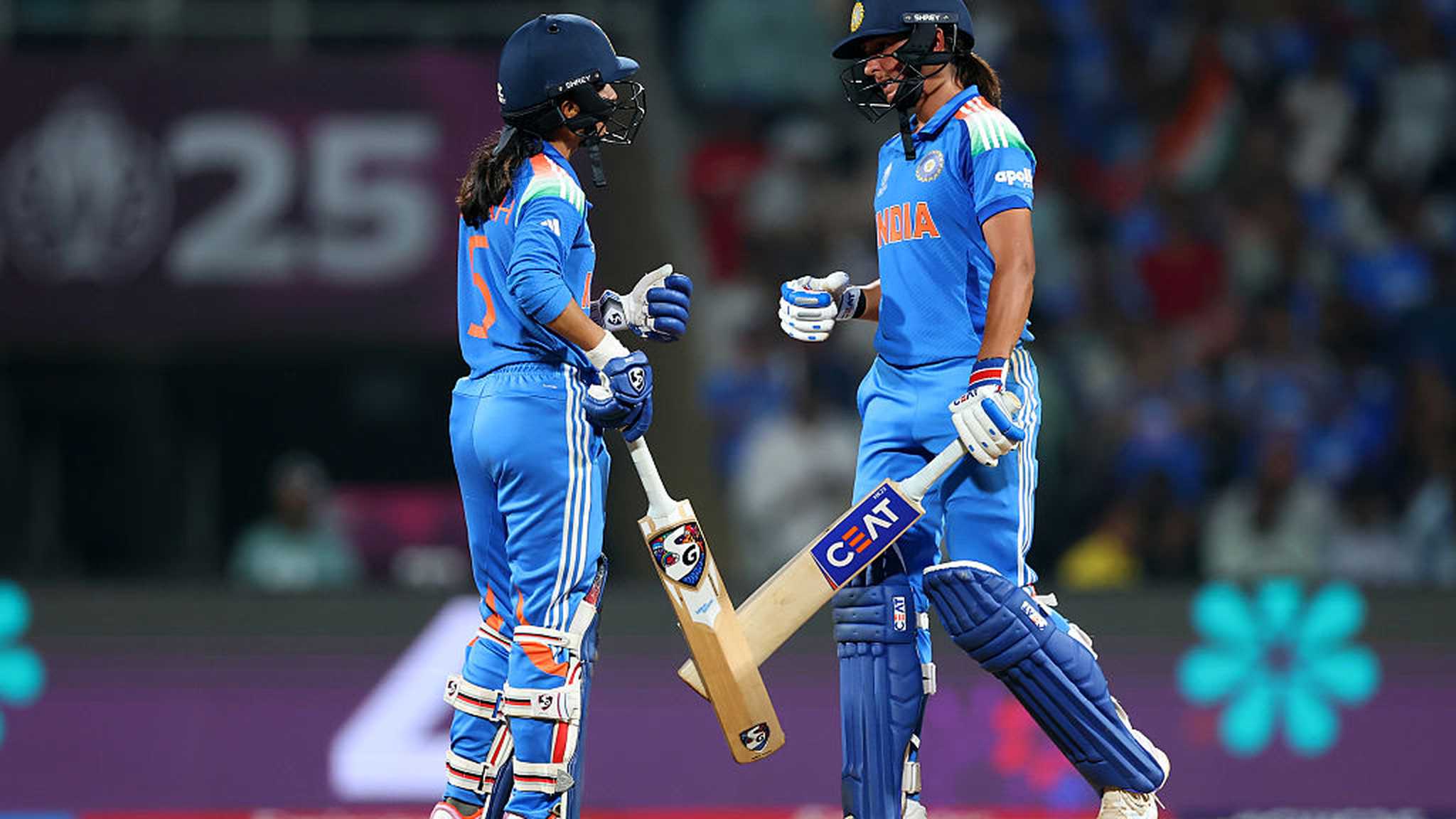
Jemimah and Harmanpreet added 167 for the third wicket to put India on track. ©Getty
Two-down early, it was up to Rodrigues and captain Harmanpreet to stabilise – a situation they had encountered in knockouts or against Australia, in the 2022 Commonwealth Games final, the 2023 T20 World Cup semifinal and the virtual quarterfinal in the 2024 edition. With the pitch and conditions playing to the script, the third-wicket pair added 167 at better than run-a-ball.
I know in the past Harry di and I have always had partnerships against Australia. She also knew. The moment Harry di came in, I said, ‘Just one good partnership. We don’t have to do anything extra. Runs are just coming. The pitch is amazing. The outfield is very fast. So, just one good partnership.’ She was like yeah, okay, and we both kept going.
We understand each other’s game a lot. I kept speaking to her. And how we were calculating every over to break down this chase. So, every over, we were like, there were 6 runs in this over – good. In the next over, we got 12 runs. There was one Sophie Molineux over which Harry di played and I think we got only 2 or 3 runs. I said, ‘It’s okay, Harry di. Out of the 12 runs in the last over, we will add 3 here and we’re at par with the required run rate. So, we are going well.’ She said, ‘Yes, yes, good, good.’
I think we just kept batting simple cricket. And kept rotating strike, hitting the odd boundaries and we were at par with the run rate. And I think in between, they showed the comparison too. And both teams were the same. We had more wickets in hand, though. I was like, so we are good.
Then at one point, at the 30th over, we had a drinks break and Harry di asked me, ‘What do you think, Jemi? The required run rate is 8 runs; almost creeping to 9. What do you think we should do?’ I said, ‘Harry di, for the next 5 overs, let’s play the same way. Because without doing anything [extra, we’re at par].’ I knew both our wickets were important. If suddenly one of us starts accelerating there, it’s very risky. It’s too soon. We were getting according to the run rate. Let’s try and get 7-8 runs an over. That’s all we will think. Harry di also agreed.
So, the game plan was simple. Singles off every ball. One loose ball, we hit. At DY Patil, you get runs if you place it in the gap easily. And that day, the dew had also come. I think it rained a bit also. So, even the slower balls were not sticking. They were coming on nicely. There was pace even on Sutherland’s back-of-the-hand delivery. There was pace on it. Not like the usual, how it used to be.
Then came the crucial wicket that felt less like a plot-twist and more like deja vu: Harmanpreet departed when India seemed to be taking control – just as she had in previous knockout games against Australia that India went on to lose.
Then I was in my 80s, at that moment, I started losing concentration because of tiredness. I was very tired. Because in fielding, in that heat, firstly in Mumbai, against Australia where every ball you have to run, and doing deep-to-deep for almost 35 overs, it was a lot for me to take in. I was getting very tired. And when you are tired, it takes a toll on you mentally. Because mentally, you have to push and I was not able to push.
So then I played a sweep and [Alyssa] Healy, I don’t know what happened there, but Healy dropped that catch. It just felt like there are days where things just have to go in your favor. It was one of those days, I feel. I turned to Harry di and said, ‘I am feeling very tired. For the next maybe one or two overs, till I get my thing back, is it okay if I just rotate strike and give it you? Because I am not able to take it on right now.’ She agreed but then Harry di went in a little aggressive mode. She hit one boundary and then she played that shot where Gardner took a good catch.
In my head, I am like, ‘Bro, this always happens. Deja vu.’
The whole memories came [rushing back] because in the Commonwealth Games it happened. In South Africa, the [2023 T20 World Cup] semi-finals against Australia, same happened after Harry di and I had a good partnership. I was like, ‘No, we can’t do this.’ But losing Harry di’s wicket actually switched on something for me. I was like, okay, now there is no other option. Till Harry di was there, you know you have a little cushion because you know Harry di will [pull it off]. But once she fell, I was like, no, this has happened in the past [but not anymore]. Something switched on the moment she got out.
Rodrigues remained determined not to let history repeat itself.
Deepti came in. I told Deepti, ‘Deepti, I am too tired. Please speak to me every ball and please help me out.’ Because I was struggling to do it myself. So, I asked her for help. And Deepti, she was like, ‘No, no, Jemi, you will do it.’ And every single ball, Deepti was literally speaking to me. Like, ‘Good, Jemi, don’t worry. We’ll make up for it.’
Alana King was bowling really well. So I told Deepti that Alana King is coming. Let’s just take singles off her, get six runs. She was like, ‘No, no, I am a lefty, I will take her on.’ I was like, ‘Oh, bro, good, good, go for it. If that’s what you have got to say, go.’ Deepti coming and playing that impact innings, just got us back again. I didn’t have to do much after that. I had to just be there. She knew I was struggling so when I stepped out, played that flick and it went to short-fine, she would never run that run, but that run she actually ran for me so that at least I will be off-strike. But in that, she lost her wicket. She was walking out and I asked, ‘Deepti, why did you run?’ She was like, ‘It’s okay, doesn’t matter, you just stay and finish it off.’ That’s what she told me.
Then Richa comes in and I tell the same thing to Richa that we don’t need much. I think it was exactly 60 balls. We needed 82, I think. Something around that. So, to Richa I broke it down. I said, ‘Richa, simple target. Don’t see the run-rate. Asking rate was 8 – 9-ish. [Just take it as] 30 balls, 40 to get. 30 balls, 40. Then, we’ll chase it down easily.’
And Richa being Richa, you know, takes on Gardner. And plays again an impact innings. By then, I start getting my rhythm back. Richa also kept speaking to me. Because I had told the same to Richa also, and she kept speaking to me.
Then Richa gets out and I was, “Jemi, the job is not done. You need to finish it off.’ I think it was 32 balls, 36 runs required when Aman walked in. So, the moment Aman walks in, I was like, this is a perfect scenario for both of us because I know Aman well. I love batting with Aman because she is a very busy player and she runs well. We both run really well between the wickets. So, I told her, simple game plan. Singles off every ball. Loose balls, we convert it into boundaries or sixes. And I told her to be ready for twos.
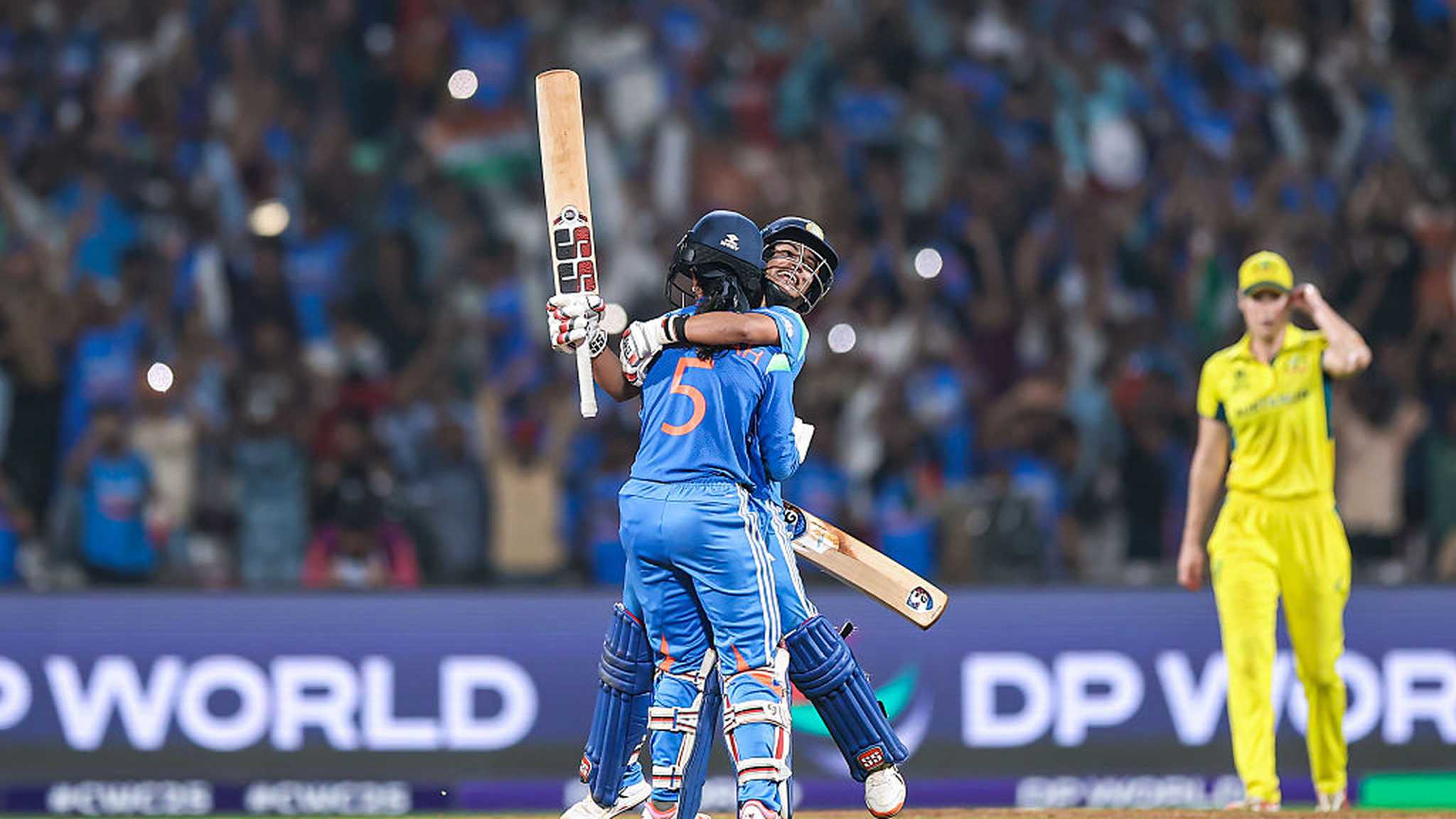
Jemimah stayed unbeaten until the end in the epic chase. ©Getty
So we both started rotating, getting off-strike. She hit a couple of boundaries. I started getting my gaps, my boundaries. I think I played one shot here and one cut and kept rotating. We ran, I think, one two or two twos. But that also, you know, puts a lot of pressure on the opposition.
Then Aman hits a boundary off Molineux. And then she hits one over mid-off. I ran. I could see the dugout. Everyone was almost coming in, you know. Aman was also a little excited. We were so close. Then, from there, I shouted, ‘Aman, it’s not finished. Just finish the game.’ Something like that. Two runs are left.
And then she steps inside [her crease] and cuts… I just start running to her. I carry her. And then suddenly, all my emotions just come out. I had not planned. You know, I had not planned. Because I had not celebrated my 50. I had not celebrated my 100. Because that night was not about my 50 or my 100. It was about making India win.
In between, when I started getting tired and thoughts started coming in my head, I looked at the hotel we were staying in. And I was like, ‘Jemi, tomorrow morning, what will make you happy? Will it be a 50 in a semi-final? Will it be a 100 in a semi-final but the regret of not playing the finals? Or will it be India is going to play the finals and you have a smile on your face?’ I like that smile on my face. I said, I want to play for that moment.
And when it happened, I just burst into tears. I couldn’t stop myself. Because now you know all that has happened [with the challenges in the first part of the tournament]. But actually, when you’re going through it, it’s a long time. It’s a long period and a build-up of everything that happened, being dropped…
But you know what they say, right? Every setback is actually a set-up for a greater comeback. Maybe if all that wouldn’t have happened, this innings wouldn’t mean so much to me. This is one of the most special innings at my home ground against Australia in a World Cup semi-finals, India winning. And, not just that, after a few days going on and lifting the cup. I don’t think anything can be better. Even a Bollywood movie couldn’t come close to this feeling.
Rodrigues’ innings brought back memories of Harmanpreet’s audacious 171* that knocked Australia out of the 2017 World Cup, and attracted so much attention that she had to uninstall a phone app to manage the reaction.
After the semi-final knock, my phone just kept buzzing and buzzing. I was getting calls from everywhere. I don’t know how random people started getting my number. I had, I’m not even over-exaggerating, but I had 1000 WhatsApp messages. I couldn’t take it because firstly, a lot had happened in that game. A lot of my emotions itself were there. I’m preparing for a final and the tournament is not over. Yes, I played a knock. Yes, we won. Yes, India was in the final. But, we still had a World Cup final to win.
After a certain point, it just started getting too much for me that I uninstalled WhatsApp. I messaged my close ones, like 4-5 of them, that just either call me or we can chat on a normal message, but I am uninstalling WhatsApp. Because even if I was not reading the message, it was just buzzing. And I just knew that people were messaging me and I just wanted to prepare for the finals. So, till the finals, I didn’t install WhatsApp. I was off social media – maybe put one post-match post, but I was off otherwise until the World Cup final.
After the World Cup is when I properly saw social media. And my whole social media is only about either the semi-finals or India winning the World Cup. I have never seen such a sight. Even till now, just randomly scrolling Instagram and suddenly my video or something comes up. Or someone is talking about me.
But, I didn’t think much about the comparison [with Harmanpreet’s innings]. Because what Harry di did then was special. It was special. And I think what happened that night also was special for me. So, I feel each knock has its own weightage. So, I wouldn’t compare that hers was better or mine was not as much, or anything like that. I think both were as important because India won at the end. And that was more important than anything else.
Part 1 of the interview can be found here. In the last of the three-part interview series, Rodrigues will dive into the night of the final, the celebrations that followed, and the transformation India’s historic triumph has led to.