
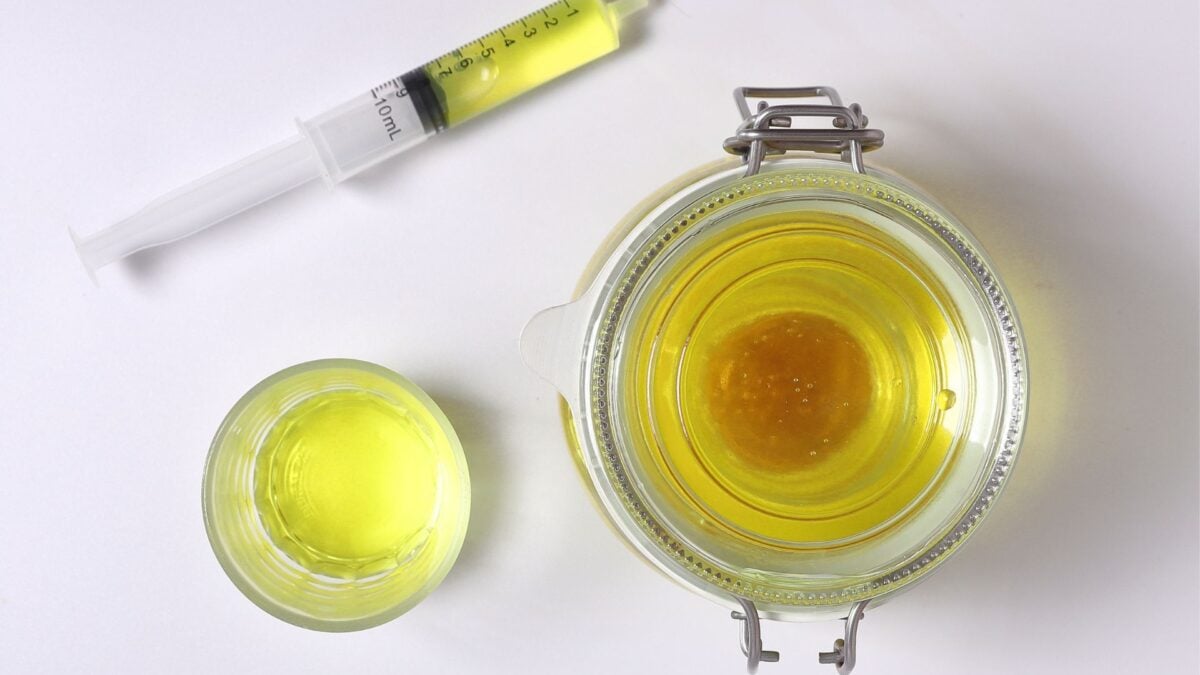
A remedy popular in the world of alternative medicine known as “Miracle Mineral Solution”—or MMS—is anything but a miracle, recent research finds. Rather, it could be dangerous to users.
Researchers at Wroclaw Medical University in Poland examined the effects of acidified sodium chlorite, the base ingredient of Miracle Mineral Solution, on various bacteria. Though the compound could effectively destroy bacteria, it did so at doses that also killed off living cells and lab animals. The findings suggest that MMS is far from the safe cure-all that its advocates claim it to be.
“We have shown that the dosage recommended by alternative medicine proponents cannot lead to the achievement of safe and therapeutic concentrations,” the researchers wrote in their paper, published in the journal Scientific Reports.
The miracle that isn’t
MMS was first popularized in the mid-2000s by author and former Scientologist Jim Humble. The concoction mixes sodium chlorite distilled in water with an acid, which then results in chlorine dioxide, a bleaching agent that’s commonly used as a disinfectant.
Humble and other proponents have claimed that chlorine dioxide/MMS can treat just about every medical condition under the Sun, from autism to HIV. But these claims have never been verified by rigorous studies, nor has MMS ever been approved for medical use.
Health officials have long warned the public to stay away from MMS, while law enforcement agencies have periodically gone after its marketers. In 2023, for instance, several members of the Grenon family in Florida were sentenced to federal prison for illegally promoting and distributing MMS as a cure for covid-19.
The scientists behind the new study say not enough work has been done to verify the medicinal effects of MMS, particularly on bacteria. So they tested out two different forms of MMS (created with two different acids) on several bacterial species, including disease-causing strains of Staphylococcus aureus and Escherichia coli, as well as probiotic bacteria. MMS was also tested for its cytotoxicity, or its ability to harm eukaryotic cells (cells containing a nucleus).
MMS could reliably destroy harmful bacteria, the researchers found, and even break apart bacterial biofilms, hardy clumps of bacteria that are usually much more resistant to antibiotics. But the dosages required for this effectiveness appeared to be toxic to human cells, while moth larvae exposed to the compound often died. MMS also killed off probiotic bacteria, suggesting it could disturb the body’s normal microbiome.
The findings imply that MMS “applied in humans can lead to damage to the mucous membrane of the gastrointestinal tract,” the researchers wrote.
A toxic cure 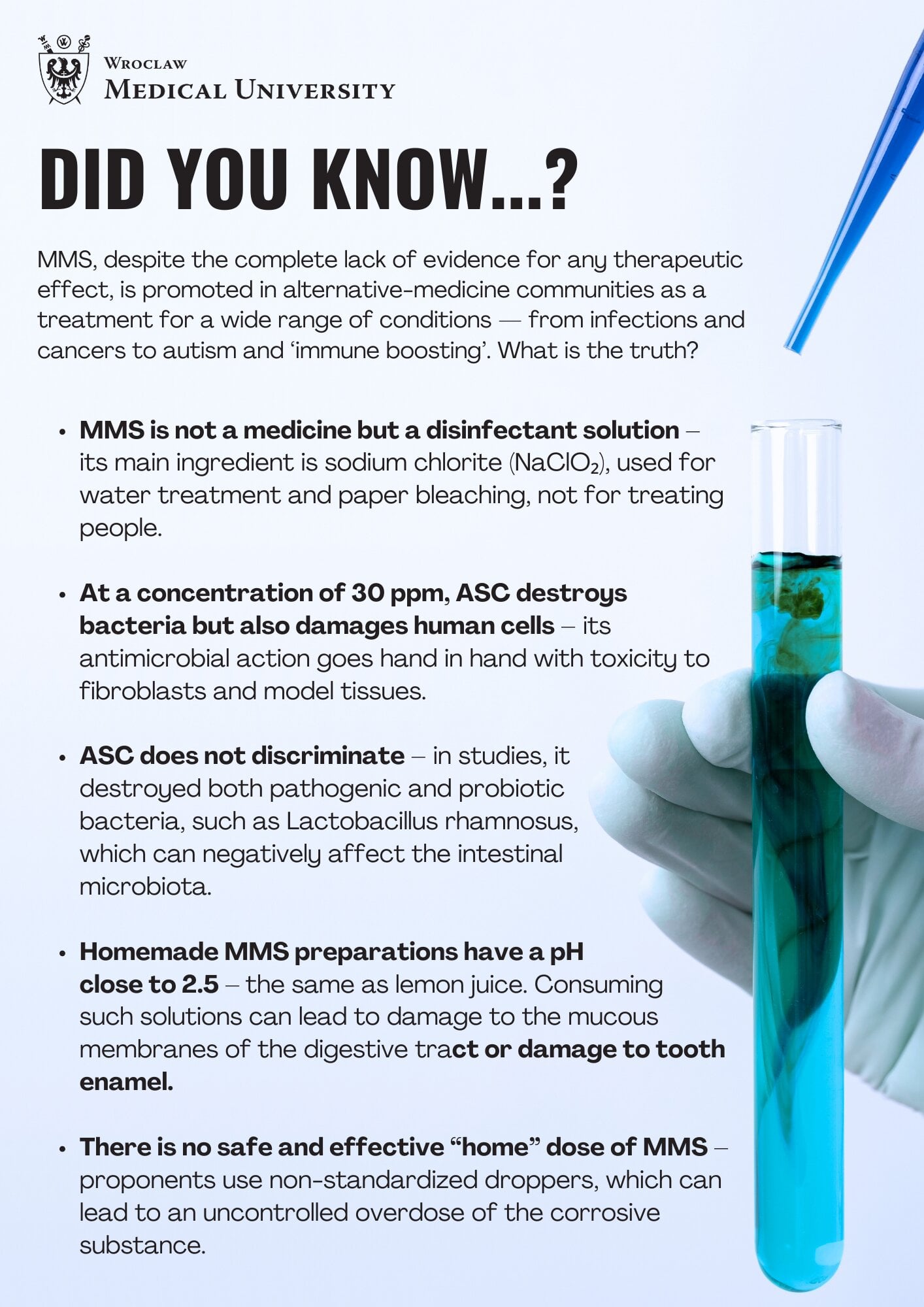 An educational graphic prepared by the Wroclaw Medical University team. © Wroclaw Medical University
The researchers acknowledge it could theoretically be possible to create a form of acidified sodium chlorite helpful against bacteria that isn’t harmful to people. But it’s certainly not the version that people today are taking. And much like other experts, they’re advising everyone to not fall for the hype beyond MMS.
“In pharmacy and medicine, the benefit-risk ratio is considered. In the case of MMS, the benefit is zero, and the risk is high, especially since the dosage is often administered using non-standardized droppers, which can achieve 1 ml by applying 15 or 30 drops. Such fluctuations in the oral dosage of a corrosive substance are extremely irresponsible,” said study author Ruth Dudek-Wicher, a pharmacologist specializing in microbiology and parasitology, in a statement from the university.
As the old adage goes: if it sounds too good to be true, it probably is.