
Scientists have often argued about the origins of moons within our galaxy. However, one scientist believed that the moon-factory was born from violent beginnings. This was centuries before modern telescopes that could scan worlds at a distance were invented. Although many have disproved his theory, a discovery has shown that he was right all along.
The lunar debate that started with Darwin centuries ago
Generations of astronomers have often speculated on the inner workings of our universe. Many of their assumptions have exhausted the premises of galaxies and planets, including their stars and accompanying moons. For the most part, some of these arguments climb on to become theories, while the rest suffer a futile fate.
One such argument stunned the science community in the 1800s. This argument speculated on the Moon and its origin. George Darwin, son of prominent biologist Charles Darwin, came up with the argument. In his hypothesis, he argued that the moon could have been born when violently spinning planets spewed into orbit.
But by his observations, he had implied that the moon and other celestial bodies may have been born from planetary violence and not the age-old slow accumulation of dust. This was in 1897, and at the time, the idea had seemed impossible and science fiction. Fast forward to today, and science has found solid evidence that supports Darwin’s claim.
Extrapolating the timeline: How Scientists made the moon-factory discovery
The last decade has seen some of the most advanced telescopes ever made. The James Webb Space Telescope (JWST) and the Hubble Space Telescope. These two can scan across galaxies millions of light-years away from us. They have helped scientists gather data that has expanded our comprehension of how vast the universe is
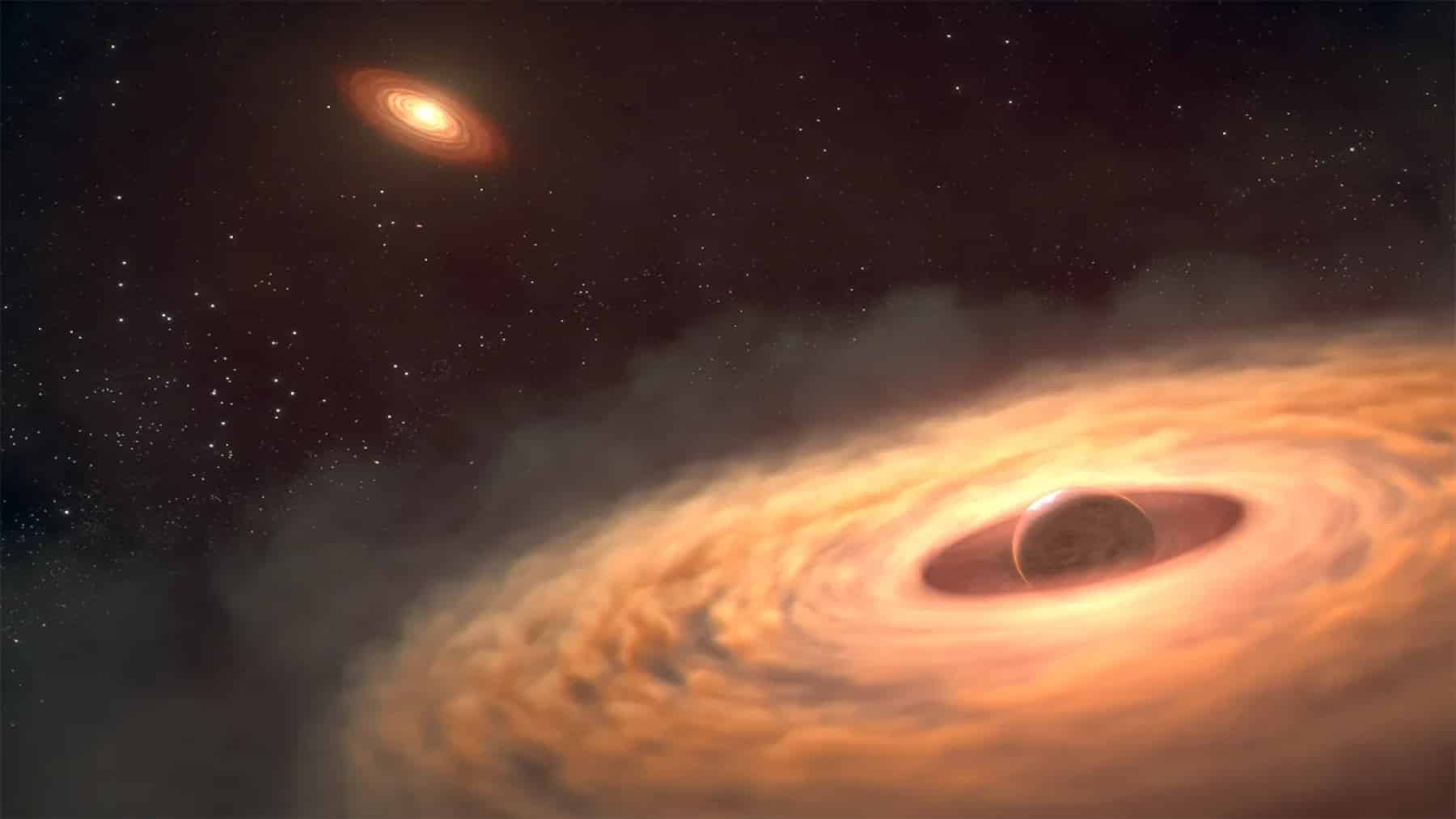
It was on such occasions that Gabriele Cugno from the University of Zürich and Sierra L. Grant from the Carnegie Institution for Science in Washington made their discovery. They discover a distant circumplanetary disk circling the orbit of a young and massive exoplanet known as CT Cha b. This exoplanet is 625 light-years from us and has a peculiar carbon molecule chemistry, like this mysterious morning titan under a lunar cloak.
After that, the team used Webb’s infrared to explore the chemical atmosphere of both the disk and the massive exoplanet. What they saw was a dynamic moon manufacturing environment, a moon-factory. Just like Darwin had predicted. Based on the carbon molecule data received, scientists believe this disk contained the raw materials required to create a lunar satellite.
NASA continues to find more evidence about the moon-factory
Who would have thought that, centuries later, Darwin’s argument would still hold?. That is why NASA continues to contain any data observed during this discovery. Astronomers keep recording the collision and clumping together of particles. These clumped particles continue to grow until they form new celestial bodies.
Why this discovery changes our understanding of planet origins
This discovery opens an opportunity to study lunar evolution with practical evidence. Those acquired today still show bands of materials orbiting the young exoplanet; this is observed alongside a bright hotspot where the lunar matter compacts. These have been registered as the early stages of moon formation.
Furthermore, researchers are planning to expand their knowledge by comparing this moon formation with those of other planets. They would compare origins and how in-situ materials are affected by their individual moon gravities. If scientists can confirm this information, it would imply that the universe may be filled with many more moon-forming factories.
A full understanding of this moon formation would help scientists understand how planetary systems are formed across the universe. Future explorations are looking to measure certain information, like how many moons are created on a steady basis, how fast these moons are created, and their trajectories through the galaxy, just like this unprecedented Earth’s long-term second moon discovery.