
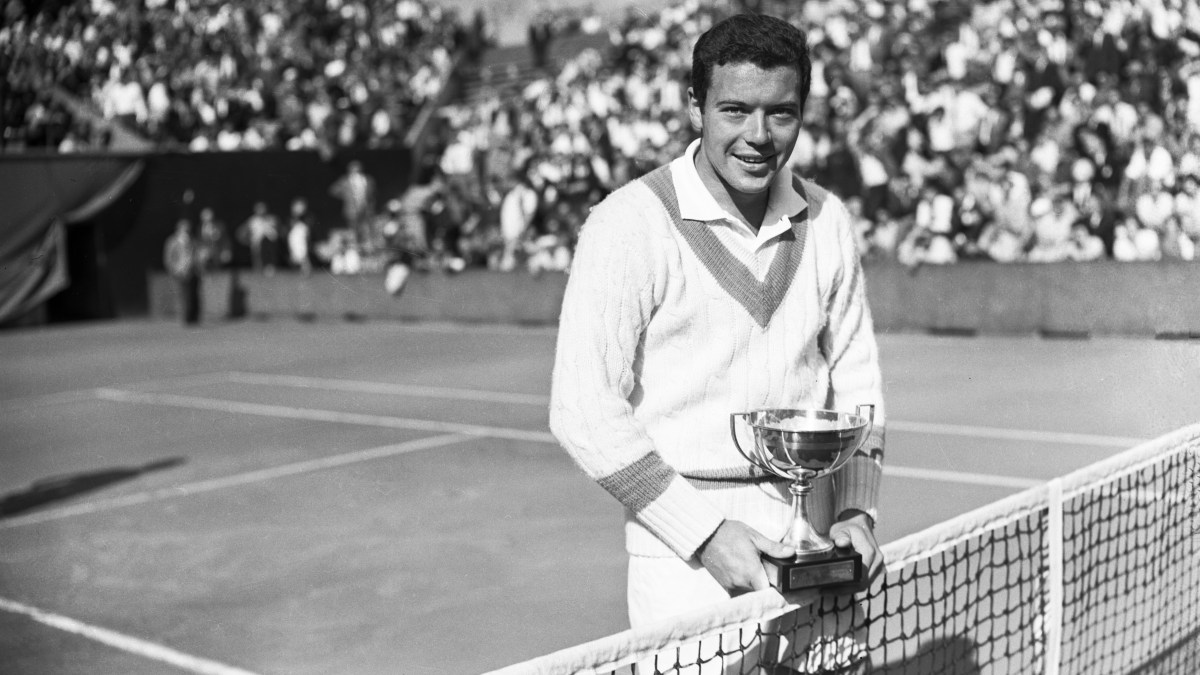
Nicola Pietrangeli disliked his playboy image, but it was hard to gainsay it when he arrived for the final of the 1959 French Open in a Buick convertible with Paris’ most fêted stripper, Miss Candida, at the wheel.
The artiste’s nightly act at the Crazy Horse cabaret club simply involved her bathing in a clear crystal tub. The Italian tennis player was similarly top of the bill after winning the title and left Roland Garros in the same vehicle, along with Miss Candida, $150 in prize money and with the French narcotics squad on their tail. The Buick had belonged to Candida’s ex-boyfriend, Jacques Angelvin, an actor and TV host who would later be arrested for heroin trafficking. He stored the dope in the car’s bumper and was an inspiration for the classic 1971 film The French Connection.
The following year, Pietrangeli decided he would court less trouble by spending his downtime at Chez Regine’s, known as the first discoteque. Frequent it he did, every evening of the 1960 French Open fortnight and even the night before the final. He recalled thinking to himself that it would be “bad luck not to”, though he denied reports that he was dancing on a table at 5am.

Pietrangeli with the US player Beverly Baker Fleitz at Wimbledon in 1959. He resented his reputation as a playboy
EVENING STANDARD/HULTON ARCHIVE/GETTY IMAGES
If he was hoping for an easy straight sets victory as the king of clay in his day, it was not to be. His opponent, Luis Ayala of Chile, forced Pietrangeli off his customary dominance on the baseline. “This scoundrel Ayala only made short balls and lobs.” Pietrangeli prevailed over five sets. “After the game, my socks were red with blood. The doctor removed the skin under the soles of my feet. I walked for two days with slippers.”
The year before, he had defeated the South African Ian Vermaak in the final 3-6, 6-3, 6-4, 6-1, but professed to feeling hollow. “I don’t want to be disrespectful to him, but I don’t know how he got to the final. Given I was playing someone whom I always knew I could beat, it made it a bit less satisfying.”
Pietrangeli was as elegant on the court as he was in the guise of a lothario off it. With a lightness of step that Roger Federer would be proud to own decades later, Pietrangeli played languidly from the baseline without seeming to break a sweat. His backhand was the most envied in the game, and his soft hands on a drop shot or lob were a thing of beauty. On clay, he hardly ever missed a shot, so would outlast his opponents in rallies until they made a mistake.

Pietrangeli was renowned for his elegance on the court
EVENING STANDARD/HULTON ARCHIVE/GETTY IMAGES
In 1959, he also won the doubles title with his fellow Italian Orlando Sirola, who was 6ft 5in and had similarly lax preparation the night before a match. “He took his guitar, went to the tavern, and drank half a litre of wine.” Together they beat the Australian pair Roy Emerson and Neale Fraser in straight sets. Pietrangeli inexplicably failed to win his third title in a row at Roland Garros in 1961, having led Spain’s Manuel Santana two sets to one before losing in five. In the moment of defeat, he sportingly embraced his tearful opponent. They became great friends. Once, when meeting up in Madrid, Pietrangeli told Santana that he was going to bring two friends along. He turned up with Claudia Cardinale on one arm and Brigitte Bardot on the other.
To many of the male players, particularly the Latin ones, Pietrangeli was the compass point of their entertainment off the court. He became known as “Capetan”, and wherever he went in the evening, they would follow.
French fans also took him to their hearts. His favourite moment was beating Emerson in the quarter-finals of the French Open in 1964 and being asked back on court for a “curtain call”. “The referee called me back from the locker room: I had played so well — twenty lobs on the line.”
The Italian was also popular at Wimbledon, reaching the semi-final in 1960 and nearly causing a huge upset against the Australian and grass-court specialist Rod Laver, before losing a tight fifth set. In all, Pietrangeli would play at the All England Club 19 times between 1954 and 1973, and decorate London’s famous nightspots while doing so. On one occasion, he went clubbing with his friend, the actor Marcello Mastroianni. “In the club, we notice Jeanne Moreau with Rudolf Nureyev. I think: how nice, let’s go and greet them. Marcello says: ‘You’re crazy! They both want to do me!’” With a match on the next day, Pietrangeli “left him to his fate.”
Pietrangeli proudly represented his country in 66 ties in the Davis Cup from 1954 to 1972, compiling a record 120 wins from 164 matches. His greatest regret was being unable to prevent Italy’s defeat in the Davis Cup finals of 1960 and 1961, both times to Australia on grass, to teams that included his rivals Emerson and Fraser.

Pietrangeli won two Italian Opens and had an excellent record in the Davis Cup as both player and non-playing captain
ANDREAS SOLARO/AFP VIA GETTY IMAGES
Three years after he retired, in 1976, he captained Italy to its first Davis Cup triumph. The Italian coalition government, which included the Communist Party, wanted the country to boycott the final against Chile because of their animus towards the country’s military dictator, General Pinochet. Pietrangeli threatened to pull out of future tournaments if his team were not allowed to play. The government relented. Ignoring death threats, Pietrangeli flew out to Chile with the team, and Italy won the final 4-1.
Nicola Chirinsky Pietrangeli was born in Tunis, in what was then the French colony of Tunisia, in 1933. His mother, Anna, was the daughter of the tsarist colonel who fled the Russian Revolution in 1917. His father, Giulio, was an entrepreneur. When the Allies swept into Tunisia during the Second World War, the family was detained in a camp, where Guilio built a tennis court. “He put a racket in my hand and proposed a doubles match. Dad did everything, and we won. The prize was a comb made from the splinter of a bomb.”
After the war, they were expelled and moved to Rome. Pietrangeli was attracted to the idea of becoming a tennis player as much by the lifestyle as by his love of the sport. Well proportioned and muscular with chiselled features and a Caesar-esque crop of dark hair, he was not to be disappointed. “Women like uniforms, and I, in my white uniform against a red or green background, I must admit, I had an advantage.”
He married at 21 to an 18-year-old Susanna, née Artero, whom he described as a “beauty that all Rome was after”. They divorced because of his infidelity. He is survived by their children, Marco and Filippo. Their son, Giorgio, predeceased him. He later took up with Licia Colo, a glamorous TV presenter who was 28 years younger than him.
Pietrangeli could look back on a career of 44 titles, including two Italian Opens and three wins in Monte Carlo, where he cultivated friendships, first with Prince Rainier and later with Prince Albert.
He remained a charming and jocular figure, though he could be waspish in his assessment of modern players, most of whom he dismissed as “machines”. He was widely considered his country’s greatest ever player until the emergence of current world number two Jannik Sinner, and he was particularly scathing of Sinner’s decision not to play in the Davis Cup for Italy this year.
Looking back on his life in tennis, he shrugged: “People said if you had trained more, you would have won more, and I said yes, but I would have had a lot less fun.”
Nicola Pietrangeli, tennis player, was born on September 11, 1933. He died on December 1, 2025, aged 92