
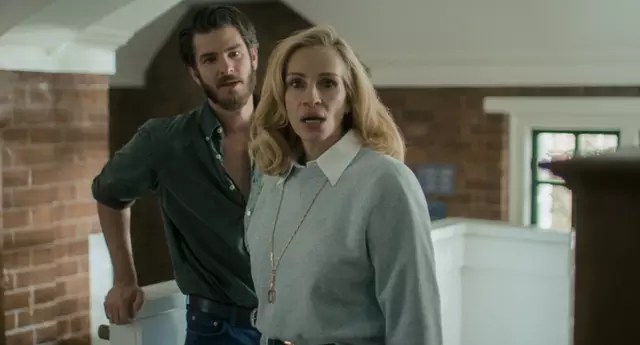
After the Hunt is a well-acted laborious pretentious extended game of “he said, she said” that doesn’t feel nearly as monumental as its filmmakers intend. While they may be pleased with the frequently obnoxious directing and blathering dialogue only propped up by the talent performing it, viewers likely won’t be as thrilled.
Yale professor Alma (Julia Roberts, Leave the World Behind) and her husband, Frederik (Michael Stuhlbarg), are hosting a dinner party with her class and a few colleagues. Among the guests are Alma’s friend Hank (Andrew Garfield, Spider-Man: No Way Home), who’s also on the tail end of the tenure track and her student Maggie (Ayo Edebiri, Opus).
As a therapist by trade, Frederik surmises that Alma likes to surround herself with people who idolize her suggesting some jealousy with her closeness to Hank. Frederik likewise isn’t too impressed with Maggie, who he doesn’t consider to be an especially brilliant student, but has made Alma’s inner circle since her parents are large contributors to the university and looks up to Alma.

Screenwriter Nora Garrett uses this opening act to showcase the characters falling over themselves to prove how much smarter and introspective they are compared to everyone else in the room. This scene proves more of a spoiler in revealing that there are few likeable characters in After the Hunt.
A key point plays out early on in After the Hunt when Maggie goes to Alma’s basement bathroom. Maggie’s search for toilet paper leads to an envelope taped to the top of a shelf with some secrets Alma probably should have done a better job of actually hiding if she didn’t want some particularly curious student to discover.
In all other regards, After the Hunt seems like it’s set in the modern day so why Alma has this damning envelope out in the “open” instead of stored more securely whether a safe or simply digitized is bizarre.

Why anyone would host a dinner party and not have extra rolls of toilet paper visible for the guests if for nothing else to prevent someone snooping around also seems like a curious choice. It’s all too convenient and Garrett asks the audience to just go along with it.
The film allegedly gets more interesting when Maggie comes to Alma alleging that Hank crossed a line after walking her home. Maggie doesn’t outright say Hank raped her, but she wants Alma’s aid in bringing this attention to school officials. Alma doesn’t want to get stuck in the middle but inevitably takes a side though ultimately it doesn’t matter as the other party feels betrayed by her as well.
MORE:
Maggie is written in a way that makes her seem suspicious as if her actions are calculated for a larger goal. Is it just to be the victim? Is it to achieve some measure of success that she couldn’t through the merit of her work? Garrett, who makes her screenwriting debut, certainly creates enough doubt in Maggie. The professors appear to have a disdainful opinion on the students questioning their need to constantly paint themselves as victims, wholly pampered and triggered by anything that makes them uncomfortable.
Garrett’s harsh spotlight also extends to the faculty. Alma is a mess on multiple fronts. She’s clearly abusing medication for a slow to reveal reason, callously indifferent to most of her connections including Frederik. Hank clearly lacks good judgement and seems destined to have made some career-destroying move sooner or later.

Director Luca Guadagnino (Challengers, Call Me By Your Name) relishes letting the camera linger on his cast’s faces and hands. It comes off far too deliberate and artsy for the sake of being artsy. Director of photography Malik Hassan Sayeed stages some compelling singular shots in framing the cast. That’s an easy highlight of the film beyond its impeccably cast of performers.
Roberts, Edebiri, Garfield and Stuhlbarg are excellent. The film could warrant award buzz due to the strength of the performances, but it’s more for the actors elevating the material rather than them being showcased in a compelling titillating drama.
After the Hunt proves far too reliant on the rarely ceasing soundtrack. Music is constantly playing throughout the film. When the music eases up, it’s mostly so Guadagino can throw in some random noisy sound effects like a ticking clock for extended periods of time. After the Hunt is not a pleasant viewing experience on several levels, but the distracting music and sound effects are easily some of the major culprits.

With a run time of two hours and 18 minutes, After the Hunt is overly plodding. There’s not enough to the film to justify its length. Maybe losing 46-minutes to an hour would have given the film a greater sense of immediacy and help gloss over the script’s deficiencies from simply wrapping up sooner?
Rating: 3 out of 10
Photo Credit: Amazon MGM Studios
Check out After the Hunt on Amazon Prime.
As an Amazon Associate, I earn from qualifying purchases.